

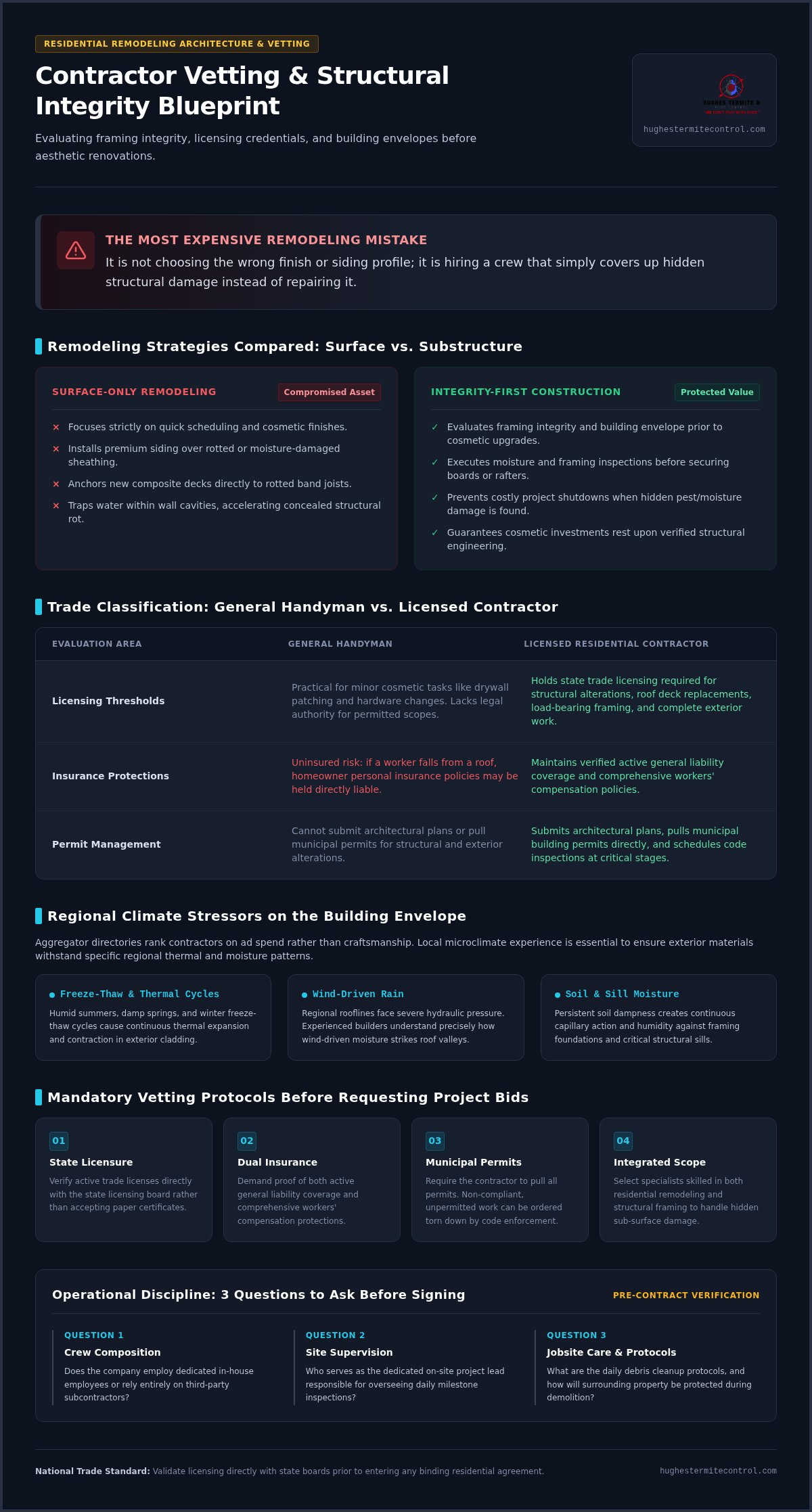
The most expensive mistake in residential remodeling isn't choosing the wrong finish or siding profile; it's hiring a crew that simply covers up hidden structural damage instead of repairing it. When property owners search for reputable home improvement contractors near me, they often focus strictly on cosmetic results and quick scheduling. True home improvement, however, always requires evaluating framing integrity and the building envelope before executing aesthetic upgrades.
It's completely natural to feel cautious about who you let work on your house. Deciphering ambiguous estimates, coordinating separate trades for roofing, siding, decking, or windows, and dreading unexpected change orders can quickly turn an exciting project into a stressful ordeal. You shouldn't have to wonder whether a contractor will cut corners behind fresh drywall or vanish halfway through the job.
This vetting guide gives you the exact blueprint to evaluate, interview, and hire trusted local professionals with total confidence. We'll walk through a repeatable vetting checklist, explain how to verify essential licenses and warranties, and show you how to partner with a skilled contractor who safeguards your home's long-term structural value.
Key Takeaways
- When evaluating home improvement contractors near me, always verify active state licensing, adequate general liability insurance, and comprehensive workers' compensation before requesting project bids.
- Hiring a professional with dedicated regional building experience ensures exterior elements like roofing, siding, and decking are installed to withstand local weather patterns.
- Avoid critical homeowner pitfalls by recognizing aggressive sales tactics and requiring the contractor to pull all necessary municipal permits.
- Partnering with a team experienced in both residential remodeling and structural framing prevents costly delays if hidden pest or moisture damage is uncovered mid-project.
Why Finding the Right Local Home Improvement Contractor Matters
A qualified residential contractor does far more than schedule crews and swing hammers. True professionals understand local residential architecture, regional building codes, and the structural stresses caused by local climates. When homeowners begin searching for home improvement contractors near me, aggregator directories often surface names based purely on ad spend rather than craftsmanship. Broadly defined, home improvement encompasses everything from basic maintenance to major structural additions, but executing high-value residential work requires verified engineering competence.
Regional building experience matters because weather patterns directly affect building materials. In regions with humid summers, damp springs, and freeze-thaw winter cycles, exterior cladding and rooflines face continuous thermal movement and moisture penetration. A contractor familiar with your microclimate knows how wind-driven rain hits roof valleys and how soil dampness impacts structural sills. Hiring unvetted, transient labor exposes homeowners to serious financial risks, including liability for on-site injuries, abandoned milestones, and non-compliant work that code enforcement can order torn down.
The Difference Between General Handymen and Licensed Contractors
Handymen serve a practical role for minor cosmetic tasks like patching drywall or replacing hardware. However, major residential improvements require clear trade specialization and legitimate credentials. Consider the following distinctions:
- Licensing Thresholds: Structural alterations, roof deck replacements, load-bearing framing, and complete exterior transformations require state trade licensing. Unlicensed labor lacks legal authority to execute permitted work.
- Insurance Protections: Dedicated contractors carry general liability and active workers' compensation. If an uninsured worker falls off your roof, your personal homeowner policy could be held liable.
- Permit Management: Established contractors submit architectural plans and pull municipal building permits themselves, coordinating code inspections at every critical stage.
Protecting Structural Integrity Alongside Aesthetic Value
Cosmetic upgrades inevitably fail if the underlying substructures remain compromised. Installing premium vinyl siding over moisture-damaged sheathing or anchoring a new composite deck to rotted band joists creates a ticking clock. Rushed installations often trap water inside wall cavities, accelerating structural rot away from view.
Methodical contractors conduct framing and moisture inspections before hanging boards or securing rafters. Taking a holistic look at the building envelope ensures every cosmetic investment rests on a solid foundation. For an in-depth breakdown of project planning timelines, consult The Homeowner’s Guide to Successful Home Remodeling in 2026. When evaluating home improvement contractors near me, always prioritize teams that verify what lies beneath the surface before finishing the exterior.
How to Vet Home Improvement Contractors Near You
Online aggregator directories often encourage homeowners to choose whoever has the most five-star reviews or the lowest bid. Star ratings rarely tell the entire story. Finding reputable home improvement contractors near me requires a structured interview and vetting framework. Professional trade groups like the National Association of the Remodeling Industry advocate for strict credential verification before entering any agreement. Begin by confirming active state licensure, current workers' compensation, and general liability coverage directly with your state licensing board rather than accepting paper certificates at face value.
Essential Questions to Ask Before Signing an Agreement
Direct communication reveals a contractor's operational discipline. Before signing an agreement, clarify exactly who will work on your property each day:
- Crew composition: Does the company use dedicated in-house employees or third-party subcontractors?
- Site supervision: Who serves as the dedicated project lead on site to oversee daily milestone inspections?
- Jobsite care: What are the daily debris cleanup protocols, and how will surrounding property be protected during demolition?
Analyzing Written Estimates and Change Order Policies
Never accept a single lump-sum figure. A professional proposal breaks down materials, labor, demolition, and disposal line by line. Vague line items like "exterior repairs as needed" open the door to contentious mid-project price spikes. Ensure the contract outlines an explicit change order policy. If a crew removes siding and finds deteriorated sheathing, you need a documented, agreed-upon process for approving structural remediation before any work proceeds.
Checking Local References and Verified Project History
Ask for references from projects completed in your immediate community within the past two to three years. Speaking with past clients provides honest insight into schedule reliability, communication habits, and post-project cleanup. Inspecting older installations also reveals how roofing, siding, or decking withstands local seasonal cycles over time. Partnering with proven local remodeling specialists who understand both framing integrity and exterior finish work ensures your investment remains durable for years to come.
Key Renovation Services: Exterior and Interior Project Scopes
A home functions as an interconnected system. Treating individual trades as isolated purchases often leads to premature failures at the transitions where materials meet. When searching for reliable home improvement contractors near me, look for professionals who treat your roofline, walls, and structural deck connections as one cohesive protective shell. Federal consumer guidance on how to vet home improvement contractors warns against fragmented scopes that leave critical integration points unaddressed.
Roofing, Siding, and the Exterior Building Envelope
Your exterior cladding does more than establish curb appeal. Roof shingles and strategically placed metal flashing divert bulk rainwater away from wall planes and into drainage paths. Siding materials, including insulated vinyl and fiber cement, create a durable barrier against wind-driven precipitation. The real vulnerability usually hides at transition joints. Without continuous underlayment and kick-out flashing where dormers meet roof planes, runoff slips behind exterior siding, rotting wall studs and rim joists without early surface symptoms.
Decking Construction, Railings, and Structural Footings
Outdoor living structures require uncompromising structural framing. While composite decking resists surface weathering longer than pressure-treated southern pine, both require an engineered substructure. The most dangerous point of failure on any deck is the ledger board connection to the house. Qualified builders install specialized through-bolts and heavy-duty flashing to lock the ledger to solid band joists. Proper installation also demands code-compliant stair stringers, secure guardrail posts, and concrete footings poured below the regional frost depth to stop seasonal frost heave.
Energy-Efficient Windows, Doors, and Quality Flooring
Interior performance depends heavily on keeping outdoor elements where they belong. High-performance replacement windows and insulated entry doors dramatically reduce household thermal transfer. Professional window contractors ensure perimeter rough openings receive airtight flashing tape and expanding foam before exterior casing is installed. This attention to detail protects interior finishes, including hardwood, engineered plank, and luxury vinyl flooring, from warping caused by foundation drafts and subfloor dampness.
Hiring qualified home improvement contractors near me who understand how exterior moisture management affects interior living spaces prevents costly rework. When your roofing, siding, windows, and structural framing work in unison, your property maintains peak durability across every season.
Critical Red Flags and Common Remodeling Mistakes to Avoid
Protecting your property starts with recognizing warning signs long before tools touch your house. While low bids and flashy sales pitches can sound tempting, they often conceal corner-cutting that leads to severe structural headaches down the road. Unscrupulous crews often take shortcuts during preliminary site prep, leaving underlying framing rot or moisture intrusion untouched beneath shiny new finishes. When searching for reliable home improvement contractors near me, identifying predatory sales practices protects your budget, your timeline, and your home's equity.
Warning Signs in Contractor Communication and Bidding
Professional builders respect your decision-making process. Watch out for these operational red flags during initial estimates:
- High-pressure sales tactics: Steer clear of sales reps who insist an estimate is only valid if you sign that day. Genuine contractors stand by their written numbers.
- Missing proof of coverage: Hesitation to supply direct insurance certificates or provide verification numbers for general liability and workers' compensation should end the conversation immediately.
- Excessive upfront deposits: Demand for large upfront cash payments before materials arrive on site often signals cash-flow troubles or an unvetted operation.
- Suspiciously low estimates: Bids far below competing numbers usually omit crucial steps, such as proper flashing, tear-off disposal fees, or rotten subfloor replacement.
Permitting Shortcuts and Uninspected Structural Work
One of the most dangerous remodeling mistakes is letting a contractor bypass local municipal permits. If an installer asks you to pull the permit as an "owner-builder" or claims the job does not require one, walk away. When you pull the permit yourself, you assume legal liability for jobsite accidents, code violations, and worker oversight. Unpermitted structural additions, roof alterations, or deck framing can also stall future home sales, as municipal inspectors can mandate drywall removal to inspect framing or issue steep fines.
Covering deteriorated wall sheathing or compromised framing members with brand-new siding or roofing is another costly error. Trapped fungal decay or insect tunnels will continue spreading unchecked behind the new exterior wrap, degrading load-bearing walls until catastrophic failure occurs. If you suspect concealed damage or need a methodical approach to your exterior project, contact Hughes Termite Control to ensure your framing is structurally sound before installation begins.
Why Choosing an Integrated Structural Specialist Protects Your Home
Conventional remodelers look at a home through the lens of surface finishes. When tearing off old siding or pulling up warped flooring, discovering hollowed framing, moisture rot, or active insect activity typically grinds the entire job to a halt. A standard general contractor must stop work, tell the homeowner to call an independent exterminator or timber specialist, and wait weeks for treatment before resuming construction. This disjointed process results in extended schedule delays and compounding trade fees.
The Advantage of Combined Renovation and Structural Expertise
A contractor possessing dual expertise in structural carpentry and wood-destroying organism management evaluates framing health in real time. Rather than covering questionable sill plates or boxing in damp rim joists, a dual-specialist identifies whether wood damage stems from active subterranean termites, wood-boring beetles, or fungal decay. To understand how regional insect pressures affect residential framing, explore A Grounded Guide to Effective Termite Control in the DMV.
Addressing these vulnerabilities immediately during demolition prevents premature failure of your new investment. Siding, decking, and roofing replacements provide a rare, direct look at your home's structural skeleton. Taking advantage of this exposure ensures necessary framing repairs and exterior finish installations happen under one coordinated scope of work.
Collaborating with Hughes Termite Control for Resilient Remodeling
Property owners filtering through home improvement contractors near me often face the dilemma of choosing between exterior finish crews and specialized structural repair teams. Hughes Termite Control bridges this exact gap across the DMV region. With over two decades of local industry experience serving property owners, our team brings methodical execution to residential renovations, combining comprehensive structural repairs with high-grade exterior improvements.
Whether you need complete deck construction, energy-efficient window and door replacements, roof restorations, or full siding overhauls, our process prioritizes structural integrity alongside clean visual appeal. Every project begins with a transparent, comprehensive on-site assessment where we inspect framing conditions, define line-item material requirements, and answer your technical questions directly.
Connect with Hughes Termite Control for an expert project estimate to ensure your next residential renovation is built on a resilient, durable foundation.
Protect Your Home With Confident Contractor Selection
A successful renovation always balances design goals with structural discipline. As you evaluate home improvement contractors near me, methodical vetting remains your best defense against unexpected costs and incomplete work. Demanding itemized written scopes, verifying active state credentials, and prioritizing the framing beneath your finishes ensures every upgrade adds lasting equity to your residential property.
Hughes Termite Control brings over 20 years of hands-on local property repair and renovation experience to DMV homeowners. By combining dual expertise in structural preservation with comprehensive exterior remodeling, we solve hidden framing vulnerabilities before installing new materials. Our craftsmen deliver dedicated service across roofing, siding, decking, flooring, and window replacements. Schedule a transparent project consultation with Hughes Termite Control to build your next home improvement project on an enduring, solid foundation.
Frequently Asked Questions
How do I verify if a home improvement contractor is properly licensed and insured?
Verify credentials by checking state licensing databases directly, such as the DPOR in Virginia, the MHIC in Maryland, or the DCRA in Washington, D.C. Request their active license number and a current certificate of insurance for general liability and workers' compensation. Call the issuing insurance agency directly to confirm coverage limits. Don't rely on printed paper certificates, as policies can lapse without warning.
What should be included in a formal home improvement contractor contract?
A comprehensive contract must clearly outline project start and completion dates, payment milestones, and an itemized breakdown of materials. It should also define cleanup protocols, daily working hours, lien waivers, municipal permit responsibilities, and formal change order terms. When vetting home improvement contractors near me, ensure the contract specifies exact manufacturer product lines rather than generic placeholders to prevent mid-project quality downgrades.
What is the typical payment schedule when hiring a home renovation contractor?
A standard residential payment schedule ties disbursements to verifiable project milestones rather than arbitrary calendar dates. Most legitimate contractors request an initial deposit upon contract signing to order custom materials like windows, doors, or siding. Subsequent progress payments occur after completing clear phases such as demolition, rough framing, or passing municipal rough inspections. Hold the final retainage payment until your final walkthrough confirms all punch-list items are finished properly.
Why is it risky to pull building permits myself instead of having the contractor do it?
Pulling permits yourself legally classifies you as the general contractor, transferring complete jobsite liability directly onto your shoulders. If a worker gets hurt on your property or structural framing fails local codes, you become personally responsible. Legitimate building professionals pull their own permits because they carry commercial liability insurance, stand behind their craftsmanship, and take responsibility for passing mandatory municipal inspections.
What happens if a contractor discovers termite damage or rot during remodeling?
Standard remodelers must halt the project immediately until an independent pest inspector evaluates the exposed framing. This pause leads to unexpected downtime and delays. Working with an integrated specialist like Hughes Termite Control in the DMV solves this obstacle. Our dual expertise allows us to assess wood-destroying organism damage or moisture rot right away, treat the problem, and execute structural framing repairs without stalling your renovation.
How many contractor estimates should I obtain before selecting a provider?
You should obtain at least three written proposals from licensed local trade professionals. Gathering multiple bids lets you compare labor allowances, scope specificity, and material selections across identical project parameters. If one quote is drastically lower than the others, it often signals missing line items or omitted site preparation. Use these consultations to gauge communication responsiveness and regional experience alongside overall project value.
What is the difference between an estimate and a formal scope of work?
An estimate is a preliminary financial approximation, whereas a formal scope of work is a binding, detailed blueprint. Scopes of work specify precise architectural tasks, material brand names, structural fasteners, demolition phases, and disposal duties. When researching home improvement contractors near me, never commit to a vague project estimate. Insist on a finalized, itemized scope of work that protects your budget from unexpected change orders.


