

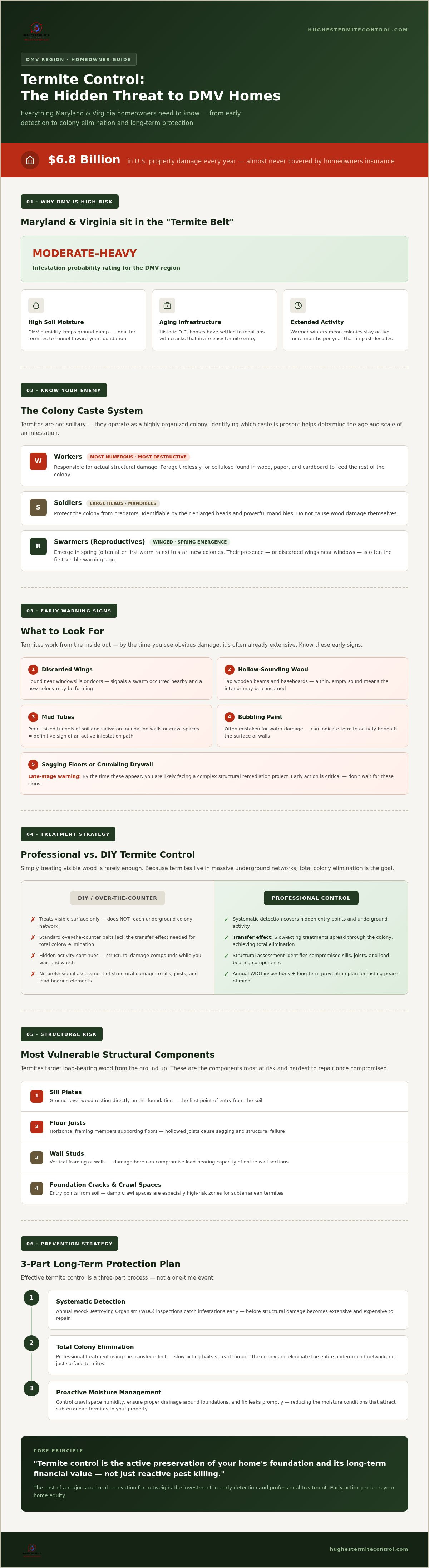
Termites cause an estimated $6.8 billion in property damage across the United States every year, a cost that homeowners insurance almost never covers. In the D.C. metro area, our warm summers and mild winters put local properties right in the middle of the "termite belt." If you're worried that something is quietly compromising your home's foundation, you aren't alone. Effective termite control is about more than just spraying chemicals; it's about understanding the specific pressure these pests put on homes in Maryland and Virginia.
We know how much anxiety comes from the fear of hidden structural damage and the confusion over whether a DIY fix is enough. You deserve a clear, grounded perspective on how to protect your investment without high-pressure sales tactics. This guide will show you how to identify early warning signs, choose the right treatment for your family's safety, and repair any damage to ensure your home remains sound. We'll walk through the process of colony eradication and building a long-term prevention plan that gives you back your peace of mind.
Key Takeaways
- Understand why the DmV's unique humidity and soil conditions create a high-pressure environment for subterranean termite activity.
- Learn to identify the different roles within a colony and the specific entry points termites use to move from soil into your home's wood.
- Discover why professional termite control methods, such as the transfer effect, are more effective at total colony elimination than standard over-the-counter baits.
- Identify which critical structural components, including sills and joists, are most vulnerable to damage and how to approach their repair.
- Establish a long-term protection strategy using annual Wood-Destroying Organism (WDO) inspections and proactive moisture management.
Understanding Termite Control: The Hidden Threat to DmV Homes
Effective termite control is a three-part process involving systematic detection, total elimination of the colony, and a long-term prevention strategy. In the DmV, this isn't just a basic maintenance task; it's a necessity for protecting your home’s structural integrity. Unlike surface pests that you might spot in the kitchen, termites work from the ground up, often remaining invisible until the damage is extensive. By the time a homeowner notices a problem, the pests have often already compromised the load-bearing elements of the property. Our goal is to shift the focus from reactive pest killing to proactive asset protection.
Why Termites are Different in the DmV
Maryland and Virginia sit firmly within the "termite belt," a region where the probability of infestation is rated as moderate to heavy. The local climate, characterized by high humidity and damp, clay-heavy soil, provides the perfect environment for Eastern subterranean termites to thrive. In 2026, we've seen seasonal shifts leading to earlier and more frequent swarming events. These swarms occur when winged termites emerge to start new colonies, often after the first warm spring rains. Several factors make our region particularly vulnerable:
- High Soil Moisture: DmV humidity keeps the ground damp, allowing termites to tunnel easily toward your foundation.
- Aging Infrastructure: Historic homes in D.C. often have settled foundations with small cracks that invite easy entry.
- Extended Activity: Warmer winters mean colonies stay active for more months out of the year than in past decades.
You can learn all about termites and their social structures to understand why they are so persistent once they find a food source. Because they live in massive underground networks, simply treating the wood you can see is rarely enough to stop the problem at its source.
The True Cost of 'Waiting and Seeing'
The most dangerous aspect of an infestation is its silence. Termites consume cellulose from the inside out, meaning your floor joists or wall studs might look perfectly fine on the surface while being hollowed out within. This hidden activity directly erodes your home equity over time. While many homeowners worry about the price of professional services, the cost of a major structural renovation far outweighs the investment in early detection. If you wait until you see visible signs like sagging floors or crumbling drywall, you're likely already facing a complex remediation project. It's helpful to remember that termite control is the active preservation of your home's foundation and its long-term financial value. By combining pest management with structural knowledge, you ensure that the solution addresses both the insects and the integrity of the wood they left behind.
The Lifecycle and Habits of Subterranean Termites
Termites are not solitary pests; they operate as a highly organized colony with a rigid caste system. The workers are the most numerous and are responsible for the actual destruction of your property. They forage tirelessly for cellulose, the organic compound found in wood, paper, and cardboard, to feed the rest of the group. Soldiers, identifiable by their larger heads and mandibles, protect the colony from predators. Finally, swarmers are the winged reproductive members that emerge during the spring to start new colonies. Understanding these roles is a fundamental part of termite control, as identifying which caste is present can help determine the age and scale of an infestation.
Because subterranean termites require high moisture levels to survive, they cannot endure open-air exposure for long. They solve this by building mud tubes. These pencil-sized tunnels, constructed from soil and saliva, act as protected highways from the soil into your home's wooden structure. If you see these tubes on a foundation wall or in a crawl space, it is a definitive sign of an active path. You can consult this EPA guide to termite control for more detailed identification tips regarding colony behavior.
Signs of an Active Infestation
Identifying an infestation early requires a keen eye for subtle changes in your home's appearance. Discarded wings near windowsills or doors are often the first sign that a swarm has occurred nearby. You should also perform a "hollow sound" test on wooden beams and baseboards; if a solid-looking piece of wood sounds thin or empty when tapped, termites may have consumed the interior. Other indicators include bubbling paint, which is often mistaken for water damage, and the presence of frass. If you suspect activity, a professional inspection can clarify the extent of the colony before the damage spreads.
Where Termites Hide in Your Property
In the DmV, termites prioritize areas where wood meets the soil or where moisture stays trapped against the foundation. Crawl spaces and basements are primary targets because they offer the darkness and humidity these pests crave. Poorly graded soil that allows water to pool near the house creates an ideal entry point. Beyond the foundation, you must also check exterior features like decks and siding. These areas are particularly vulnerable in our local climate, and regular maintenance is the best way to ensure these structures remain sound and uninviting to foraging workers.
Professional Termite Control vs. DIY: Choosing the Right Strategy
While it is tempting to pick up a box of bait stations at a local hardware store, effective termite control requires a more comprehensive approach than most over-the-counter products can provide. DIY sprays often serve as a repellent, which sounds positive but can actually backfire. These chemicals often cause a colony to "split" or "scatter," leading the termites to find new, untreated entry points elsewhere in your home. Professional-grade termiticides utilize a "transfer effect." This non-repellent technology allows termites to pass through the treated zone without realizing it, eventually carrying the agent back to the queen and the rest of the colony for total eradication. This ensures the entire population is eliminated rather than just the few workers you might see on the surface.
The Risks of Improper DIY Application
Misapplying pesticides poses more than just a risk to your floorboards; it affects the local environment. In the DmV region, runoff from improperly applied chemicals can easily reach local watersheds and sensitive ecosystems. Professionals are trained to apply these substances with precision, ensuring they stay where they are intended. Additionally, a DIY approach lacks a professional structural assessment. Killing the insects is only the first step. Without an expert eye to check if your joists or sills are still load-bearing, you might be living in a home that is technically insect-free but structurally unsafe. This Homeowner's guide to termite control provides a deeper look at why specific application methods matter for long-term success.
What a Professional Treatment Actually Looks Like
A standard professional treatment is methodical and transparent. It typically begins with soil trenching around the perimeter of the foundation. We apply a liquid barrier into these trenches to create a continuous shield that foraging workers cannot bypass. For homes with specific vulnerabilities, we may use localized spot treatments on individual structural members. This process is supported by advanced detection tools, such as moisture meters and borescopes, which allow us to see behind finished walls without unnecessary demolition. Safety is always a priority. Modern treatments are designed to bind tightly to the soil, minimizing the risk of exposure to families and pets once the application is complete. Choosing a professional also provides the security of a warranty and recurring inspections, which ensures that your home stays protected year after year.
Assessing and Repairing Structural Termite Damage
Eliminating a colony is a significant achievement, but for many homeowners, it is only half the battle. Once the insects are gone, you are often left with the physical evidence of their presence: hollowed-out timber and compromised supports. Effective termite control must include a thorough structural assessment to ensure your home remains safe for your family. This goes beyond standard carpentry; it requires a specialized understanding of how these pests traverse a building and which load-bearing members they prioritize.
Common areas that require professional attention often include:
- Sill Plates: These rest directly on the foundation and are usually the first point of contact for subterranean colonies.
- Floor Joists: Weakened joists can lead to sagging floors and compromised load distribution throughout the home.
- Wall Studs: Hidden damage inside walls can eventually affect the stability of your roofing and siding.
If these elements are weakened, the integrity of your entire property can suffer. For example, a compromised sill plate can lead to uneven floors or doors that no longer latch correctly. Because we are both pest experts and licensed remodeling contractors, we look at these issues through a dual lens of safety and long-term durability.
When Does Damage Require Full Replacement?
Determining whether wood can be salvaged or requires full replacement often starts with a "pick test." By probing the wood with a specialized tool or a screwdriver, we can feel for soft spots or "give" that indicates internal decay. If the tool sinks easily into the grain, the structural integrity is likely gone. This is particularly critical for flooring supports or deck posts where a failure could lead to injury. When termites move into window and door frames, the damage often requires a complete tear-out and replacement to restore the home's energy efficiency and security. We evaluate each piece of timber individually to provide a transparent recommendation based on safety rather than a desire for a bigger project.
Integrating Restoration with Prevention
The repair phase is an ideal time to upgrade your home's defenses. By using modern remodeling materials, such as composite decking or pressure-treated lumber, we can make your property much less attractive to future foraging workers. Proper flashing and siding installation are also vital during restoration. These components prevent the moisture buildup that termites require to survive near your foundation. At Hughes, we take pride in being a one-stop-shop that handles both the "kill" and the "cure." If you are ready to move from eradication to restoration, you can schedule a structural assessment to verify the safety of your home.
Long-Term Prevention and Professional Safeguards
Once the immediate threat of an infestation is gone, your focus should shift to creating an environment that is fundamentally unappealing to pests. Sustaining effective termite control requires a combination of professional oversight and consistent home maintenance. In the DmV, where humidity is a constant factor, managing moisture is your primary line of defense. This involves keeping gutters clear to prevent water from pooling near the foundation and ensuring that the soil is graded to slope away from the structure. These simple steps significantly reduce the damp conditions that subterranean colonies need to survive.
The WDO Inspection: More Than Just a Checklist
In Maryland, Virginia, and D.C., a Wood-Destroying Organism (WDO) inspection is often a mandatory step during real estate transactions. However, these inspections shouldn't be reserved only for buying or selling a home. During a comprehensive walkthrough, we look for more than just active insects; we identify moisture leaks, fungal rot, and structural vulnerabilities that could invite future trouble. Think of the resulting WDO report as a structural health certificate for your home. It provides a transparent record of your property's condition and serves as a roadmap for any necessary preventative adjustments. Having this documentation annually ensures that any new activity is caught before it can cause significant damage.
Building a Termite-Resistant Home Environment
Reducing wood-to-ground contact is another critical safeguard for your property's exterior. We recommend maintaining at least a six-inch gap between the soil and any wooden elements of your home, including siding and deck supports. If your property currently has wood mulch touching the foundation, consider replacing it with gravel or rubber mulch to eliminate a direct food source. Updates to your flooring or siding can also play a major role in prevention. Modern materials and proper installation techniques eliminate the gaps and damp spots that foraging workers exploit to enter a building.
Long-term protection relies on a relationship with an expert who speaks plainly about your home’s needs. By combining our knowledge of pest behavior with our background in structural remodeling, we ensure that your prevention plan is as solid as your foundation. If you want to move forward with a clear strategy for your property, contact Hughes Termite Control for a grounded assessment and professional guidance you can rely on.
Securing Your Home’s Structural Future
Effective termite control in the DmV requires a shift from reactive pest management to proactive structural protection. The path to a secure home involves identifying early warning signs, choosing professional-grade eradication methods over limited DIY fixes, and addressing physical damage with specialized carpentry. By integrating moisture management with annual Wood-Destroying Organism (WDO) inspections, you create a long-term safeguard for your property’s foundation and home equity.
At Hughes, we pride ourselves on being a steady hand for homeowners in Maryland and Virginia. With over 20 years of local experience and dual expertise as both pest specialists and licensed remodeling contractors, we provide a transparent solution for your home. We don't just clear the colony; we verify the safety of your sills, joists, and flooring to ensure your home remains a stable investment. Schedule your professional termite inspection with Hughes today for a grounded assessment of your property's health. Protecting your home is a long-term commitment, and we're here to help you do things the right way.
Frequently Asked Questions
How do I know if I have termites or flying ants?
Termites have straight antennae and a broad waist, while flying ants have elbowed antennae and a pinched waist. Termite wings are all the same size; ant wings are different sizes. Seeing these differences helps you determine if you're dealing with a nuisance or a structural threat. If you're unsure, a professional can provide a definitive identification to prevent unnecessary worry or delayed action.
Can termites really destroy a house in the DmV area?
Termites can cause severe structural failure in DmV homes if left unchecked for several years. While they don't consume a house overnight, a large colony of Eastern subterranean termites can eat several pounds of wood annually. Over time, this hollowing out of sill plates and floor joists compromises the building's stability. Our dual expertise in pest management and remodeling allows us to assess exactly how much integrity remains.
Is termite treatment safe for my children and pets?
Modern termite control treatments are designed to be used safely around your family and pets when applied by licensed professionals. We use specialized products that bind tightly to the soil and building materials, minimizing the risk of migration or accidental exposure. Our technicians follow precise application protocols to ensure the treatment area is secure. We always prioritize transparency by explaining the safety profile of the specific methods we use.
How much does a professional termite inspection cost?
The cost of a professional inspection depends on the size of your property and the complexity of its structure. Because every home in Maryland and Virginia is unique, we provide clear pricing after understanding your specific situation. A thorough assessment is an investment in your home's equity, as it identifies hidden issues before they require expensive structural repairs. Contact us directly for a straightforward quote tailored to your property.
What happens during a Wood-Destroying Organism (WDO) inspection?
During a Wood-Destroying Organism (WDO) inspection, a specialist performs a methodical walkthrough of your home's interior and exterior. We look for active infestations, past damage, and environmental conditions like high moisture or wood-to-ground contact. The resulting report identifies more than just termites; it also covers wood-boring beetles and fungal rot. This document serves as a detailed record of your home's structural health and is essential for many local real estate transactions.
Can termites come back after a professional treatment?
Termites can return if the protective barrier is disturbed or if new conducive conditions develop. While a professional treatment is highly effective, environmental changes like soil erosion or new landscaping can create gaps in your home's defense. This is why we emphasize annual inspections and moisture management. Maintaining a consistent relationship with your termite control expert ensures that your property remains protected as the local environment shifts over time.
Does homeowners insurance cover termite damage repair?
Standard homeowners insurance policies almost never cover the cost of termite damage or the repairs needed to fix it. Insurance companies generally view pest infestations as a preventable maintenance issue rather than a sudden, accidental event. Because these costs can be substantial, proactive inspections and early intervention are the most effective ways to protect your financial interests. Regular maintenance is far more affordable than paying for major structural restoration out of pocket.
How long does a typical termite treatment take to work?
The timeline for results depends on the treatment method used for your home. Liquid termiticides often provide faster results by creating an immediate barrier that insects encounter as they move through the soil. Baiting systems work more slowly because they rely on the workers to find the bait and share it with the rest of the colony. We'll explain the expected timeline for your specific treatment plan so you know exactly what to expect.