

The most expensive mistake in any remodel isn't choosing the wrong paint color; it's paying for surface polish while ignoring what sits behind the walls. High-end finishes won't protect your equity if your structural framing or moisture barriers fail. When hiring home renovation contractors, treating structural integrity as secondary to cosmetics often leads to compromised living spaces and expensive structural corrections down the road.
If you feel uneasy about starting a major project, you're not alone. Most homeowners dread the familiar pattern of vague bids, creeping costs, and contractors who gloss over hidden damage behind fresh drywall. You deserve total transparency, predictable schedules, and absolute certainty that every trade professional touching your roof, framing, or siding is properly licensed and accountable.
This grounded guide shows you how to evaluate, vet, and select reliable home renovation contractors who protect your property value from the foundation up. We'll break down the exact criteria needed to analyze line-item proposals, verify trade qualifications across the DMV, and establish milestone-based contracts that keep your renovation predictable from day one.
Key Takeaways
- Prioritize structural framing, subflooring, and weather-tight building envelopes before investing in cosmetic upgrades to avoid costly structural failures.
- Learn how to vet licensed home renovation contractors by requiring line-item scopes, active insurance verification, and structured milestone schedules.
- Understand the distinct boundary between light handyman repairs and specialized trade projects that demand municipal permits and certified expertise.
- Identify proposal red flags early by comparing bids on identical specifications and questioning suspiciously low estimates that omit critical prep work.
- Safeguard long-term property value by partnering with seasoned professionals who protect both your exterior envelope and underlying home framework.
What Qualified Home Renovation Contractors Actually Do for Your Property
Many homeowners assume a remodel is primarily about visual changes like new tile, fresh trim, or modern cabinetry. In practice, qualified home renovation contractors protect your property's structural foundation, weather-tight envelope, and long-term appraisal value. They coordinate municipal permits, manage certified trade specialists, enforce building code compliance, and ensure that every upgrade rests on sound infrastructure rather than deteriorated wood.
A successful remodel requires a clear division of operational responsibilities to maintain site safety and structural performance:
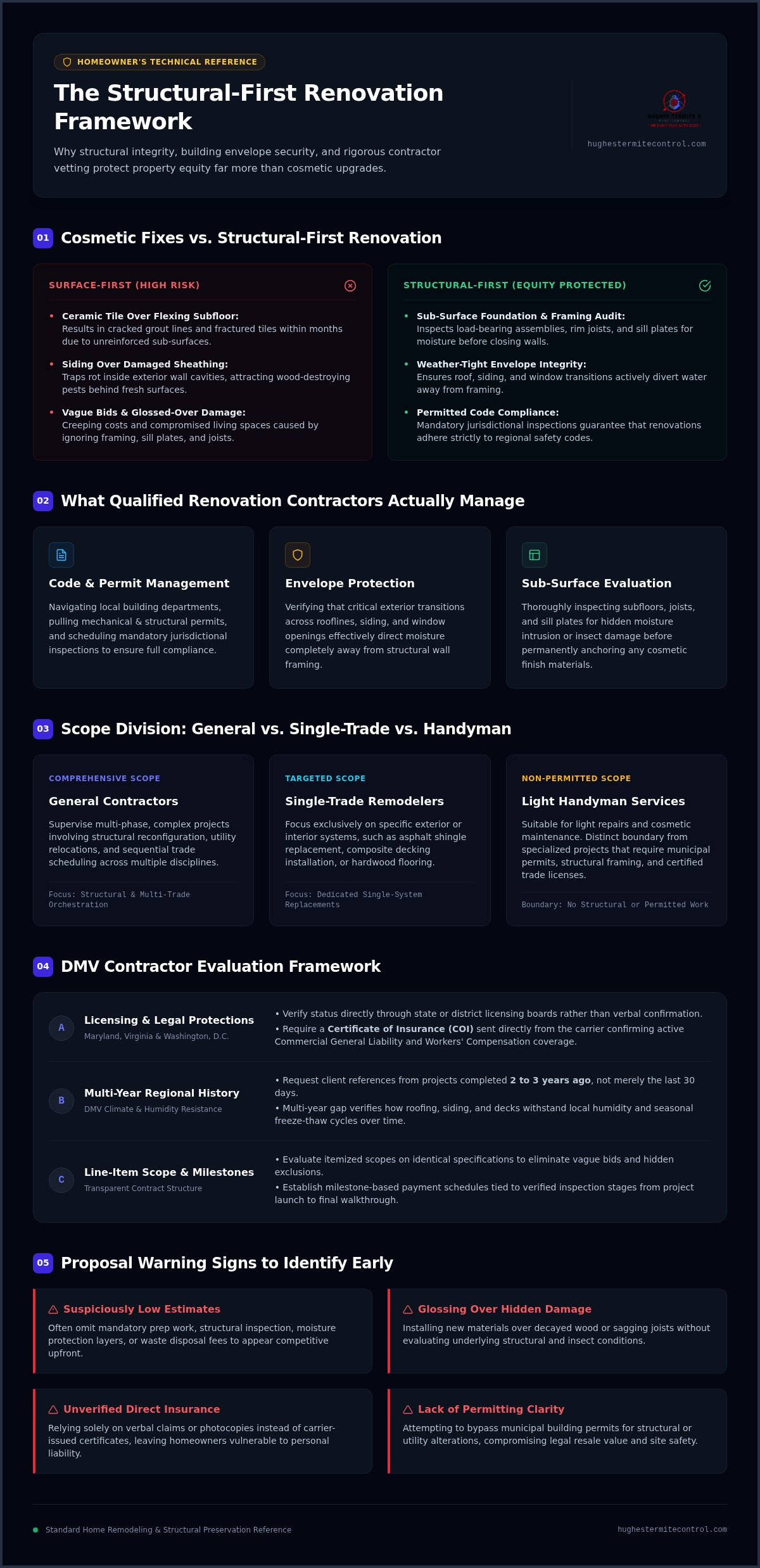
- Code and permit management: Navigating local building departments, pulling mechanical and structural permits, and scheduling mandatory jurisdictional inspections.
- Envelope protection: Verifying that exterior transitions across roofs, siding, and window openings effectively direct moisture away from structural wall framing.
- Sub-surface evaluation: Inspecting subfloors, joists, and sill plates for hidden moisture intrusion or insect damage before installing permanent surface finishes.
The Distinction Between General Contractors and Single-Trade Remodelers
Understanding traditional general contractor responsibilities helps you choose the right partner for your project scope. General renovation contractors supervise complex, multi-phase jobs involving structural reconfiguration, utility relocations, and sequential trade scheduling. In contrast, single-trade remodelers focus exclusively on specific exterior or interior systems, such as replacing asphalt shingles, installing composite decking, or laying hardwood flooring. For a broader overview of how to plan these improvements effectively, explore our guide on home remodeling.
Why Structural Soundness Outweighs Surface Aesthetics
Cosmetic materials only last as long as the framing beneath them. Installing custom ceramic tile over a flexing, unreinforced subfloor leads to cracked grout lines and fractured tiles within months. Similarly, hanging new siding over moisture-damaged sheathing traps rot inside exterior wall cavities, which attracts wood-destroying pests. Reliable home renovation contractors inspect load-bearing assemblies, rim joists, and foundation plates thoroughly before closing up walls, ensuring your investment remains durable for decades.
Key Criteria for Evaluating Local Remodeling and Renovation Contractors
Online directories often prioritize paid placement over craftsmanship. To separate genuine builders from slick sales operations, you need a disciplined evaluation framework. Evaluating home renovation contractors requires looking past promotional brochures and examining three non-negotiable fundamentals: legal authorization, regional building experience, and clear scope documentation.
Licensing, Insurance, and Legal Protections in the DMV
Jurisdictions across Maryland, Virginia, and Washington, D.C., enforce distinct residential licensing rules. Never accept a contractor's word that their credentials are current; verify status through your state or district licensing board. A legitimate operation must carry substantial commercial general liability coverage alongside active workers' compensation. If an uninsured crew member sustains an injury on your roof or inside your crawl space, you could face personal liability. Following standard FTC contractor vetting guidelines, request a Certificate of Insurance sent directly from their insurance carrier to confirm the policy remains active.
Portfolio Verification and Local Track Record
Examine completed jobs that mirror your planned scope, whether that involves custom decking, complete roof replacements, siding, or window installations. Ask for references from projects finished two or three years ago rather than just last month. This gap reveals how installations hold up against DMV humidity and seasonal freeze-thaw cycles. Companies backed by more than two decades of regional field experience offer a stable track record that short-lived operations simply cannot match.
Communication Rhythm and Predictable Scoping
Vague quotes invite budget creep. A dependable estimate outlines exact material grades, designated brands, disposal logistics, and milestone-driven timelines. Before signing, ensure the contractor outlines a written procedure for unexpected framing issues and change orders. If you want a deeper look at qualifying local trades, consult our framework for remodeling contractor evaluation. When you need transparent assessments built on decades of regional expertise, partnering with the team at Hughes Termite Control gives you a reliable, no-pressure starting point.
Handyman Services vs. Specialized Home Renovation Contractors
Hiring decisions often falter when distinguishing between minor household maintenance and major structural remodeling. A handyman is well-suited for minor cosmetic tasks like patching drywall, hanging light fixtures, or swapping out interior door hardware. In contrast, projects that alter your building envelope, support loads, or redirect water drainage require fully licensed home renovation contractors who possess technical design training and trade-specific certifications.
Relying on an unlicensed handyman for major structural work introduces severe property risks. If an unpermitted deck installation fails, or if a roof replacement leaks into interior wall cavities, homeowner insurance policies often deny resulting claims due to unpermitted modifications. Knowing the legal boundary between light maintenance and trade work keeps your property protected.
Project Scope and When Building Permits Are Legally Required
Municipal building codes draw a firm line at structural alterations. Under the International Residential Code, surface finishes like interior painting or floor tiling do not require municipal oversight. However, replacing a roof, framing a multi-level deck, moving load-bearing partitions, or installing exterior windows requires formal permits and jurisdictional inspections. Unlicensed handymen cannot pull permits, leaving the homeowner personally liable for code violations and unpermitted work disclosures during future property sales. Following the NAHB checklist for hiring a remodeler helps homeowners identify whether their planned project demands specialized trade credentials and formal building department approvals.
Material Longevity, Workmanship Warranties, and Accountability
Handyman repairs rarely include enforceable, multi-year warranties on labor. Once final payment clears, any subsequent settlement or water leak becomes your financial problem. Specialized home renovation contractors stand behind their builds with written workmanship warranties that complement manufacturer coverage. Premium exterior products like architectural shingles, fiber-cement siding, and high-efficiency windows require strict adherence to manufacturer nailing schedules and flashing details. If an uncertified installer skips these specific installation steps, the manufacturer's 30-year warranty is instantly voided. Professional contractors document compliance at every phase, guaranteeing your installations remain structurally sound and fully warranted.
The Step-by-Step Vetting Process: From Estimates to Final Walkthrough
A dependable project outcome starts with an objective bidding process. To make meaningful comparisons, hand every prospective builder an identical, written scope of work specifying materials, structural expectations, and clean-up requirements. Evaluating bids without uniform criteria leaves you guessing which line items are covered and which are hidden exclusions.
Deconstructing Bids: Identifying Exclusions and Low-Ball Tactics
Be skeptical of single lump-sum numbers. Vague quotes often conceal omitted expenses like dumpster fees, permit filing costs, or subfloor prep work. Unscrupulous home renovation contractors intentionally submit rock-bottom bids to win the job, only to issue inflated change orders once your walls are already open. A transparent estimate details each construction phase, listing exact structural lumber dimensions, moisture barriers, and daily cleanup protocols.
Structuring Milestone Payments and Change Orders Fairly
Never agree to hand over half the project total upfront. Reputable builders structure payments around verifiable physical milestones, keeping financial control aligned with completed labor. In many states, statutory caps strictly restrict advance deposits, often limiting upfront funds to one-third of the total contract price or less. Tie your payment disbursements to measurable project steps:
- Initial deposit: Covers administrative scheduling and dedicated material orders.
- Intermediate draws: Released only after passing rough-in structural, framing, or building envelope inspections.
- Final retainage: A concluding 10% balance held until punch-list items are fully resolved and the contractor delivers unconditional lien waivers.
Managing Hidden Discoveries and Structural Repairs
Demolition frequently uncovers unexpected problems behind siding or beneath subflooring. When pulling away old decking, bathroom tile, or exterior cladding, crews often encounter rotted sill plates, water leaks, or active insect activity. If your builder lacks diagnostic remediation experience, these discoveries can bring work to a complete halt. Partnering with a dual-specialty contractor ensures framing repairs and pest defense happen concurrently; explore our grounded approach to termite control to see how structural preservation protects your home. If you want transparent project scoping backed by two decades of local building experience, reach out to Hughes Termite Control to review your remodeling plans.
Choosing Hughes for Enduring Home Renovation and Structural Protection
Selecting the right team means finding builders who care as much about your home's structural framing as they do about the final coat of finish. Hughes Termite Control brings over 20 years of hands-on building and property preservation experience to homeowners across the DMV. We eliminate the gap between cosmetic improvements and underlying structural health, ensuring every renovation we deliver stands firm against time, seasonal moisture, and environmental wear.
Full-Spectrum Exterior and Interior Renovation Capabilities
Our experienced craftsmen deliver comprehensive solutions across essential structural trades, handling exterior envelopes and interior living spaces with equal precision. We construct durable roofing and weather-tight siding systems engineered to withstand intense Mid-Atlantic heat, driving rain, and winter freezes. Our decking installations prioritize code-compliant footings, solid ledger connections, and stable framing that easily supports premium composite or hardwood finishes. Inside, our precise flooring, window, and door replacements eliminate drafts, elevate daily comfort, and strengthen your home's energy performance.
The Structural Integrity Advantage: Dual-Expertise Reliability
Most home renovation contractors only focus on surface aesthetics. When they encounter concealed termite tunnels, decayed sill plates, or damp crawl space joists, work stops while you scramble to locate outside remediation specialists. Our dual background in building trades and wood-destroying organism defense changes that dynamic completely. Our renovation specialists identify moisture pockets and timber degradation before placing a single finish board. You avoid the stress, delays, and unexpected costs of managing separate subcontractors to fix structural issues mid-build.
Straightforward Scoping and Grounded Customer Care
Home improvements shouldn't involve aggressive closing tactics, inflated change orders, or manufactured urgency. We provide calm, methodical project evaluations built on complete scope transparency and predictable execution. Every phase of our work respects your daily schedule, budget parameters, and residential property value. When you want structural reliability paired with meticulous craftsmanship, schedule your project consultation with Hughes to start your renovation on solid ground.
Protecting Your Investment Through Grounded Renovation
A successful remodel isn't measured solely by how fresh a room looks on completion day. Lasting satisfaction comes from knowing your investment rests on level subfloors, robust framing, and weather-tight building envelopes. When you take the time to evaluate bids carefully and structure payments around verified milestones, hiring home renovation contractors becomes a methodical, low-stress partnership.
You don't have to navigate structural decisions or complicated exterior scopes alone. Hughes Termite Control combines over 20 years of local DMV craftsmanship with specialized dual expertise in structural preservation and exterior envelope remodeling. We provide transparent, methodical project scoping with zero high-pressure sales tactics, keeping your priorities front and center from initial planning through final punch list.
Take the uncertainty out of your next remodeling project. Request an Honest Project Consultation with Hughes today and build with complete confidence.
Frequently Asked Questions
How do I verify if a home renovation contractor is properly licensed in the DMV?
You verify credentials through each jurisdiction's official portal: the Maryland Home Improvement Commission (MHIC), the Virginia Department of Professional and Occupational Regulation (DPOR), or the D.C. Department of Licensing and Consumer Protection (DLCP). Check that the business entity name matches the active license number and confirm there are no unresolved administrative sanctions. Always require a Certificate of Insurance issued directly to your name from their insurer to verify current general liability and workers' compensation coverage.
What questions should I ask a contractor before signing a renovation agreement?
Ask who supervises daily jobsite activity, how change orders are priced, and how long the company has operated under its current legal name. Request the specific brand names and material grades included in the scope. Ask how the team handles unexpected framing damage, whether they pull permits directly, and what physical milestones trigger each payment draw. Reputable home renovation contractors provide clear, written answers without evading your questions or rushing your decision.
Why do bids for the exact same home renovation project vary so widely?
Discrepancies usually stem from differing material specifications, omitted project phases, or inadequate contractor insurance. Lower estimates frequently leave out permit fees, waste haul-away, site protection, or adequate subfloor preparation. Some operations also submit cut-rate bids to secure contracts, planning to recoup margins through aggressive change orders once demolition begins. Higher bids typically reflect premium materials, experienced full-time labor, comprehensive liability coverage, and realistic labor allowances.
What should happen if hidden rot or insect damage is discovered during remodeling?
Work around the affected area should stop immediately so a qualified specialist can assess the full extent of timber degradation. Rather than concealing damaged framing behind fresh drywall, a dependable contractor documents the issue with photos, explains the load-bearing implications, and presents a written change order. Working with a dual-specialty builder experienced in wood-destroying organism inspections allows structural timber repairs and moisture mitigation to proceed smoothly without costly jobsite shutdowns.
How much deposit should a reputable home renovation contractor require upfront?
An upfront deposit should generally cover only administrative planning and initial custom material procurement, typically capped between 10% and 33% depending on regional laws. In Maryland, statutory regulations strictly cap residential home improvement down payments at one-third of the total contract price. Reliable home renovation contractors structure remaining payments into milestone-based draws tied directly to physical progress, like completed framing or rough-in sign-offs, with the final balance held until punch-list completion.
Is a building permit required for exterior projects like decking, siding, or roofing?
Yes, most local DMV jurisdictions require permits for deck construction and structural envelope modifications. Building a new deck or replacing ledger boards always demands plan approval and footing depth inspections. While simple siding repairs or minor roof shingle patches might qualify for exemptions in certain counties, complete replacements and structural penetrations regularly trigger permit requirements under the International Residential Code. Your contractor should handle all plan filings and schedule mandatory municipal inspections directly.
What is the difference between a cosmetic remodel and a structural renovation?
A cosmetic remodel updates visible surfaces without altering the home's framework, whereas a structural renovation modifies load-bearing components or the exterior envelope. Cosmetic updates include painting, replacing cabinet hardware, or laying floating flooring over an intact base. Structural renovations involve removing load-bearing walls, sistering floor joists, replacing roof decking, or securing exterior ledger connections. Structural projects require trade-specific engineering, precise code compliance, and formal building permits to keep the home safe and insurable.


