

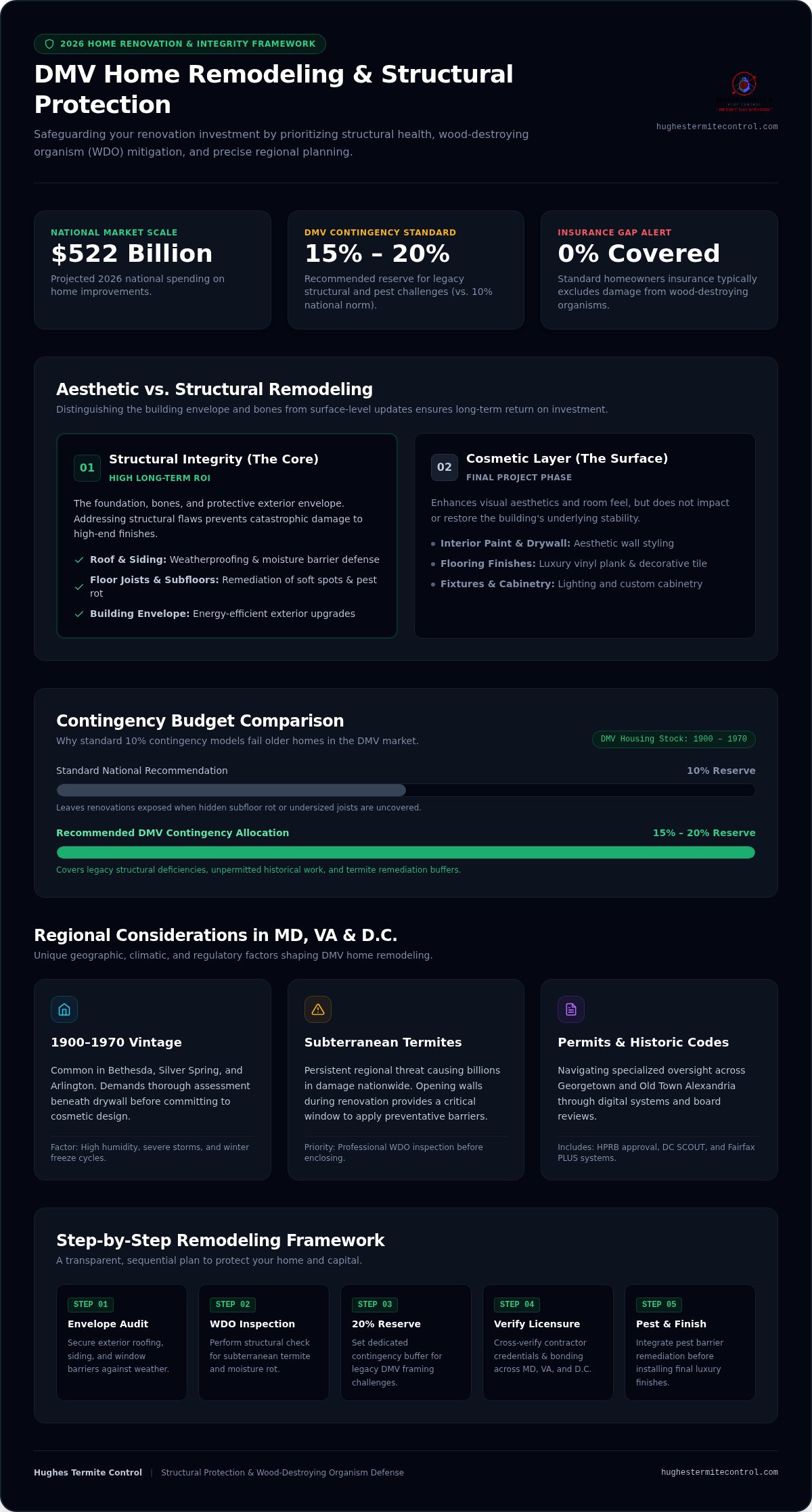
The most expensive part of a home remodeling project isn't the high-end finishes; it's the structural rot and pest damage hidden behind your existing walls. In 2026, national spending on home improvements is projected to reach $522 billion, yet many homeowners will lose thousands because they prioritized aesthetics over structural health. You likely want a beautiful space that increases your property value, but the fear of hidden costs and contractors who cut corners is real. It's frustrating to think that your new kitchen could be sitting on joists weakened by subterranean termites, especially since standard insurance policies don't cover that damage.
This guide provides a transparent, step-by-step framework to help you manage the complexities of your renovation with confidence. We'll walk through the essential planning phases, from understanding local DMV licensing requirements to setting a realistic 20% contingency budget. You'll learn how to verify contractor credentials and why a professional structural inspection is the only way to ensure your investment lasts. By the end, you'll have a clear roadmap to a home that is both beautiful and built on a stable foundation.
Key Takeaways
- Establish a realistic 2026 budget by incorporating a 20% contingency fund to handle the hidden structural challenges common in Mid-Atlantic homes.
- Prioritize a professional Wood-Destroying Organism (WDO) inspection to ensure your home remodeling efforts aren't compromised by undetected termite damage.
- Verify contractor credentials using a specific framework that accounts for the unique licensing and bonding requirements across Maryland, Virginia, and D.C.
- Distinguish between high-value structural renovations and simple cosmetic updates to maximize your property's long-term stability and market value.
- Learn how to integrate pest remediation with structural repair to protect your investment before installing expensive new finishes.
Understanding the Home Remodeling Landscape in the DmV
The Washington Metropolitan Area presents a unique environment for any home remodeling project. With a housing stock often dating between 1900 and 1970, properties in Bethesda, Silver Spring, and Arlington require more than just a surface-level refresh. Success in 2026 depends on recognizing that what lies beneath your drywall is just as important as the paint you choose. A grounded approach starts with a thorough assessment of your property's current health before you commit to a design.
Aesthetic vs. Structural Remodeling
It's helpful to categorize home improvement projects into two distinct groups: cosmetic and structural. Cosmetic upgrades include painting, installing new light fixtures, or laying down luxury vinyl plank flooring. These changes impact how a room feels, but they don't affect the building's stability. They are the final layer of a successful project.
Structural remodeling involves the bones of the house. This includes replacing a roof, updating siding, or repairing floor joists. In older DmV homes, a simple repair often reveals a need for a full remodel. If you find soft spots in your subfloor while replacing tile, you're likely dealing with moisture or pest damage that requires structural intervention before the new floor can be laid. Ignoring these issues only leads to more expensive repairs later.
Regional Considerations for DmV Homeowners
The local climate in Maryland and Northern Virginia is characterized by high humidity and significant seasonal shifts. These factors dictate your choice of exterior materials. Siding and roofing must be durable enough to withstand heavy summer storms and winter freezes without trapping moisture against the frame. Moisture management is a non-negotiable part of maintaining structural integrity.
Pest cycles also play a critical role in project timing. Subterranean termites are a persistent threat in this region, causing billions in property damage annually across the country. Because standard homeowners insurance typically excludes damage from wood-destroying organisms, your home remodeling strategy must include a structural-first mindset. Opening walls during a renovation provides a rare window to inspect for hidden damage and apply preventative barriers.
Homeowners in historic districts like Georgetown or Old Town Alexandria face additional layers of complexity. These areas have strict guidelines regarding exterior alterations. You'll need to account for:
- Historic Preservation Review Board (HPRB) approvals for window or roofline changes.
- Specific material requirements to maintain neighborhood character.
- Digitized permitting systems like DC's SCOUT or Fairfax County's PLUS system.
Approaching your project with this regional awareness ensures your investment is protected from both the elements and regulatory surprises. It creates a predictable path forward, allowing you to focus on the results rather than the hurdles.
The Planning Phase: Defining Your Remodeling Scope and Budget
A successful home remodeling project is built on a foundation of data and realistic expectations. In 2026, with national renovation spending projected to exceed $518 billion, the difference between a project that adds value and one that drains your bank account is the planning phase. You must define what your home needs to function better before you decide how you want it to look. This clarity prevents scope creep and keeps your financial goals within reach.
Setting Your Remodeling Priorities
When planning your home remodeling priorities, address the building envelope first. Exterior protection, such as roofing, siding, and windows, must be secure before you invest in interior comforts like flooring or custom cabinetry. A beautiful kitchen offers little value if a leaking roof or moisture-damaged wall frame compromises the new installation. When evaluating return on investment (ROI), energy-efficient upgrades and structural repairs often yield better long-term equity than purely aesthetic changes in the DmV market.
Budgeting requires honesty about hidden costs. While many guides mention a 10% contingency rule, homes in the DmV area frequently require a 15% to 20% reserve. Older properties in Silver Spring or Alexandria often hide legacy issues behind finished walls. Plan for the unexpected. This financial buffer ensures that if a contractor discovers undersized floor joists or unpermitted electrical work from a previous owner, your project doesn't grind to a halt.
Navigating Permits and Regulations
Permitting is a legal safeguard, not just a bureaucratic hurdle. In Maryland, any residential project over $500 requires a licensed contractor; Virginia sets this threshold at $1,000. Each jurisdiction has its own rules. Washington D.C. requires a specific Home Improvement Contractor license and a mandatory $25,000 surety bond. Professional contractors should handle these filings through digital portals like DC’s SCOUT or Fairfax County’s PLUS system. This ensures the work meets the 2021 Virginia Uniform Statewide Building Code or the relevant Maryland standards.
Unpermitted work can cause significant issues during future home sales, title transfers, or insurance claims. It's a risk that rarely pays off. To protect your investment and your peace of mind, follow the FTC guidelines on avoiding contractor scams during your hiring process. Before you finalize your budget, consider a professional assessment to identify any underlying issues. A specialized wood-destroying organism inspection can reveal structural concerns that might otherwise stay hidden until demolition begins.
Structural Integrity: The Hidden Foundation of Every Remodel
Investing in a high-end kitchen is a poor decision if the wall studs are hollowed out by pests. A common mistake in home remodeling is focusing solely on what's visible, such as paint colors or cabinetry. If you install luxury flooring over a spongy subfloor, you're merely masking a crisis. Structural integrity ensures your investment doesn't collapse under its own weight. You should look for red flags like spongy floorboards, unexplained cracks in the siding, or moisture stains on the ceiling. These aren't just cosmetic flaws; they're indicators of compromised stability that require immediate attention.
The Role of WDO Inspections in Remodeling
Most home remodeling contractors focus on the finish work and might overlook the subtle signs of subterranean termites in the sill plates. By integrating pest management with structural repair, you create a permanent solution rather than a temporary fix. A Wood-Destroying Organism (WDO) inspection is a specialized assessment of a property’s structural components to identify damage or active infestations from termites, carpenter ants, and wood-boring beetles before any home remodeling begins. This proactive step prevents you from sealing active damage behind new, expensive walls.
Exterior Defense: Roofing, Siding, and Decking
Your roof and siding are your home's armor. A failing roof doesn't just cause a leak; it rots the trusses and creates a pathway for moisture to enter the home's core. Siding serves as the primary barrier against the elements and wood-destroying organisms. If the siding is cracked or improperly installed, moisture enters the wall cavity, creating the perfect environment for rot and infestation. This is why following EPA guidance on termite prevention and control is essential during the planning phase of your renovation.
Decks also require careful evaluation during a remodel. Ensure that ledger boards are properly flashed and that support posts remain free of decay. Structural failures in decking are often preventable through regular inspections and the use of treated materials. By securing the exterior first, you protect the interior finishes from the threat of water intrusion and structural settlement. This methodical approach preserves your property's equity and ensures your home remains a safe environment for your family.
Evaluating Home Remodeling Contractors: A Reliable Framework
Choosing a partner for your home remodeling project is a decision that impacts your property's safety and value for decades. You shouldn't rely on star ratings or marketing hype alone. A grounded vetting process prioritizes technical literacy and structural expertise over salesmanship. This framework helps you identify a professional who values "doing things the right way" and treats your home as a long-term asset rather than a quick win.
Vetting for Technical Expertise
A licensed contractor carries specific legal and financial accountabilities that a handyman does not. While a handyman is suitable for minor repairs, a home remodeling project requires a professional who understands load-bearing paths and local building codes. Look for a firm with 20+ years of industry experience. This longevity suggests the team has navigated the specific structural challenges of DmV properties, from settling foundations in historic D.C. rowhouses to moisture issues in suburban Maryland.
There is significant value in choosing a single-source provider with dual-expertise in both pest management and construction. If a contractor discovers active termite damage or wood rot during demolition, they must have the technical skill to remediate the infestation and repair the structural framing simultaneously. This integrated approach ensures that your new finishes aren't installed over a compromised core. Ask prospective contractors how they handle these discoveries and whether they hold the necessary Wood-Destroying Organism (WDO) credentials.
Communication and Transparency
Reliability is built on predictable communication and financial transparency. A professional estimate should be detailed and written, breaking down costs for labor, materials, and permit fees. If a contractor provides a vague one-page quote or pressures you to sign immediately, consider it a red flag. A grounded professional provides a methodical timeline that suggests thoroughness rather than haste. They don't overpromise; they explain the logical progression of the work from demolition to final inspection.
Expectations for daily updates and project changes should be established before the contract is signed. When surprises occur, a trusted advisor remains calm and provides a matter-of-fact solution. Verify their history by asking for references from projects completed five or ten years ago. This confirms the long-term stability of their structural work, ensuring the home remained sound long after the initial renovation was finished. If you want to ensure your next project is handled with this level of precision, contact our team for a professional consultation.
Hughes Termite Control: Protecting and Enhancing Your Home
Our approach to home remodeling is defined by a commitment to structural health and long-term asset protection. We've spent 20+ years serving the DmV area, developing a specialized understanding of how local humidity and pest cycles impact residential framing. By combining pest eradication with professional renovation services, we provide a steady hand for homeowners who value precision over quick fixes. This dual-expertise allows us to identify and resolve hidden issues before they compromise your investment. The result is a home that looks exceptional and remains structurally sound for decades.
Comprehensive Exterior and Interior Services
A home's exterior must function as a cohesive shield. We provide expert roofing, siding, and decking installations designed to withstand the Mid-Atlantic's unpredictable weather patterns. Our roofing services focus on long-term weatherproofing, using materials that complement the architectural styles found throughout D.C. and Maryland. Siding installations aren't just about curb appeal; they're about creating a moisture-resistant barrier for your home's frame. When we install decking, we prioritize the ledger board and flashing details that many general contractors overlook, ensuring the structure remains safe and stable.
Inside the home, our services extend to professional window and door replacements that improve energy efficiency and security. We also offer quality flooring solutions built on a reliable foundation. Before a single plank is laid, we assess the subfloor for any signs of subterranean termite activity or wood rot. If your project requires structural remediation, we handle the repairs and the new installation as a single-source provider. This focus on the core of the building is what separates a standard renovation from a high-quality structural remodel.
The Hughes Commitment to Transparency
We avoid high-pressure sales tactics and alarmist language. Our project planning is matter-of-fact and grounded in physical results. We provide clear, written estimates that account for both the visible upgrades and the necessary structural remediation. This predictability helps lower the stress often associated with large-scale construction projects. You can trust that your home is in capable hands, with every stud and sill plate verified for integrity before we close up the walls. We take pride in being the reliable partner you need for a complex home remodeling project.
If you are ready to begin your project with a focus on stability and fairness, the first step is a thorough evaluation of your property's current condition. Our team provides the technical expertise required to handle both aesthetic updates and deep structural repairs. Schedule your professional remodeling assessment today to ensure your next project is built on a sound and pest-free foundation.
Secure Your Investment With a Structural-First Approach
Successful home remodeling in 2026 isn't just about modernizing your living space; it's about protecting the asset that houses your family. By prioritizing structural integrity and conducting thorough inspections before the first hammer swings, you avoid the hidden costs that derail so many projects in the DmV area. A grounded plan that accounts for regional climate factors and potential pest activity ensures your renovation stands the test of time. It's the difference between a temporary face-lift and a permanent improvement.
Hughes Termite Control brings 20+ years of local experience and a dual-specialty in both home improvement and pest control to every project. We are A+ rated for structural remediation, providing the steady hand you need to navigate complex renovations with transparency and quiet confidence. You don't have to guess about the health of your home's framing or foundation. Start your remodeling project with a structural assessment to ensure your vision is built on a sound, lasting foundation. Your home is one of your most significant investments, and it deserves a professional approach that values doing things the right way.
Frequently Asked Questions
How do I know if I need a remodel or just a repair?
A repair addresses a specific failure, such as a leaking pipe or a few cracked shingles, while a remodel involves changing the layout, functionality, or structural profile of a room. If you find yourself constantly fixing the same issue, it's often a sign that the underlying system requires a full renovation. For instance, replacing soft floorboards is a repair, but upgrading the entire subfloor and surface is a remodel.
Should I get a termite inspection before I start remodeling my kitchen?
Yes, you should always schedule a Wood-Destroying Organism (WDO) inspection before starting a kitchen renovation. Kitchens are high-moisture areas that frequently attract subterranean termites to the wall studs and subflooring. Identifying these issues before you install expensive custom cabinetry prevents you from sealing active damage behind new finishes. It's a proactive step that ensures your new kitchen is built on a sound and pest-free foundation.
What are the most popular home remodeling projects in the DmV for 2026?
In 2026, DmV homeowners are prioritizing exterior-to-interior cohesion and structural longevity. Popular projects include high-efficiency window and door replacements, durable fiber-cement siding, and composite decking. There is also a strong trend toward whole-home health, where residents integrate pest remediation with kitchen or bathroom renovations. These projects focus on maintaining property value in a competitive market while addressing the unique humidity challenges and pest cycles of the Mid-Atlantic climate.
How long does a typical home remodeling project take?
The duration of a project varies based on its complexity and the permitting requirements of your specific DmV jurisdiction. A cosmetic refresh might take two to four weeks, while a major kitchen or structural remodel can last three to six months. Accurate timelines depend on the planning phase and the availability of skilled trades. A grounded contractor provides a methodical schedule that accounts for demolition, structural repairs, and final inspections to avoid unexpected delays.
Can a remodeling contractor also handle termite damage repairs?
Yes, a dual-specialty contractor like Hughes Termite Control is uniquely qualified to handle both the eradication of pests and the subsequent structural repairs. Most general contractors lack the specialized licensing to treat for termites or identify WDO damage accurately. Choosing a single-source provider ensures that the remediation of wood rot or insect damage is integrated seamlessly into your home remodeling timeline, reducing the risk of coordination errors between different companies.
What should I do if my contractor finds hidden wood damage during a remodel?
If hidden damage is discovered during demolition, you should stop work immediately and have a specialist assess the extent of the decay or infestation. It's essential to identify whether the cause is active pests, past water intrusion, or fungal rot before proceeding. A professional assessment provides a matter-of-fact solution for repairing the compromised framing. Once the structural integrity is restored and the underlying cause is addressed, your home remodeling project can continue safely.
How much should I budget for home remodeling permits in Maryland or Virginia?
Permit fees in the DmV are typically calculated based on the project’s total value or square footage. In Maryland, any contract of $500 or more legally requires a licensed contractor, and application fees for those licenses are approximately $281.25. Virginia requires licensing for work exceeding $1,000. While permit costs vary by county, you should budget for these as part of your 15% to 20% contingency fund to ensure total financial transparency.
Does home remodeling always increase property value?
A remodel increases property value most effectively when it addresses structural integrity alongside aesthetics. High-quality updates to roofing, siding, and decking often provide a better return than purely cosmetic interior changes. In the DmV market, buyers prioritize homes that are verified as pest-free and structurally sound. If a renovation masks underlying issues like wood rot, it may actually decrease value during a home inspection. Focus on projects that enhance both the house's stability and its visual appeal.


