
Could a WDI finding affect a Bethesda home purchase without proving hidden damage? That distinction matters. A WDI inspection in Bethesda MD documents visible evidence in readily accessible areas. It is not a structural damage assessment and does not reveal what is inside concealed spaces. A finding can point to a concern that deserves follow-up without confirming the full extent of damage.
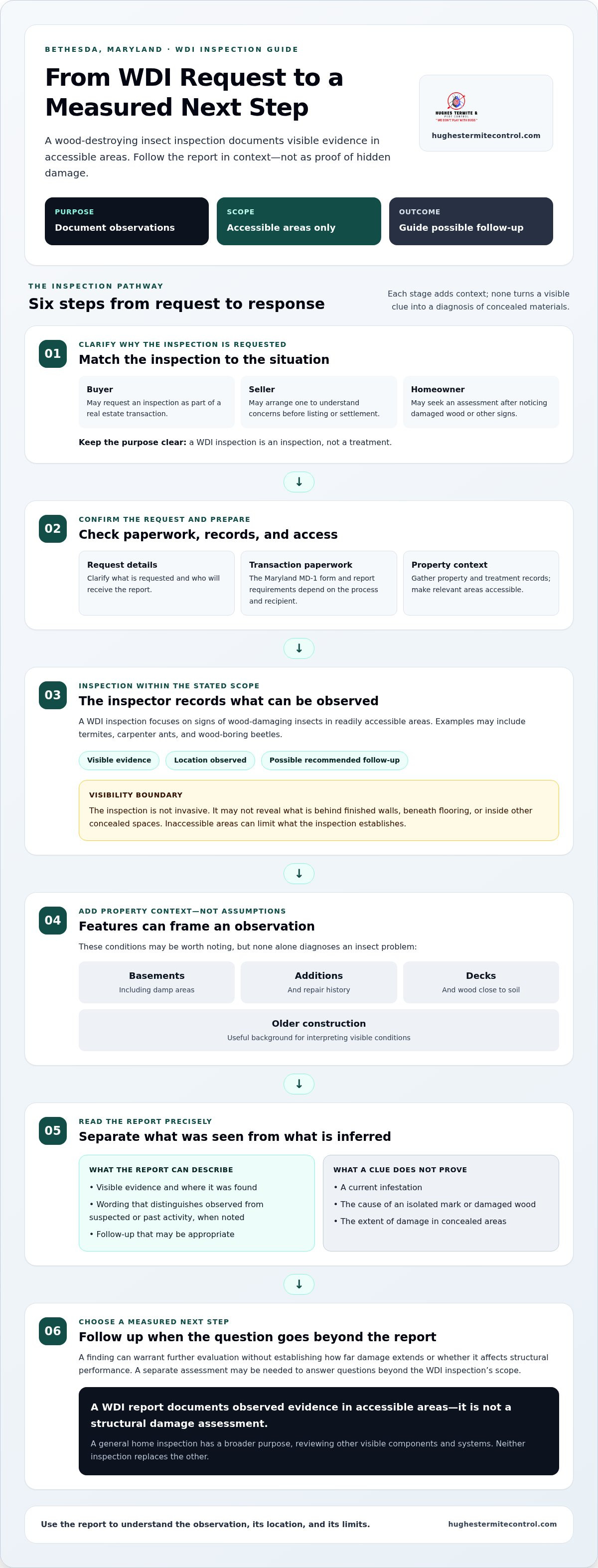
The inspection’s purpose, paperwork, and next steps can depend on whether you’re preparing for a real estate transaction or investigating a concern at home. This guide explains what a Bethesda WDI inspection covers, what it doesn’t, and how to prepare. You’ll also learn how Maryland’s MD-1 form and inspector credentials relate to a transaction, how to interpret findings carefully, and how to choose a practical next step. The goal is a clearer picture of the property, not an automatic recommendation for treatment.
Key Takeaways
- Learn why buyers, sellers, and homeowners may request a wood-destroying insect inspection, and how its purpose differs from treatment.
- A WDI inspection Bethesda MD can help you understand observed evidence and decide whether further evaluation is appropriate.
- See how transaction paperwork, including the Maryland MD-1 form, relates to the inspection request and the recipient’s requirements.
- Prepare by clarifying the request, gathering property and treatment records, and making relevant areas accessible.
- Use the report to guide measured next steps, not as proof of the extent of damage.
What a WDI Inspection in Bethesda, MD Is Designed to Tell You
A wood-destroying insect inspection, often shortened to WDI inspection, assesses a property for signs of insects that can damage wood. It is an inspection, not a treatment. Its purpose is to document observations and help determine whether further evaluation or action may be appropriate. The report describes what was visible during the inspection, not the condition of every part of the structure.
Buyers may request an inspection as part of a real estate transaction. Sellers may arrange one to understand property concerns before listing or settlement, and homeowners may seek an assessment after noticing damaged wood or other insect-related signs. For a transaction, the required report and form depend on the process and the party receiving the report. A WDI inspection Bethesda MD should be matched to the request rather than treated as a one-size-fits-all service.
Read findings as observations, not conclusions about what lies behind walls or beneath finished surfaces. A report may identify evidence that warrants follow-up, but it does not automatically establish the extent of damage, prove that insects are currently active, or determine structural condition. Those questions may require a separate evaluation.
Which wood-destroying insects and organisms may be considered?
Common examples include termites, carpenter ants, and wood-boring beetles. Inspectors may note visible damage or insect-related signs, such as damaged wood or evidence consistent with insect activity. These clues need context: an isolated mark or piece of damaged wood does not confirm an active infestation or identify its cause. The report records what was observed and can help determine whether further assessment is warranted.
People sometimes use “wood-destroying organisms” as a broader term, while a WDI report generally focuses on designated wood-damaging insects. The general Wood Destroying Insect Report overview explains why this type of documentation is used in some real estate transactions. The specific scope and form depend on the location and purpose of the inspection.
How does a WDI inspection differ from a general home inspection?
A WDI inspection focuses on insects that damage wood and related evidence within the accessible inspection scope. A general home inspection has a broader purpose: it reviews other visible components and systems as part of an overall property assessment. Neither replaces the other, and a WDI report is not a comprehensive structural assessment.
For example, a buyer concerned about a WDI finding may use the report to understand that specific observation while relying on a general home inspection for a wider view of the property. The right combination depends on the transaction and the recipient’s requirements. For another practical perspective on preparing for a property review, see this Washington, DC pest inspection checklist.
What a Bethesda WDI Inspection Examines, and What the Report Can Show
A WDI inspection is based on what an inspector can observe in areas that are accessible during the visit. It is not an invasive search, so the inspector may not see behind finished walls, beneath flooring, or inside other concealed spaces. Read the report’s conclusions within those limits. If an area cannot be accessed, that may limit what the inspection can establish about it.
Depending on the inspection and its stated scope, a report may record observed evidence, where it was found, and recommended follow-up. A specific location gives buyers and homeowners a more useful starting point than a general concern, but it does not describe what may be present beyond the observed area. Pay attention to the report’s wording, distinguishing direct observations from suspected or past activity when those differences are noted.
What local property conditions can make worth noting
Bethesda homes may have features that help frame an inspection, including basements, additions, decks, damp areas, and wood close to soil. Older construction or a history of repairs can also provide useful context. These features do not diagnose an insect problem. They help explain why a location may deserve attention and why property history can help the inspector interpret what is visible.
For example, wood near soil may be worth noting because of its placement, while a damp basement corner may provide context for an observation in that area. Neither condition alone proves that wood-destroying insects are present. The report should describe evidence found within its scope, not treat a property feature itself as a finding.
How to read findings without jumping to conclusions
Start with the report’s exact wording and the location it identifies. If it describes visible evidence, focus on what was observed. If it characterizes activity as suspected or past, do not interpret that as confirmation of a current infestation. A separate assessment may be needed to answer questions beyond the report’s scope.
A WDI report can document observed evidence in accessible areas, but it can’t establish the condition of concealed materials or, by itself, determine the full extent of structural damage. Evidence associated with insects and the extent of wood damage are related questions, but they are not interchangeable. A finding may justify follow-up without proving how far damage extends or whether it affects structural performance.
The National Pest Management Association (NPMA) provides industry resources on pest management and inspection practices. For a transaction, the required document and reporting details depend on the request and the recipient. A general industry reference does not replace the requirements that apply to a Maryland property transaction.
Hughes Termite Control provides wood-destroying organism inspections for property owners in the DMV. The inspection helps put observed evidence in context and identify whether follow-up may be appropriate.
MD-1 Reports, WDI-O Credentials, and Choosing the Right Inspection Path
A WDI inspection, a Maryland MD-1 report, and a general home inspection serve related but different purposes. The inspection assesses evidence of wood-destroying insects within its scope. The MD-1 is Maryland’s transaction-related wood-destroying insect report form. A general home inspection reviews a wider range of visible home components. Which document you need depends on the transaction, the contract, and the party receiving the report.
For Maryland real estate transactions, the official form is the Maryland Wood Destroying Insect Inspection Report, commonly called Form MD-1. The NPMA-33 form is not used for these Maryland transactions. Requirements can vary by sale, so confirm the current form and inspection requirements with the lender, contract parties, or settlement professionals involved.
When might an MD-1 form be relevant in Bethesda?
An MD-1 may be requested as documentation for a Maryland property transaction, including when a lender or contract calls for a WDI report. The form records inspection findings in a transaction-specific format. It does not replace a broader home inspection or establish conditions beyond the inspection’s scope. For a WDI inspection Bethesda MD, first identify who needs the report and what they require before scheduling.
| Primary purpose | What to clarify | |
|---|---|---|
| WDI inspection | Assess for evidence of wood-destroying insects within the inspection scope | Why it’s requested and what areas are accessible |
| Maryland MD-1 | Document WDI inspection findings for a transaction when required | Whether the recipient requires this form and whether it meets the transaction’s needs |
| General home inspection | Review a broader range of visible home components | Which property systems and components the service covers |
Maryland’s reporting rules and transaction instructions matter. A WDI report used for mortgage or settlement purposes is considered invalid if it is not used within 90 days of inspection. Because timing and transaction requirements can affect whether a report is usable, verify current guidance for your specific transaction rather than relying on a form from an earlier sale.
What does WDI-O credentialing mean for a homeowner?
WDI-O is the Maryland State Pest Control Association’s “WDI-O Credentialed Inspector” designation, earned through a WDI course and exam, an MSPCA supplement, and a signed pledge. The program’s described path includes the Virginia Pest Management Association course and exam, followed by the MSPCA supplement. The credential is valid for three years and requires renewal. See the Maryland State Pest Control Association (MSPCA) for program information. This voluntary designation is distinct from Maryland’s inspection licensing and category requirements.
Prepare for a WDI Inspection and Respond to Findings
A little preparation helps clarify the request and gives the inspector useful context. For a WDI inspection Bethesda MD, keep the transaction purpose or household concern in view, gather records you already have, and make relevant areas accessible where practical. Preparation can help the inspection proceed, but it cannot guarantee access to every part of a property.
What to have ready before the inspection
Before the appointment, note any deadlines and identify who needs the inspection or report. If it is part of a purchase or sale, the transaction purpose can help clarify the requested documentation. Gather prior inspection reports and available records of termite activity, repairs, or pest treatments. These documents can add context, especially if earlier work took place in a particular area.
Make accessible spaces such as basements and garages available where practical. If you can do so safely, move stored items away from areas you want inspected and share any access limitations in advance. Do not dismantle finishes or move heavy objects to prepare. Inaccessible areas can be noted as limits rather than treated as inspected.
Use a simple sequence to prepare and follow up
- Clarify the request. Identify the inspection’s purpose, any transaction deadline, and the report or form the recipient expects.
- Share property history. Provide relevant reports and available repair or treatment records, and point out areas of concern.
- Prepare access. Make relevant spaces available where practical, while recognizing that some materials may remain concealed or inaccessible.
- Review the findings. Read the location, description, and stated limits before deciding what follow-up makes sense.
After the inspection, start with the report. What location does it identify? Does it describe an observation, suspected activity, or a recommendation for further evaluation? Keep those points separate. A recommendation to investigate further is not the same as a confirmed need for treatment, and evidence in one area does not establish the condition of every concealed surface. If the report leaves a specific question unresolved, use that question to guide the next evaluation.
For example, if a report notes evidence in an accessible basement area but cannot assess an enclosed section nearby, the documented observation and the inaccessible space are separate facts. Identify what additional evaluation would address the unknown, then decide whether treatment is appropriate based on the evidence and any follow-up assessment. Hughes Termite Control also shares a grounded guide to termite control for readers considering what treatment options may involve.
Keep transaction deadlines in mind when arranging follow-up, particularly if a report must meet a lender’s or other recipient’s requirements. If you need an inspection to understand observed evidence and plan a clear next step, schedule a wood-destroying organism inspection with Hughes Termite Control.
Book a WDI Inspection in Bethesda with Hughes Termite Control
Hughes Termite Control provides wood-destroying organism inspections for property owners in the DMV, including buyers, sellers, and current homeowners with questions about visible wood or insect-related evidence. The inspection helps you understand what was observed and decide whether follow-up may be appropriate. It is an assessment, not an automatic treatment recommendation.
For a real estate transaction, the inspection should fit the request and the needs of the person or organization receiving the report. An inspection does not replace transaction-specific paperwork or lender requirements. Clarifying its purpose helps keep the next step focused, whether you are preparing for a purchase, addressing a concern before listing, or checking a condition at a home you already own.
When a local WDI inspection can help
A buyer may want information about observed evidence before making property decisions. A seller may want to understand a concern that could come up during a transaction. A homeowner may have noticed damaged wood or insect-related signs and want an assessment to guide follow-up. In each case, a WDI inspection can inform decisions, but it cannot establish the condition of concealed areas or replace a form or inspection specifically required for the transaction.
Consider findings in context. An observation may support further evaluation, but it does not automatically prove an active infestation, determine the extent of damage, or mean treatment is needed. If the report raises a question, identify what information is missing and whether a more focused evaluation is warranted. That keeps the response tied to the evidence rather than an assumption.
Schedule an inspection in Bethesda
When arranging an inspection, share its purpose and any transaction deadline, along with relevant property history or areas of concern. This context helps frame the request. If the inspection is connected to a purchase or sale, keep the recipient’s documentation requirements in view so the report aligns with the transaction’s needs.
Hughes Termite Control’s wood-destroying organism inspection service gives Bethesda-area property owners a way to understand observed evidence and consider an appropriate next step. The inspection provides a property-focused assessment within its stated scope. It does not promise a particular finding or make treatment automatic. If treatment is later considered, it should follow from the evidence and the situation at the property.
For a clear starting point, Request a WDI inspection in Bethesda from Hughes Termite Control. Share whether you’re buying, selling, or addressing a concern at home, and use the resulting information to make a measured property decision.
Make Your Next Property Decision with Clarity
Once you have a concern or transaction request in hand, focus on the decision ahead: what information would help you move forward with confidence? A WDI inspection Bethesda MD provides a grounded point of reference, while the right follow-up depends on the report, property, and transaction. Not every observation calls for immediate action. Take time to understand what was documented and what remains uncertain, then decide whether more information would help.
Hughes Termite Control provides wood-destroying organism inspections and termite control, giving property owners in the DMV a local resource for assessment and, when warranted, a next conversation about termite concerns. The inspection helps you understand observed conditions; it does not promise a particular finding or treatment outcome. For a purchase, sale, or existing-home concern, start with the purpose of the inspection and the question you need answered.
Request a WDI inspection in Bethesda to take a measured next step with your property. A clear assessment can help you plan thoughtfully, whether that means proceeding with a transaction, seeking more information, or considering further action.
Frequently Asked Questions
Is a WDI inspection required to buy a home in Bethesda?
Not every Bethesda home purchase has the same inspection requirements. The lender, purchase contract, and other transaction participants can determine whether a report or specific form is needed. Confirm what applies to your transaction and check current Maryland guidance before scheduling. A WDI inspection Bethesda MD can inform a purchase, but it does not replace a general home inspection or other obligations in your contract.
How long does a WDI inspection take?
There is no single reliable duration for every inspection. A smaller home with straightforward access may take less time than a property with additions, detached structures, or areas that are difficult to reach. The requested scope also matters. When arranging the appointment, share property details and timing constraints, then coordinate the schedule with the person managing your transaction rather than relying on a generic estimate.
Can a buyer attend a WDI inspection?
A buyer may be able to attend if the seller or transaction contacts arrange access and the schedule permits it. Being present can help connect a report note to a location, such as a basement area or deck. Use the written report as the record of the inspection’s findings and scope, even if you attend. Access to an occupied property needs to be arranged in advance.
What happens if a WDI report finds termite evidence?
First, read the specific location and description, then note whether the report recommends further evaluation. Evidence in one accessible area, for example, does not tell you what is behind a finished wall elsewhere. Share the report with relevant transaction participants if it affects the sale, and keep a copy with repair records. If follow-up is recommended, use the documented concern to determine whether an additional assessment or termite treatment is appropriate.
Does a WDI report cover detached garages, sheds, and decks?
Not necessarily. Whether a detached garage, shed, or deck is included depends on the request, the report’s stated scope, and access at the property. If a structure matters to your purchase decision, mention it when arranging the inspection instead of assuming it will be assessed. After receiving the report, check that the structures you asked about are addressed and note any areas the inspector could not access.
How long is a WDI inspection report valid?
For Maryland real estate transactions, a report is not valid for mortgage or settlement use if it is not used within 90 days of the inspection date. The recipient’s requirements still matter, so check the date and confirm the report’s acceptance for your specific transaction. An older report also cannot establish current conditions. If new evidence appears or the property changes, a fresh assessment may be useful.


