
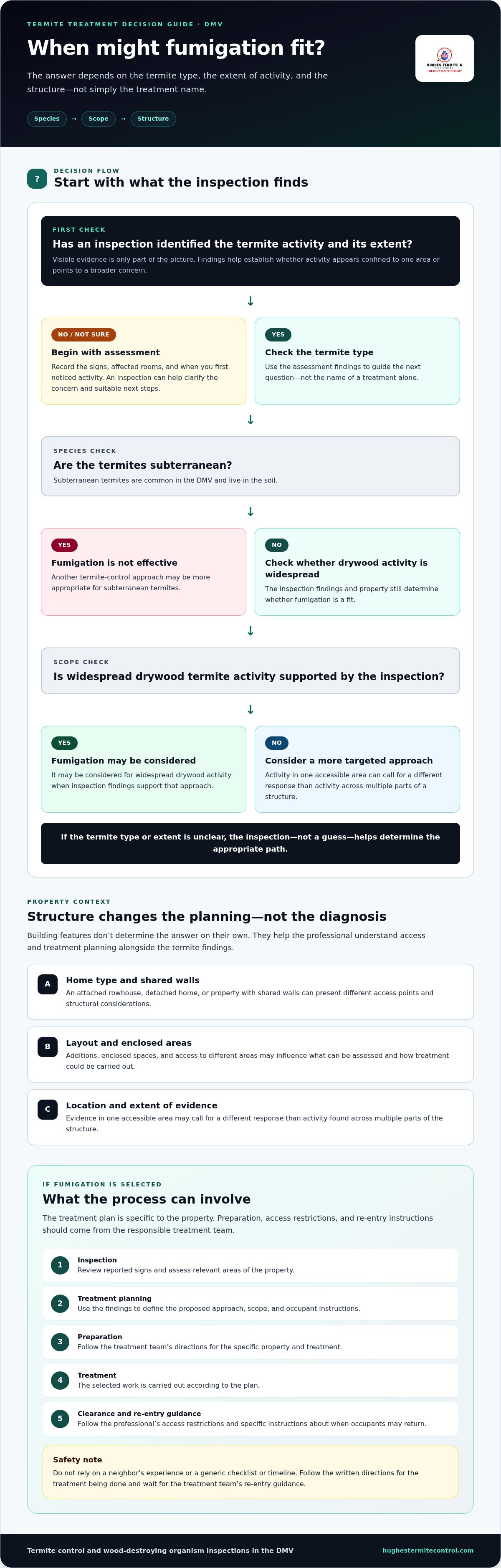
Fumigation isn’t the default answer to every termite problem. If you’re considering termite fumigation services DMV homeowners should know that the right approach depends on the termite type, the extent of activity, and the structure. Subterranean termites are common in the DMV, and fumigation isn’t effective against them.
A whole-house treatment can involve leaving home and preparing food, medications, plants, and pets, so it’s understandable to wonder whether it’s necessary. Fumigation may be considered for widespread drywood termite infestations; other situations may call for a more targeted approach. An inspection helps clarify which circumstances apply.
This guide explains when fumigation may be considered, how it compares with localized treatments, and what preparation and re-entry can involve. The termite species and building both matter when choosing a response. If you’ve noticed signs of termites, Hughes Termite Control provides termite control and wood-destroying organism inspections in the DMV to help homeowners understand the concern and identify a practical next step.
Key Takeaways
- Fumigation is one possible response, not a universal solution. Termite type, activity, and building structure all affect whether it fits.
- Understand the typical stages, from inspection and planning to preparation and re-entry, and follow directions tailored to the property.
- Compare fumigation, localized treatment, and other approaches by scope, access, preparation, and disruption.
- Before an assessment, record visible signs, note affected rooms, and prepare questions about the property and treatment plan.
- For termite fumigation services DMV homeowners can document what they’ve seen and arrange a termite assessment to understand suitable next steps.
Termite fumigation services in the DMV: when might they be considered?
Whether fumigation fits depends on what’s causing the activity, where it is located, and how the property is built. The name of a treatment alone doesn’t establish a plan or promise a particular result. An assessment helps determine whether fumigation is suitable for the home.
What does termite fumigation mean for a home?
Structural fumigation treats pests within a structure as a whole, rather than applying treatment only to a specific surface or accessible area. The process depends on the method and property. General information about Fumigation describes its use against structural pests, but it isn’t a treatment plan for a particular home.
Fumigation may be considered for widespread drywood termite activity when inspection findings support that approach. It is not effective against subterranean termites, the most common termite type in the DMV, which live in the soil. Other treatment approaches may be more appropriate for those termites. The distinction matters: recommendations should reflect the identified activity, not just the word “fumigation.”
Why the DMV property and infestation context matters
Termite activity can look similar from one home to another, even when the underlying circumstances differ. An attached rowhouse, a detached home, and a property with shared walls can present different access points and structural considerations. Visible evidence is only part of the picture. An inspection helps establish whether activity appears confined to one area or points to a broader concern.
Building layout also affects treatment planning. Shared walls, additions, enclosed spaces, and access to different areas may influence what can be assessed and how treatment could be carried out. These features don’t determine the answer on their own; they help the professional understand the structure alongside the termite findings.
- Termite type: The approach should match the pest identified during assessment.
- Location and extent: Evidence in one accessible area can call for a different response than activity found across multiple parts of a structure.
- Property layout: Attached and detached homes may require different planning considerations.
For a broader look at local termite concerns and treatment decisions, the DMV termite control guide provides helpful context. Homeowners researching termite fumigation services DMV can use it to frame their questions, then rely on an inspection to connect the signs in their home to appropriate next steps.
How termite fumigation works, from assessment through re-entry
Fumigation isn’t a one-size-fits-all event. A responsible process starts with understanding the termite concern and the property, then follows a plan specific to the treatment selected. Homeowners should know what preparation directions apply, what access restrictions to follow, and how they’ll be told when it’s safe to return.
What happens before a fumigation treatment?
Before treatment is recommended, an inspection helps document visible evidence and assess the structure. Share where you’ve noticed activity, when you first saw it, and whether anything has changed. The findings help determine whether fumigation fits or another termite-control approach is more appropriate.
If fumigation is selected, the treatment team provides preparation instructions for the property. Requirements can vary by treatment plan, so don’t rely on a checklist intended for a different method or home.
The process generally follows these stages:
- Inspection: The professional reviews reported signs and assesses relevant areas of the property.
- Treatment planning: The findings inform the proposed approach, its scope, and what occupants need to know.
- Preparation: The treatment team explains the steps required for the specific property and treatment.
- Treatment: The selected work is carried out according to the plan.
- Clearance and re-entry guidance: The responsible professional explains access restrictions and when occupants may return.
What should homeowners expect during and after treatment?
Access to the property may be restricted during treatment. How long restrictions apply depends on the treatment and the professional’s instructions. Don’t plan around a neighbor’s experience or general information online. Follow the written safety directions and wait for the treatment team’s specific re-entry guidance.
After treatment, next steps depend on the inspection findings and plan. The professional may provide follow-up or monitoring recommendations for the property. Keep those instructions with your treatment records and follow them if questions arise.
Fumigation safety depends on following instructions for the specific treatment, not a generic checklist or timeline. Preparation, access restrictions, and re-entry guidance should all relate to the work being done. Homeowners researching termite fumigation services DMV can keep the process clear by using written treatment steps and safety directions, and sharing them with everyone in the household.
Hughes Termite Control provides termite control and wood-destroying organism inspections in the DMV. A property assessment can help clarify the concern and guide the next step. Explore Hughes termite control services to learn more.
Fumigation vs. other termite treatments: compare the fit, not just the method
Different termite treatments address different patterns of activity. Compare them by the pest identified, where it is active, which parts of the structure need attention, and what occupants may need to do. Fumigation may be considered for widespread drywood termite infestations. Subterranean termites, the most common termite type in the DMV, are generally addressed with other approaches.
| Approach | Scope and access | Preparation and disruption |
|---|---|---|
| Structural fumigation | Whole-structure treatment; suitability depends on the infestation and property. | Occupants need to leave during treatment. Preparation and re-entry follow the treatment team’s instructions. |
| Localized treatment | Focuses on a defined area where inspection findings support a targeted approach. It may not address activity beyond that area. | Access and preparation depend on the treated location and method. Disruption may be more limited, but varies with the plan. |
| Liquid barriers or bait systems | Common approaches for subterranean termites, which nest in soil. The appropriate scope depends on the site and inspection findings. | Access needs and household preparation vary with the selected approach and property conditions. |
The table is a starting point, not a diagnosis. Inspection findings determine which options are relevant. A treatment plan should explain its intended scope and practical requirements.
When might localized termite treatment be considered?
A localized approach may fit when an assessment identifies activity in a defined area and supports treating that location. Evidence around one accessible section of a home may lead to a different discussion than signs across several parts of the structure. Consider the treatment’s reach: addressing one area doesn’t automatically resolve activity elsewhere, so findings and follow-up guidance matter.
Termite type is another key distinction. Drywood termites live in wood, while subterranean termites nest in soil and can enter structures from below. Localized treatment isn’t a blanket substitute for fumigation or other methods. The assessment should connect the pest and its location to a suitable plan.
What trade-offs should DMV homeowners understand?
Fumigation treats the structure as a whole and requires occupants to leave during treatment, which can cause more household disruption. A localized application or another approach may involve a narrower work area, but that doesn’t guarantee less preparation or make it appropriate for every infestation. Requirements vary with the treatment, property access, and job-specific instructions.
Attached homes and rowhouses add planning considerations, including shared walls and access around the building. Those features don’t prove that neighboring homes have termites; they matter when assessing the structure and treatment scope. A Washington, DC pest inspection checklist can help homeowners organize observations before discussing findings with a termite professional.
The appropriate termite treatment depends on evidence from the property, not the service label. Homeowners comparing termite fumigation services DMV can focus on the termite type, inspection results, treatment scope, and disruption rather than assuming one method is always best.
How to prepare for termite fumigation in the DMV
Good preparation starts with clear information, not guesswork. Before an assessment, note what you’ve seen and where. If fumigation is later recommended, use the treatment team’s property-specific directions to plan household schedules, pets, and access. Requirements vary by treatment, so online checklists shouldn’t replace instructions for your home.
Before the assessment, write down:
- Visible signs: Describe what you noticed and when. Photos can help you recall details and show where signs appeared.
- Locations: List the rooms, floors, or accessible areas where you’ve seen evidence. Note whether it seems limited to one area or appears in several places.
- Changes: Record any new signs or changes since you first noticed them.
- Household considerations: Note pets, access needs, and schedule constraints that could affect planning if treatment is proposed.
- Questions: Bring a short list so you can review the findings and proposed next steps clearly.
Questions to resolve before treatment begins
Before work is scheduled, make sure you understand the proposed treatment’s scope and the findings behind it. Know who will provide preparation and re-entry directions, how you’ll receive them, and what follow-up observation or inspection the plan recommends. Clear information helps you organize the household around the actual treatment rather than assumptions about fumigation.
- What area of the property does the proposed treatment address?
- Which inspection findings support this approach?
- Who will provide written preparation and re-entry instructions, and how will they be shared?
- What follow-up does the plan recommend, if any?
How to keep the process organized
Keep inspection notes, treatment directions, and follow-up recommendations together in a folder or digital file. Share relevant instructions with household members who may need to arrange access or coordinate schedules. If the plan includes arrangements for pets or temporary relocation, follow the directions provided.
For attached homes, rowhouses, or multi-unit properties, access and coordination may need extra attention. The plan may involve shared areas, a property manager, or neighboring occupants. Shared walls alone don’t establish that nearby units are affected, so keep coordination tied to the assessment and property-specific instructions.
Homeowners considering termite fumigation services DMV can reduce uncertainty by keeping observations and treatment directions in one place and using the written schedule to plan who needs access and when. If you’re addressing a termite concern, discuss termite control with Hughes and review the property-specific next steps.
A clear next step for termite concerns across the DMV
Termite concerns are easier to address with a clear decision process. Record the signs you’ve noticed and where they appear. A professional assessment can clarify the concern, account for the structure, and help compare suitable treatment approaches. Once a plan is selected, follow its specific preparation and safety instructions.
A visible sign alone doesn’t establish which treatment is appropriate. Fumigation may fit some situations, while other findings may point toward another approach. Focus on what the evidence shows and what the proposed plan is intended to address, rather than starting with a treatment label.
What Hughes Termite Control can help property owners address
Hughes Termite Control provides termite control and wood-destroying organism inspections for property owners in the DMV. Termite control connects inspection findings to practical next steps for addressing a termite concern. A wood-destroying organism inspection can help assess evidence of termites and other organisms that affect wood, giving property owners useful information about potential structural concerns.
For a home, this information can help distinguish a suspected termite issue from confirmed evidence and identify areas that may need attention. An inspection doesn’t mean one treatment method fits every property. Recommendations should reflect what was observed, where activity is located, and the characteristics of the structure.
What a useful next step looks like
Gather a few details before discussing the concern. You don’t need to diagnose the problem yourself. Share what you’ve observed and let the assessment help establish what the evidence means.
- Describe the signs: Note what you saw, when you noticed it, and whether it has changed.
- Identify the area: Name the room, floor, or accessible part of the property where you found evidence.
- Mention prior treatment: Share any treatment history or inspection information you have available.
- Review the recommendation: Discuss what the assessment found, what the proposed approach addresses, and what follow-up may be appropriate.
A useful recommendation relates to the property assessment, rather than relying on a generic assumption about all homes. If you’re researching termite fumigation services DMV, focus on the findings and whether that method fits the specific concern. Hughes Termite Control helps property owners across the DMV understand termite-control needs and wood-destroying organism inspection findings.
If you’ve noticed signs of termites or want to understand an inspection finding, talk with Hughes Termite Control about your property concern. A clear conversation about the evidence is a steady first step toward deciding what to do next.
Take the next step with confidence
Uncertainty about termites can make it tempting to settle on a treatment before the full picture is clear. A more useful next step is to bring your observations and questions into a conversation about the property. This keeps the focus on what the evidence shows and what approach may fit, whether you’re researching termite fumigation services DMV or considering another form of termite control.
Hughes Termite Control is a privately owned local business serving the DMV. Discuss the signs you’ve noticed and how an inspection or termite-control service can help clarify the concern. You don’t need to arrive with a diagnosis. Start with what you’ve observed, then take the next step with a local team.
Talk with Hughes Termite Control about your termite concerns, and move forward with a clearer understanding of your property.
Frequently Asked Questions
Is termite fumigation the right choice for every termite infestation?
No. Fumigation is one possible approach, and evidence in a particular home helps determine whether it fits. Signs in a single accessible area may lead to a different discussion than evidence in several parts of a structure. If you’re researching termite fumigation services DMV, focus on what the assessment found and what the proposed treatment is designed to address, rather than assuming the service name identifies the right solution.
How long do homeowners need to stay away during termite fumigation?
There isn’t one stay-away period that applies to every treatment. The schedule and re-entry conditions depend on the method and property, so don’t use a neighbor’s experience or an online estimate to plan your return. Before treatment begins, know how re-entry instructions will be provided and who is responsible for them. If anyone in the household is unsure whether re-entry is allowed, wait for specific guidance.
Can termite fumigation damage belongings or household items?
Item-handling requirements depend on the treatment plan, so there isn’t a universal rule for every home or possession. Before work begins, review the written instructions for the property and clarify any specific directions about belongings such as food, medications, or items that are difficult to move. Don’t rely on a checklist written for another method. Clear, item-specific guidance helps you prepare without taking unnecessary steps or overlooking a required precaution.
Does termite fumigation prevent termites from returning?
No treatment should be treated as a permanent guarantee against future termite activity. A completed treatment addresses the concern within its defined scope, while later activity can depend on conditions at the property. Keep any records and recommendations provided after treatment. If you later notice new signs, record their location and date and arrange an assessment rather than assuming the evidence relates to the earlier infestation or is covered by prior work.
What happens if termites are found in an attached DMV home?
Finding termites in an attached home doesn’t automatically mean neighboring units have activity or need the same treatment. The assessment should clarify where evidence appears and which parts of the property a proposed plan addresses. If a shared area or property manager may be relevant, raise that early in planning. Keep observations tied to your own unit and follow property-specific directions for any inspection or treatment.
Are termite fumigation requirements the same in Maryland, Virginia, and Washington, DC?
Requirements may differ by jurisdiction and treatment, so don’t assume directions for one DMV location apply to another. This FAQ doesn’t set out local legal requirements. For a specific property, follow the applicable safety, preparation, and re-entry directions provided for its treatment, and rely on current jurisdiction-specific information when a regulatory question affects your plans.
Should I get a termite inspection before choosing fumigation?
Yes. An inspection can help establish what signs are present and where they occur before you settle on a treatment approach. For a more useful assessment, note when you first saw evidence, take clear photos if practical, and gather records of earlier termite work. These details can help distinguish a new observation from a previously documented concern and give you a specific basis for discussing the proposed scope and next steps.


