
What if the damage you can see is old, while the real concern is hidden somewhere else? A pest inspection Washington DC homeowners arrange can help clarify what’s happening, but a stain, damaged board, or discarded insect wing isn’t proof of an active infestation. It’s reasonable to ask what the inspection covers and how its findings fit with a general home inspection.
This checklist explains what to do before, during, and after an inspection. You’ll learn how a pest or wood-destroying organism inspection can complement a general home inspection without replacing it, and how to distinguish possible past activity from evidence that pests may be present now. Hughes Termite Control offers wood-destroying organism inspections, which may be relevant when concerns involve termites or other organisms that damage wood.
You’ll also find questions to ask if an inspector identifies damage, conditions that may attract pests, or a need for further evaluation. The goal is to understand what the evidence supports and choose a proportionate next step, not to assume that every sign calls for treatment.
Key Takeaways
- A pest inspection Washington DC homeowners arrange documents observable conditions within an agreed scope. It can’t predict every future pest issue or replace a broader home inspection.
- Damaged wood, mud tubes, discarded wings, and droppings warrant context and assessment, but don’t automatically confirm an active infestation.
- Before the visit, note leaks, past repairs, pest sightings, and areas that may be difficult to access.
- Ask how the inspection distinguishes current activity, past signs, damage, and conditions that may attract pests. Find out what follow-up each finding may warrant.
- Compare providers by inspection scope, written documentation, and clarity of explanations. Verify applicable DC requirements through official sources.
What a Pest Inspection in Washington, DC Can and Cannot Tell You
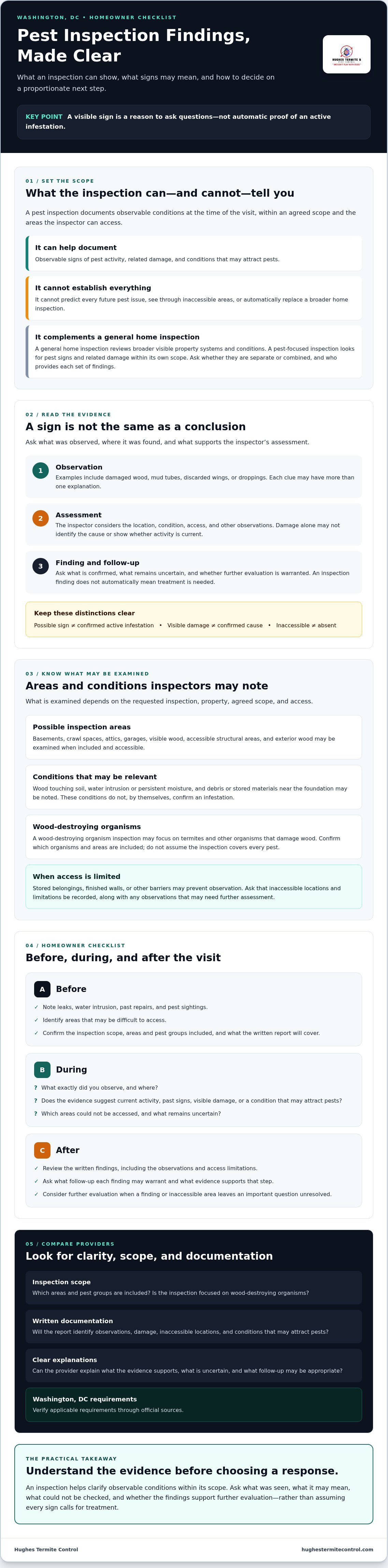
A pest inspection can clarify observable conditions at the time of the visit, but it can’t predict every pest issue that may develop later. Findings depend on what the inspector can access and what the inspection is designed to cover. Before scheduling, confirm the scope and what the report will include so you know what the visit can and cannot establish.
A pest inspection assesses accessible areas for observable signs of pest activity, related damage, or conditions that may attract pests, within an agreed scope. A suspected sign, visible damage, and a confirmed active infestation are different findings. For example, damaged wood may need closer assessment, but that alone doesn’t establish which organism caused it or whether pests are still present.
How a pest inspection differs from a general house inspection
A general home inspection is a broader review of visible property systems and conditions. A pest-focused inspection looks for signs of pests and related damage within its agreed scope. The two may complement each other, but one doesn’t automatically replace the other. Ask whether the inspections are separate or combined, which areas and pest groups are included, and who will provide each set of findings.
What a Washington, DC inspection may examine
Depending on the scope and access, an inspector may examine visible wood, accessible structural areas, and conditions that could attract pests. A wood-destroying organism inspection may focus on termites and other organisms that damage wood. Don’t assume it covers every pest. Hughes Termite Control offers wood-destroying organism inspections, so confirm the specific scope before arranging one.
Access matters. Stored belongings, finished walls, and other barriers may prevent an inspector from seeing certain areas. Ask the inspector to document inaccessible locations and note any observations that need further assessment. A limitation isn’t the same as a clean bill of health or confirmation of an infestation. It tells you where the inspection could not reach and helps you decide whether another evaluation is appropriate.
If findings lead to a discussion about pest management, you can review the principles of Integrated Pest Management. An inspection documents what was observable within its scope; it doesn’t automatically mean treatment is needed.
What Inspectors Look for in DC-Area Homes
An inspection focuses on what can be observed at the property within the agreed scope. Findings may include possible pest evidence, visible damage, or conditions that merit attention. None should be treated as proof of a particular pest or an active infestation without supporting assessment. For a pest inspection Washington DC homeowners arrange, relevant observations depend on the building, the areas the inspector can access, and the type of inspection requested.
Depending on the property and access, an inspector may look at basements, crawl spaces, attics, garages, and exterior wood. They may record damaged wood, mud tubes, discarded wings, or droppings. These clues can guide further evaluation, but each can have more than one explanation. Ask the inspector to identify what they saw, where they found it, and how it supports any conclusion.
Signs of termites and other wood-destroying organisms
Visible wood damage and mud tubes can warrant closer assessment for termites or other wood-destroying organisms. Damage may be old, however, and its presence alone doesn’t establish current activity or identify the cause. Ask which observations support the inspector’s conclusion, whether activity appears current, and what remains uncertain. Hughes Termite Control offers wood-destroying organism inspections for homeowners seeking a focused assessment of wood-related concerns.
Conditions around the property that may matter
Inspectors may note wood touching soil, water intrusion or persistent moisture, and debris or stored materials near the foundation. These conditions can be relevant to follow-up, but they don’t confirm an infestation. A DC rowhouse or older home may have different access points and construction details from another property. Age or home type alone doesn’t establish a pest problem.
If a wall, stored item, or other obstruction prevents access, ask that the affected area and limitation be recorded. This helps distinguish “not observed” from “not present” and can show whether further evaluation may be useful. Before deciding on treatment, ask what evidence supports the finding and what next step it warrants. For general information about pest-control approaches, the EPA provides resources for residents.
How to Read Pest Inspection Findings Without Overreacting
A report is most useful when it separates what the inspector observed from what those observations may mean. For a pest inspection Washington DC homeowners should look for specific locations, supporting evidence, and access limits. A flagged condition isn’t automatically a diagnosis.
A reported sign is evidence to evaluate, not automatic confirmation of an active infestation. Old damage may remain after pest activity has stopped, while a condition that could attract pests doesn’t prove they are present. If evidence is inconclusive or an area was inaccessible, the inspector may recommend further evaluation rather than make a firm conclusion.
Active activity, past damage, and conditions are not the same
Current activity means the inspector observed signs they consider consistent with pests being present now. Past signs or damage may point to earlier activity, but don’t establish whether it continues. Conducive conditions, such as moisture or wood touching soil, can warrant attention without confirming pests. Don’t diagnose from one sign alone. Ask whether activity was observed or only suspected, and what evidence supports that distinction.
| Observation | What it may indicate | What to ask next |
|---|---|---|
| Live pests or fresh signs noted during the inspection | Possible current activity, subject to the inspector’s assessment | What supports that conclusion, and what follow-up is recommended? |
| Old-looking damage or repaired wood | Past damage or another cause; visible condition alone may not show when it occurred | Can you identify the location and explain whether activity appears current? |
| Moisture, wood-to-soil contact, or stored materials | A condition that may warrant attention, not proof of an infestation | What practical change or further assessment, if any, is appropriate? |
| Concern near an inaccessible area | An unresolved question because the inspector could not fully examine the location | What was blocked, and what access or evaluation would clarify it? |
Questions to ask about the inspection report
Ask where each finding was observed and whether the area was fully accessible. Request the supporting observations and any scope limitations in writing. If the report recommends monitoring, additional inspection, or treatment evaluation, ask why that step fits the evidence and what uncertainty it addresses. Have technical terms explained in plain language before deciding what to do.
For local background on pest-management principles, consult the DC Department of Energy and Environment’s Integrated Pest Management information. A clear report should help you choose a proportionate next step, not pressure you to treat based on an unexplained note.
A Washington, DC Pest Inspection Checklist for Homeowners and Buyers
A little preparation can make an inspection more useful. Use this checklist before, during, and after a pest inspection Washington DC homeowners or buyers arrange. Share relevant context, understand the inspection’s limits, and leave with clear next steps.
Before booking or attending, clarify the inspection goal, prepare access, confirm the scope, ask specific questions, and request written findings with any limitations explained.
Before and during the inspection
- Set your goal. Note whether you’re investigating a particular sighting, checking for wood-destroying organisms, or seeking information for a property purchase. If a lender or other party has requested an inspection, confirm which report they require.
- Gather useful history. Write down known leaks, repairs, pest sightings, and where and when you noticed them. Bring any past pest treatment records you have. Specific dates and locations can help focus the discussion.
- Prepare access where practical. Make relevant areas accessible if it’s safe to do so, and point out spaces that may be blocked or difficult to reach. Don’t disturb suspected pests or damage to investigate it yourself.
- Confirm scope and deliverables. Ask which pests and areas the inspection covers, what it excludes, and whether you’ll receive a written report. If photographs matter to you or a third party, ask whether they’re included.
- Ask questions during the visit. Find out what the inspector is observing and whether any area can’t be evaluated. Ask how the inspector distinguishes observed activity from suspected activity, past signs, or conditions that may need attention.
After the inspection: decide on proportionate follow-up
- Review the findings. Ask the inspector to explain each item, where it was observed, and whether anything needs prompt attention. Keep the report and any photographs provided so you can refer to the same details later.
- Clarify before arranging work. If the evidence is uncertain or access was limited, ask what further evaluation could resolve the question. Get a qualified assessment before arranging pest treatment or structural repairs. A finding alone doesn’t mean either is automatically needed.
For additional termite context, read this grounded guide to termite control in the DMV. If your concern involves wood-destroying organisms, you can also learn about wood-destroying organism inspections from Hughes Termite Control.
Choosing a Pest Inspection Provider and Taking the Next Step
Choose a provider by setting clear expectations rather than relying on assumptions. For a pest inspection Washington DC homeowners can compare providers by the inspection’s scope, the inspector’s relevant experience, the written findings they’ll receive, and how clearly the provider explains uncertainty. A useful explanation should make it clear what was observed and what still needs checking.
What to confirm before scheduling
Before booking, ask which pests and property areas the inspection includes, what access is needed, and which locations or conditions fall outside the scope. Confirm whether you’ll receive a written report, what information it contains, and how you can ask follow-up questions. If the inspection is for a purchase or another specific purpose, check that its scope and documentation meet that need.
Ask about the provider’s experience with your concern, such as termites or other wood-destroying organisms. Verify any qualifications and applicable District of Columbia requirements independently through current official sources. Don’t rely on an assumption or an informal claim. Requirements may depend on the work being performed.
When inspection findings point to other work
An inspection, pest treatment, and structural repair are distinct steps. A finding may support further evaluation, but it doesn’t automatically mean treatment or repairs are needed. Ask what evidence supports the proposed next step, whether another assessment is appropriate, and which provider is responsible for each service. Confirm that any company you consider offers the service you need.
Hughes Termite Control offers wood-destroying organism inspections, which may be relevant if the concern involves termites or other organisms that affect wood. This is an inspection offering, not a general home inspection. If a report identifies repair considerations, you can review this home remodeling guide for related context.
Use the report to clarify the concern and choose a proportionate next step. If a wood-destroying organism inspection fits your needs, ask Hughes Termite Control about wood-destroying organism inspections.
Use Your Findings to Choose a Clear Next Step
A pest inspection Washington DC homeowners arrange is most useful when it clarifies what was observed, what remains uncertain, and whether further evaluation is warranted. Visible damage or a possible pest sign isn’t automatically proof of active activity. The inspection’s scope and any access limits matter, too.
Review the written findings, ask questions about specific locations, and keep inspection decisions separate from treatment or repair decisions. A clear explanation can help you choose a proportionate follow-up without rushing into work that may not be needed.
Hughes Termite Control offers wood-destroying organism inspections, and termite control is a pest management service. If a focused inspection fits your concern, ask Hughes Termite Control about wood-destroying organism inspections.
With clear information and appropriate follow-up, you can make the next decision with confidence.
Frequently Asked Questions
What does a pest inspection include in Washington, DC?
A pest inspection checks agreed areas for observable pest signs, related damage, and conditions that may attract pests. The exact scope varies by provider and inspection type. A wood-destroying organism inspection, for example, focuses on organisms that affect wood, while a general pest inspection may address other pest concerns. Before scheduling, ask which pests and areas are included, what access is needed, and what the written findings will cover.
Is a pest inspection the same as a home inspection?
No. A general home inspection reviews visible property systems and conditions more broadly. A pest inspection focuses on signs of pests and related damage within its agreed scope. The inspections may be separate or coordinated, but don’t assume one includes the other. If you’re arranging both for a DMV property, confirm who performs each inspection, which areas are covered, and whether you’ll receive separate reports.
Should I get a pest inspection before buying a house in Washington, DC?
A pest inspection can provide focused information about possible pest activity or wood-related concerns before you buy, alongside a general home inspection. Whether it’s needed may depend on the property, your concerns, and any lender or transaction requirements. Ask what inspection documentation is required and verify those requirements with the relevant parties. A report can help you understand observed conditions, but it doesn’t predict every future pest issue.
What are common signs an inspector looks for?
An inspector may record damaged wood, mud tubes, discarded wings, droppings, or other observations relevant to the inspection scope. They may also note conditions such as moisture or wood touching soil. These signs can warrant assessment, but one sign alone doesn’t confirm a specific pest or active infestation. Ask where the evidence was found and whether the inspector considers activity current, suspected, or possibly historical.
How long does a pest inspection take?
There isn’t one reliable duration for every pest inspection. Timing can depend on the property’s size and layout, the requested scope, access to areas such as basements or attics, and whether the inspector needs to discuss particular concerns. Ask the provider for an estimate based on your property and inspection purpose. Also confirm whether time is set aside to review findings or explain any access limitations.
Can a pest inspection find hidden termite damage?
An inspection may identify signs of termite activity or damage in areas the inspector can access, but concealed areas can limit what’s visible. A standard visual inspection cannot guarantee that all hidden damage will be found. If the report notes a concern behind a finished surface or in an inaccessible space, ask what evidence supports the finding and whether further evaluation is appropriate before making repair decisions.
What should I do if a pest inspection finds termite damage?
First, ask the inspector to identify the damage’s location, explain the evidence, and clarify whether active termite activity was observed or only suspected. Past damage doesn’t by itself prove termites are still present. Request written findings and any access limitations, then seek an appropriate assessment before deciding on treatment or structural repairs. Hughes Termite Control offers wood-destroying organism inspections and termite control as distinct services.
For a focused assessment of wood-related concerns in the DC area, contact Hughes Termite Control to ask about a wood-destroying organism inspection.


