
The right drywood termite treatment Alexandria VA homeowners need may start with confirming that the problem isn’t drywood termites at all. Drywood termites are uncommon in Virginia, while subterranean termites are the more typical concern. Wood damage or small piles of debris can understandably raise alarm, but those clues alone don’t identify the termite species or show how far an infestation extends.
Choosing a treatment before confirming the cause can leave active termites behind. A professional inspection helps distinguish warning signs from other types of wood damage and guides the next step. This article explains what signs warrant an inspection, how treatment approaches differ, and why the right option depends on the findings in your home. You’ll also learn what to expect from assessment and follow-up, including how Hughes Termite Control’s termite management and wood-destroying organism inspections help Alexandria homeowners make informed decisions.
Key Takeaways
- Pellets, exit holes, damaged wood, or discarded wings can raise concern, but no single sign confirms drywood termites.
- A careful inspection looks at affected wood and surrounding areas to assess what the evidence means and how extensive activity may be.
- The right drywood termite treatment Alexandria VA homeowners consider depends on the confirmed species, extent of activity, and access to affected wood.
- Preparation and follow-up vary by treatment plan. Keep notes about what you observe and follow the instructions for your home.
- Hughes Termite Control connects termite control with wood-destroying organism inspections, using findings to guide the next steps.
Drywood Termite Treatment in Alexandria, VA: What the Signs Can, and Cannot, Tell You
Drywood termites live and feed within dry wood, rather than relying on a connection to soil. Their habits help explain why evidence may appear around wood members, furniture, or window and door frames. Learn more about their biology and habits in Drywood Termite Biology.
Inspection, not one visual clue, determines the likely termite type. A pellet pile or small hole is a reason to look more closely, but it doesn’t confirm drywood termites. Similar signs can have other causes, so consider their location and the condition of the surrounding wood as well.
Which signs may point to drywood termites?
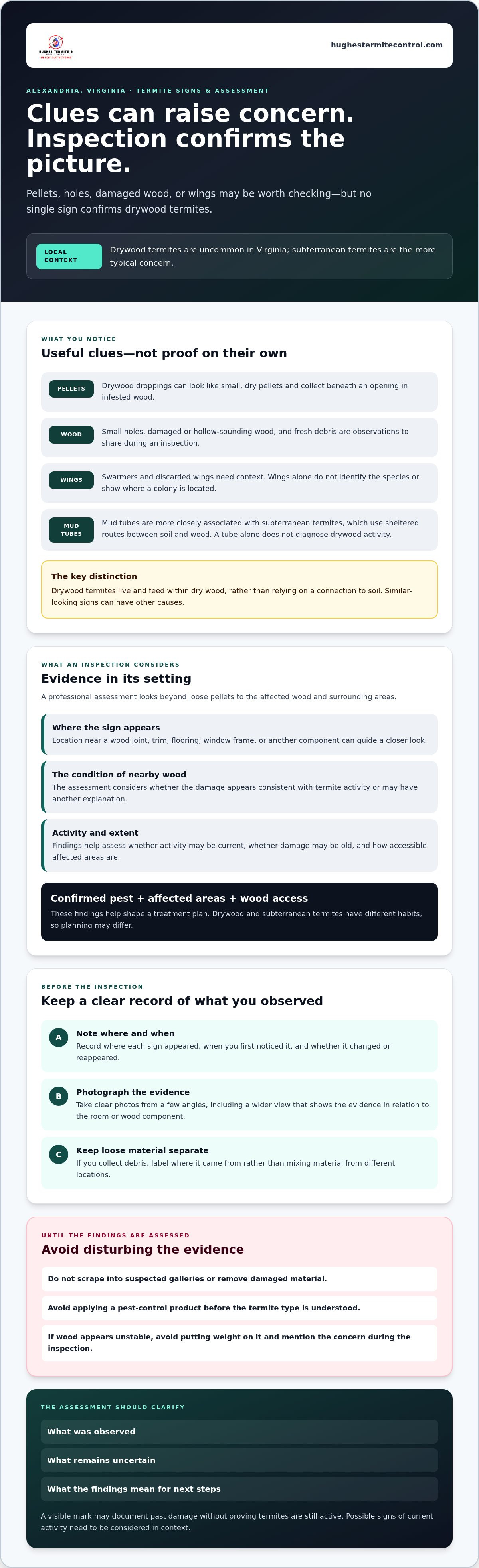
Drywood termite droppings can look like small, dry pellets and collect beneath an opening in infested wood. Photograph the material and note where it appeared before cleaning it up. Small holes, damaged or hollow-sounding wood, and fresh debris are also useful observations to share during an inspection, but none proves the cause on its own.
Swarmers and discarded wings need context, too. Termites may swarm as part of reproduction, but wings alone don’t identify the species or show where a colony is located. Mud tubes are more closely associated with subterranean termite activity, as these termites use sheltered routes between soil and wood. A tube by itself doesn’t diagnose drywood activity. Record where you found any evidence and whether it reappears.
Why Alexandria homeowners should avoid guessing the termite type
Drywood and subterranean termites differ in where they live and how they reach wood. That matters because treatment planning depends on the confirmed pest, the affected areas, and how accessible the wood is. Choosing a method based on a pellet pile or a swarm alone risks addressing the wrong problem or overlooking activity elsewhere.
Regional assumptions can also mislead. Claims about how common a termite species is in Virginia should be supported by reliable, location-specific information, not used as a substitute for inspecting the property. If you’re considering drywood termite treatment Alexandria VA, first identify the likely termite type and document what you’ve observed. Those findings help shape a practical next step instead of a guess.
Termite control approaches depend on the pest and conditions around the home. Keep your notes, photographs, and any collected debris available for the inspection. A clear record of where and when signs appeared gives the professional useful context to assess the wood and explain what the evidence does, and does not, indicate.
How Professionals Assess Drywood Termite Activity in an Alexandria Home
A professional assessment turns scattered clues into a clearer picture of what may be happening in the home. It considers where evidence appears, the condition of nearby wood, and whether the signs suggest current activity or damage left by an earlier infestation. A wood-destroying organism inspection helps distinguish suspected termite activity from other possible causes while keeping the limits of visible evidence clear.
What a wood-destroying organism inspection can clarify
An inspection considers visible evidence and accessible affected areas, rather than treating loose pellets as the whole story. Location matters: signs near a wood joint, trim, flooring, or a window frame may call for a closer look at that component and its condition. The inspection can also help assess whether the damage appears consistent with termite activity or may have another explanation.
Identifying the termite type helps determine which treatment plan fits the evidence and affected wood. Drywood and subterranean termites have different habits, so their management may require different planning. Inspection findings provide a basis for discussing next steps, including whether the evidence points to active activity, old damage, or a different concern.
What to document before the inspection
A little preparation can make the visit more useful. Keep a simple record of what you observed and where. For example, note whether pellets appeared beneath a particular beam, whether you saw a small opening in trim, or where you found discarded wings. Include when you first noticed each sign and whether it has changed or reappeared.
Take clear photographs from a few angles, including a wider view that shows the evidence in relation to the room or wood component. Keep the images and written notes together so the inspector can compare your observations with the accessible areas being assessed. If you collect loose material, keep it separate and label where it came from rather than mixing evidence from different locations.
Until the findings are assessed, avoid scraping into suspected galleries, removing damaged material, or applying a pest-control product to the area. Disturbing the wood may remove useful evidence, and applying a product before the termite type is understood may complicate assessment. If a section of wood appears unstable, avoid putting weight on it and mention that concern during the inspection.
The assessment should leave you with a plain explanation of what was observed, what remains uncertain, and what the findings mean for the next step. A visible mark may document past damage without proving termites are still active; possible signs of current activity need to be considered in context. For homeowners seeking drywood termite treatment Alexandria VA, Hughes Termite Control’s wood-destroying organism inspections help establish that context and inform termite-control planning. Arrange a wood-destroying organism inspection to have the evidence assessed.
Comparing Drywood Termite Treatment Options: Match the Method to the Findings
There isn’t one treatment approach that fits every suspected drywood termite problem. A professional recommendation should follow the inspection, not precede it. The confirmed termite type, extent of activity, location of affected wood, and access to that wood all influence which options may be appropriate. Product directions also set important limits on how a treatment can be used.
The comparison below shows how the scope of treatment planning can vary. It can help explain why two properties with similar-looking signs may need different plans.
| Planning scope | When it may be considered | What shapes the decision |
|---|---|---|
| Localized approach | When inspection findings indicate limited activity in an identifiable, accessible area. | Whether the evidence supports a localized plan, the condition of the wood, and whether the affected area can be reached and treated according to product directions. |
| Broader treatment planning | When activity appears extensive, concealed, or difficult to reach, or the inspection cannot support a limited scope. | How widely evidence is distributed, which areas can be assessed, the confirmed termite type, and the treatment options appropriate for those findings. |
When a localized approach may be considered
A localized approach may be discussed if the inspection supports a limited, identifiable area of activity and the affected wood is accessible. For example, evidence confined to one reachable wood component may be assessed differently from signs found in several separated parts of a home. That observation alone doesn’t determine the treatment. The professional must consider whether the evidence confirms activity and whether the proposed use follows product directions.
Localized does not automatically mean simple or sufficient. Hidden areas, connected wood, or uncertain evidence can affect whether a narrower plan is appropriate. The inspection findings should explain the basis for the proposed scope and its limits.
When broader treatment planning may be needed
If evidence occurs in multiple areas or activity may be concealed within inaccessible wood, a broader assessment may be needed before selecting a plan. This does not automatically mean a particular whole-structure method is necessary. It means the scope and access questions deserve careful review before treatment decisions are made.
Disruption, coverage, and preparation requirements vary by method. Without method-specific details, it would be misleading to rank approaches on those points or assume a broad plan always reaches every affected area. A professional should explain what the recommended approach is intended to address and what it does not establish. Treatment also does not repair wood already damaged; any repairs depend on the condition of the affected material.
For homeowners considering drywood termite treatment Alexandria VA, the useful comparison is not simply “small treatment versus large treatment.” It is whether the proposed scope matches confirmed findings, accessible areas, and applicable product directions. A clear explanation of that match helps you understand why a plan was selected without assuming one method suits every home.
Before and After Drywood Termite Treatment: Practical Steps for Alexandria Homeowners
A clear routine helps preserve useful evidence before treatment and track changes afterward. Start with what you observed, follow the instructions for your specific treatment plan, then monitor the areas identified during the assessment. Preparation varies by approach, so general online advice should not replace instructions tailored to the work being done in your home.
How to prepare without disrupting the assessment
Before an inspection or treatment, make the affected area accessible where practical, but don’t scrape, patch, or remove suspected evidence unless instructed. A photo and note about where a mark or debris appeared can be more useful than a cleaned-up area. If you’ve already disturbed the evidence, record what you did and what you saw beforehand.
Once a treatment plan is set, follow its specific preparation directions. Requirements depend on the approach and areas involved, so don’t assume instructions for another home apply to yours. If a direction is unclear, get clarification before making changes. This keeps preparation aligned with the plan and avoids unnecessary steps.
What to monitor after treatment
Follow the treatment plan’s guidance about monitoring and follow-up. Keep a brief record of observations in the areas identified during the assessment. If you notice new pellets, openings, or other changes, note the date and location and take a photograph before disturbing the area. Share those details for professional review instead of deciding on your own that they prove treatment was unsuccessful.
Old damage can remain visible after termite activity has ended. A hole, stain, or weakened piece of wood does not by itself show whether termites are still active. If a sign appears new or keeps recurring, document the change and arrange a professional reassessment. Separating existing damage from fresh observations makes it easier to discuss what may need attention, including whether wood repair is appropriate.
Prevention is useful, but it is not a substitute for addressing confirmed activity. Store firewood in a dry place away from the structure, and don’t treat a change in storage as a remedy for termites already inside the home. Good records and consistent monitoring help keep the next steps grounded in what you actually observe.
If you’re arranging drywood termite treatment Alexandria VA, Hughes Termite Control provides termite control and wood-destroying organism inspections to connect assessment findings with appropriate next steps. Schedule a termite inspection to have your concerns assessed and treatment planning informed by the evidence.
Drywood Termite Treatment in Alexandria, VA: How Hughes Termite Control Helps
Suspected termite evidence can leave homeowners unsure whether to arrange an inspection, treatment, or repairs. Hughes Termite Control provides termite control and wood-destroying organism inspections to assess concerns and determine next steps based on observed conditions at the property. The process starts with understanding what you’ve noticed, then uses inspection findings to guide the discussion. The appropriate treatment approach depends on those findings.
From suspected activity to a clear service plan
When you share a concern, details such as where you saw pellets, holes, wings, or damaged wood provide useful context. An inspection assesses visible evidence and accessible affected areas. The findings help distinguish suspected termite activity from other possible causes and clarify what the evidence may mean for your home.
Recommendations should relate to the conditions observed. If termite activity is indicated, treatment planning can account for the suspected or identified pest and the areas involved. If the evidence points elsewhere or doesn’t establish current activity, that distinction matters too. Clear explanations help you understand what was observed, what remains uncertain, and why a particular next step is being considered.
For homeowners researching drywood termite treatment Alexandria VA, an assessment-led approach replaces guesswork with a conversation grounded in the property’s condition. Share your observations and ask for the findings and recommendations to be explained in plain language. The goal is to connect the next step to the evidence, not assume every sign calls for the same treatment.
When termite treatment and home repairs intersect
Termite control and property repair address different needs. Treatment planning focuses on termite activity; repair work addresses damaged or worn building materials. If an inspection identifies wood damage, the condition and location of that material help determine whether repair should also be considered. Not every termite concern calls for remodeling, and repairs alone don’t resolve an active infestation.
When property improvements are appropriate, Hughes also handles home repair and remodeling work, including flooring, roofing, siding, decking, windows, and doors. The relevant work depends on what the property needs. A damaged component may call for repair, while other areas of the home may need no improvement. Keeping pest management and repair decisions distinct helps homeowners understand the purpose of each step.
You can expect the conversation to focus on your concern, the inspection findings, and practical next steps tied to those findings. To discuss termite concerns in Alexandria, contact Hughes Termite Control about termite concerns in Alexandria.
Take the Next Step With Clear Information
Uncertainty can make every mark in the wood seem urgent. You don’t have to decide on a treatment based on a single clue. A useful next step is to have your concern assessed and leave the conversation with a clear understanding of what was observed and what action makes sense for your property.
For drywood termite treatment Alexandria VA, a measured approach also helps keep pest management and any needed property improvements in perspective. If repairs are recommended, consider them as a separate part of caring for your home, not as an automatic consequence of suspected termite activity. Clear information makes it easier to plan without guessing.
Hughes Termite Control provides termite control and wood-destroying organism inspections, along with home improvement and repair services when property conditions call for them. Request an inspection for your termite concerns and take the next step with a clearer view of your home’s needs.
Frequently Asked Questions
Are drywood termites common in Alexandria, Virginia?
No. Drywood termite infestations are rare in Virginia, where subterranean termites are the more typical concern. That regional context can help set expectations, but it can’t identify what’s affecting a particular home. If you find suspicious evidence, note its location and have the wood assessed rather than assuming it points to drywood termites. A confirmed identification helps keep next steps relevant to the actual pest.
Can drywood termites be treated without fumigation?
Yes, depending on the inspection findings, a professional may consider an approach other than fumigation. A limited, accessible area can present different options from activity that is widespread or concealed. For drywood termite treatment Alexandria VA homeowners are considering, the plan should reflect the identified species, affected wood, and applicable product directions. No single approach suits every home, so the inspection should guide the discussion of scope and method.
Do drywood termites leave mud tubes?
Mud tubes are generally associated with subterranean termite activity, not a typical sign used to identify drywood termites. They can appear along foundations, walls, or other routes between soil and wood. If you find a tube, photograph its location and avoid treating it as proof of a particular species. A professional can assess the tube alongside other evidence, such as where wood damage or insect debris appears.
How long does drywood termite treatment take?
There isn’t one reliable duration for every treatment. The time involved depends on the selected approach, the extent of confirmed activity, and the affected areas. The inspection and treatment plan should clarify what work is expected and any preparation or follow-up that applies. Before making household arrangements, get timing specific to your home and plan. Avoid relying on a generic estimate for a different treatment method or property.
Can drywood termites spread from firewood into a house?
Infested firewood can carry termites, so bringing it close to or inside a home may create a risk of introducing insects. Store firewood dry and away from the structure, and bring in only what you plan to use. If you see insects or unusual debris on stored logs, keep the wood separate from indoor wood and seek an assessment. Storage practices help reduce risk, but they don’t address an established indoor infestation.
Does homeowners insurance cover drywood termite damage?
Coverage depends on the policy, the cause of damage, and the insurer’s terms. Homeowners policies commonly treat termite damage differently from sudden accidental damage, so don’t assume a repair will be covered or excluded based on a general answer. Review your policy language and contact your insurer to ask how it applies to your situation. Keep inspection findings, photographs, and repair records together if you need to discuss a claim.
Can termite treatment repair wood that termites have damaged?
No. Termite treatment addresses pest activity; it doesn’t restore wood that has already been weakened or damaged. After the affected areas are assessed, a separate repair decision may be needed based on the material’s condition and role in the home. Hughes Termite Control also provides home improvement and repair services, which may be relevant if property work is warranted. Not every termite concern requires repairs, and repairs alone don’t treat termites.


