
What if the right treatment for an existing home depends less on a standard package and more on what an inspection finds? It’s understandable to wonder whether termites can be addressed without major disruption, especially when access around the foundation or inside the home may affect the work. A post construction termite treatment DMV plan should fit the property, not rely on guesswork.
This article explains how professionals assess an already-built home, which property conditions can shape a treatment approach, and what follow-up may involve. Signs of termite activity, construction details, and access to key areas all inform the plan. Knowing what to document and how to prepare can make the next steps clearer.
Hughes Termite Control provides termite control and wood-destroying organism inspections in the DMV. An assessment helps bring a property’s conditions into focus and provides a practical starting point for understanding treatment options.
Key Takeaways
- Post-construction treatment addresses termite concerns in an existing home, while preventive measures during construction serve a different purpose.
- A property assessment connects signs of activity, construction details, and access conditions to a suitable treatment plan.
- Compare treatment approaches by how they fit the home and inspection findings, rather than assuming one method suits every property.
- Preparation and follow-up depend on the selected approach. Sharing prior treatment records and providing access can help clarify next steps.
- For post construction termite treatment DMV homeowners can start with a property-specific assessment and a plan grounded in what it reveals.
What Post-Construction Termite Treatment Means for DMV Homes
Post-construction termite treatment is termite control planned for a structure after it has been built. It differs from measures incorporated during construction, which are planned around an unfinished building. Treatment in a completed home must account for its foundation, finished surfaces, and accessible areas. A post construction termite treatment DMV plan should reflect the conditions found at that property, not assume every home needs the same response.
An inspection helps establish what is known before treatment is considered. A professional can examine accessible areas, note signs that warrant closer attention, and consider how construction details affect access to relevant parts of the home. Soil conditions and the layout around the foundation may also shape what can be inspected and which approaches are practical. The goal is to make decisions based on the property’s findings, not a generic description of termite treatment.
Some treatment discussions involve barriers intended to limit termite access to a structure. For background on physical and chemical approaches, see this overview of Termite Barriers. A general reference explains the concept, but it cannot determine which approach fits a particular home. That depends on inspection findings, construction, site conditions, and access.
Why an existing home may need a different assessment
Finished surfaces can conceal parts of a structure, and foundations, additions, or renovations may affect where an inspector can look. Access to basements, crawlspaces, utility areas, and the exterior foundation can provide a clearer picture. Limited access does not establish that termites are present; it affects what can be observed during the assessment.
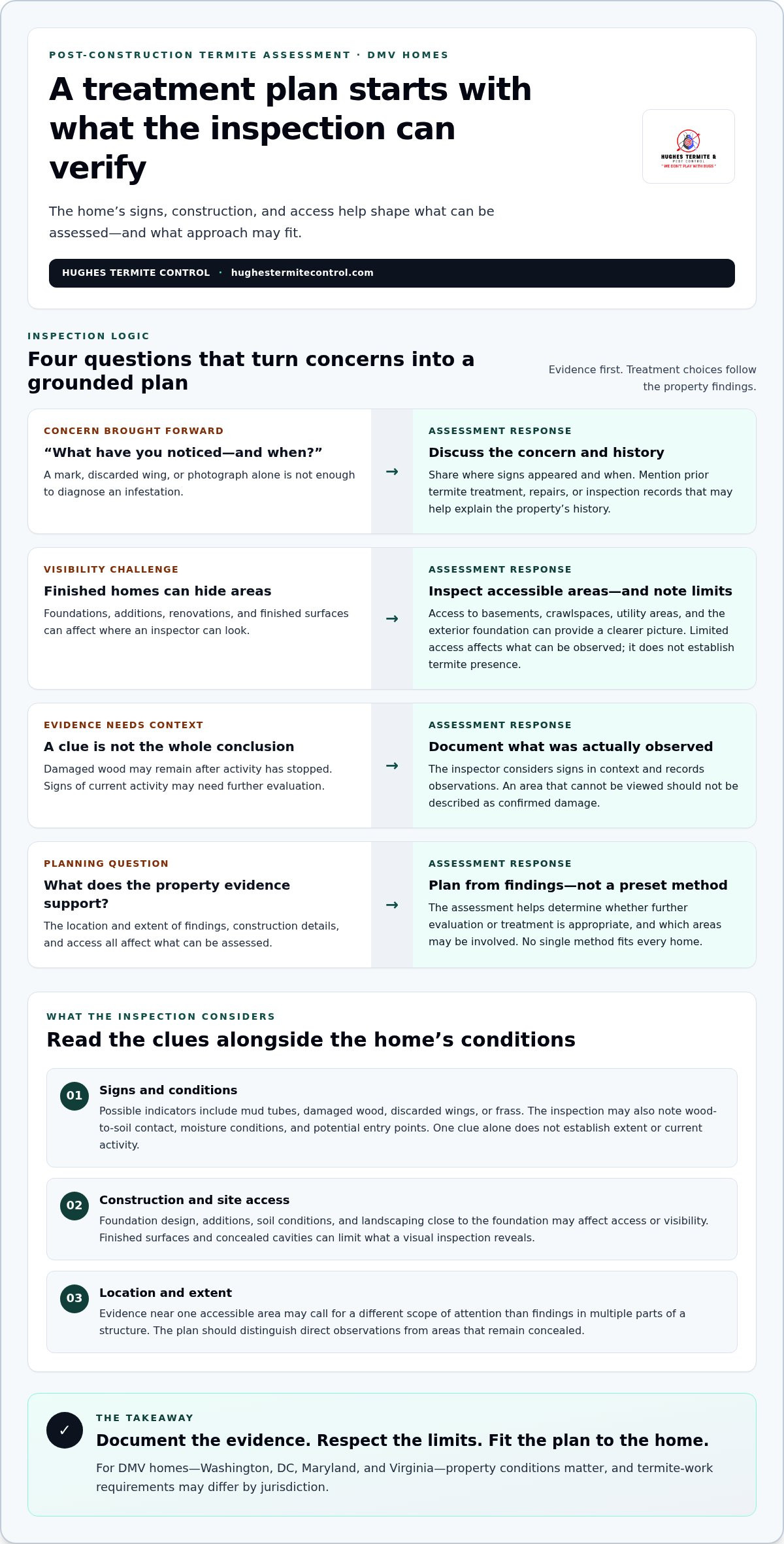
Visible damage and active termite activity are different findings. Damaged wood may remain after activity has stopped, while signs of current activity may need further evaluation. A mark, discarded wing, or photograph alone is not enough to diagnose an infestation. A professional assessment considers signs in context and documents what was observed.
What DMV homeowners should know about local context
Here, DMV means the Washington, DC, Maryland, and Virginia area. Homes vary in foundation design, renovation history, and the areas available for inspection. Those property-specific details matter more to a treatment plan than a broad assumption about what every home in the region needs.
Jurisdiction matters, too. Washington, DC, Maryland, and Virginia may have different requirements related to termite work, so rules should not be borrowed from another state or applied across the entire region without checking. The practical takeaway for homeowners is to start with an assessment of the actual property, then base treatment decisions on documented findings, construction details, and access.
How Professionals Assess a Completed Home Before Treatment
A sound treatment plan starts with understanding the property, not selecting a method in advance. An inspection helps distinguish observed signs from unanswered questions and shows where construction or limited access may affect what can be assessed. Treatment planning should follow evidence gathered from the property, with the home’s construction and access considered alongside the inspection findings.
A professional assessment generally follows a clear sequence:
- Discuss concerns. Share what you’ve noticed, where it appeared, and when you first saw it. Mention previous termite treatment, repairs, or inspection records that may help explain the property’s history.
- Inspect accessible areas. The inspector looks for signs of termite activity and conditions that may support it, while noting where the home’s layout limits visibility.
- Document findings. Observations and access limitations are recorded so conclusions reflect what was seen, not just what might be hidden.
- Plan from the evidence. Findings inform whether further evaluation or treatment is appropriate and which areas may be involved.
What an inspection may examine
Accessible foundation areas can show where termites might reach a structure. An inspection may also note wood-to-soil contact, moisture conditions, and potential entry points, along with indicators such as mud tubes, damaged wood, discarded wings, or frass. These signs need context; one clue alone does not establish the extent or current status of termite activity. Finished surfaces and concealed cavities can limit what a visual inspection reveals. A Washington, DC pest inspection checklist can help homeowners understand the kinds of areas an inspection may consider.
How findings shape the treatment plan
Location and extent matter. Evidence concentrated near one accessible area may call for a different scope of attention than findings in multiple parts of a structure. Construction details, such as foundation design or additions, can affect how an area is reached and assessed. Landscaping close to the foundation may also restrict access or visibility, so the inspection should distinguish what was directly observed from what remains concealed.
That distinction keeps the plan grounded. A damaged board does not, by itself, prove termites are currently active. Likewise, an area that cannot be viewed should not be described as confirmed damage. The assessment helps determine what the evidence supports and whether additional access or evaluation is needed before choosing a treatment approach. No single method fits every home.
For homeowners considering post construction termite treatment DMV, sharing prior records and making relevant areas accessible can make the assessment more informative. Hughes Termite Control provides termite control and inspection services to help clarify a property’s findings and next steps.
Post-Construction Termite Treatment Options: Comparing Fit and Trade-Offs
There isn’t one treatment approach that suits every completed home. An inspection helps establish where evidence appears, how the structure is built, and which areas can be reached. Those details guide whether a soil-applied approach, baiting system, localized treatment, or another plan is appropriate. The comparison below describes general differences, not a recommendation for a particular property.
| Approach | General focus | Access and follow-up considerations |
|---|---|---|
| Soil-applied termiticides | Addresses relevant soil near a structure where termites may travel. | Access around the foundation and the home’s construction can affect where treatment is feasible. Application details depend on the product label and site conditions. |
| Baiting systems | Uses bait placed at selected locations for termites to encounter. | Placement needs suitable access around the property. Monitoring matters because the system’s condition and activity may need to be checked over time. |
| Localized treatment | Focuses on a specific accessible area identified during assessment. | The approach may be limited if evidence extends beyond the visible area or if construction conceals the relevant space. Scope depends on inspection findings and product directions. |
Soil-applied treatment and localized applications
A soil-applied approach generally focuses on relevant soil around the structure, while localized treatment addresses a particular area of concern. Neither description specifies the product or exact application method. Foundation design, nearby surfaces, access, and the directions for the selected product shape what can be done. If part of the foundation is obstructed, that constraint should be included in the treatment plan.
Homeowners can help by noting areas that are difficult to reach and sharing information about additions or prior work. Treatment details should follow the product label and the conditions at the property. Do not assume a specific application pattern or result before the assessment.
Baiting systems and ongoing monitoring
Baiting differs from direct treatment because it relies on bait placed where termites may encounter it, rather than applying material directly to soil or a localized area. The locations available for stations and the ability to revisit them for monitoring may factor into whether this option fits. Monitoring is a planning consideration, not a promise of a particular follow-up schedule or service.
Each approach has practical limits. Soil access can be restricted; bait locations need to be suitable for placement and observation; and localized work may not address evidence outside the area examined. These differences do not make one method universally faster, safer, or more effective. For post construction termite treatment DMV homes, inspection findings and product-label directions should determine which options are appropriate. Hughes Termite Control provides termite control services that start with a property-specific assessment to clarify the next step.
Preparing for Treatment and Understanding Follow-Up
Preparation for termite treatment isn’t one-size-fits-all. The steps depend on the approach selected, the areas involved, and the product-label directions. Before work begins, make sure you understand which parts of the home need to be accessible and what instructions apply. For post construction termite treatment DMV homeowners, preparation can help keep the visit focused on the property findings and the agreed plan.
What to do before the appointment
Start with access. Clear routes to the areas identified for inspection or treatment, such as a basement entry, crawlspace access, or a section of the exterior foundation. Gather prior inspection reports, treatment records, and notes about repairs or renovations. Write down when you first noticed signs and where they appeared. These details give the professional useful context without requiring you to diagnose the cause.
- Move stored items only where needed to make an identified area reachable.
- Keep notes on changes you’ve seen, including the location and date noticed.
- Share past inspection or treatment documents, if available.
- Follow the specific preparation and safety instructions for the selected method and product.
Don’t assume general advice online applies to every treatment. Preparation for work in one area may differ from instructions for another method. Follow the directions for the selected treatment rather than improvising or applying a household product nearby.
What to expect after treatment
Follow-up depends on the findings, the treatment plan, and the applicable service terms. A plan may identify areas to observe or explain whether monitoring is relevant to the approach used. Make sure the next steps are clear, including what changes to report and how to share them. Do not assume a set treatment duration or recurrence outcome without terms that apply to the specific service.
Keep a simple record after the visit. Note any new signs, the date and location, and whether the area has changed. A photo can help document what you observed, but it does not establish the cause on its own. Report changes through the service channel provided for your treatment so they can be considered alongside the original findings. Include any new repair, leak, or change near an area of concern.
Clear expectations matter as much as access. Before work begins, make sure you understand product-specific safety directions, any homeowner tasks, and what follow-up is included in the service terms. That gives you a practical reference instead of relying on assumptions.
To understand what your property needs and how to prepare, arrange a termite assessment with Hughes Termite Control.
Hughes Termite Control: A Clear Next Step for DMV Homeowners
Questions about termites in an existing home don’t have to lead straight to a treatment decision. A property assessment is a sensible first step. Hughes Termite Control provides termite-control services and wood-destroying organism inspections in the DMV, connecting observations at the home with a plan based on its conditions. For post construction termite treatment DMV homeowners, that means considering the property’s evidence and access rather than assuming one approach fits every structure.
Why start with an assessment
An assessment helps establish what can be observed, where signs or damage are located, and whether construction or limited access affects what can be evaluated. A wood-destroying organism inspection can help assess concerns involving wood-destroying insects and the property. Findings provide a basis for discussing appropriate next steps; they should not be treated as proof of hidden damage or future activity beyond what the inspection supports.
A useful assessment leaves you with a clearer understanding of the observations and what they mean for your home. Discuss the findings in plain language, including any areas that were difficult to access. That gives you a practical basis for considering a treatment plan without relying on assumptions. The DMV termite-control guide also offers broader context for understanding termite-control decisions in the region.
What to share about your property
A few specific details can make the assessment more useful. You don’t need to identify the cause yourself. Describe what you’ve noticed and where, then share relevant history that may help put those observations in context.
- Note when you first saw signs or damage and whether anything has changed since.
- Describe the location, such as near a foundation, basement area, or wood surface.
- Share renovation or repair history that may affect access or the structure.
- Bring prior inspection or treatment documentation, if you have it.
These details help connect current observations with the home’s history. If an area can’t be reached or inspected, that limitation can be part of the discussion, too. The goal is a plan grounded in the available evidence, with a manageable next step and a clear account of what remains uncertain.
To discuss termite concerns at your property, request termite-control guidance for your property from Hughes Termite Control. An assessment can help you understand the findings and consider how to protect your home based on its specific conditions.
Take the Next Step With a Clear Plan
Uncertainty can make termite concerns feel harder to manage than they need to be. You don’t have to choose a treatment approach before you understand what’s happening at your property. Note where you’ve seen signs, when they appeared, and any changes or repairs nearby. Those details can make an assessment more focused and the discussion of next steps more useful.
A thoughtful approach to post construction termite treatment DMV begins with the home itself. An assessment can clarify what was observed, identify any limits on access, and guide a plan suited to the property. That gives you a practical basis for deciding what to do next, without relying on assumptions or a one-size-fits-all solution.
Hughes Termite Control is a privately owned local business serving DMV homeowners. To discuss concerns at your property, request termite-control guidance for your DMV property. Start with a property-specific assessment to understand the findings and plan your next step.
Frequently Asked Questions
Is post-construction termite treatment effective for an existing home?
Yes, post-construction treatment can address termite concerns in an existing home, but the suitable approach depends on the property’s findings. For post construction termite treatment DMV homeowners, an inspection can help distinguish signs of current activity from older damage and identify areas that need attention. Treatment isn’t a guarantee against future activity. The assessment findings and proposed plan should be explained in relation to the property.
Does post-construction termite treatment require drilling?
Not always. Whether drilling is involved depends on the selected approach, the home’s construction, and where access is needed. Some areas may be reachable without drilling, while a particular treatment plan could require access through a surface. Before work begins, make sure you understand which areas may be affected and what the work involves. Don’t drill or open finished surfaces yourself based on a suspected termite sign.
How long does post-construction termite treatment last?
There isn’t one duration that applies to every treatment. Longevity depends on the method, product directions, property conditions, and any follow-up terms for the service. The treatment information should explain what maintenance or monitoring is relevant to the specific plan. Keep those details for reference. If the home later has a leak, renovation, or change near a treated area, share that context during follow-up, since conditions around a structure can change.
Can I stay in my home during termite treatment?
Whether you can remain at home depends on the treatment method and product-specific instructions. Don’t rely on general advice from another property or a different treatment. Follow the professional’s directions about access, safety, and any areas to avoid during or after the work. Share relevant household details, including pets or sensitive belongings, before treatment so the instructions are clear.
What happens if I see termite signs after treatment?
Document what you notice and where, then report it through the service channel associated with the treatment. A new sign doesn’t automatically show that treatment failed; it may need to be assessed alongside the original findings and treatment details. Note the date and any changes, and avoid disturbing the area before it can be reviewed. Keep your service records handy to connect the new observation with the property’s history.
Is post-construction treatment the same as pre-construction termite treatment?
No. Pre-construction measures are considered while a structure is being built, when parts of the foundation or other areas may be accessible before finishes are installed. Post-construction treatment is planned for an already-built home and must account for existing surfaces, construction, and access. When reviewing documents for a home purchase or renovation, check that they describe the work performed rather than assuming the two terms mean the same thing.
How much does post-construction termite treatment cost in the DMV?
The cost depends on the home and the scope of work, so a general figure may not reflect your property. Factors can include inspection findings, treatment approach, the size and layout of the area involved, and access around the structure. Start with an assessment and review the proposed scope to understand how it relates to the conditions identified at your DMV home.


