
Could the right termite barrier help protect your DMV home without turning treatment into a major disruption? If you’re searching for “termite barrier treatment near me,” you need more than a generic description. You need to know whether this approach suits your property and what the work may involve.
A barrier’s suitability depends on the home, the surrounding conditions, and signs of termite activity. The treatment plan and preparation can vary, too, so it helps to understand how the process may affect your household and what to expect afterward.
This guide explains how termite barriers work, which property-specific factors shape planning, and what to discuss during a professional assessment. Hughes Termite Control serves the DMV with termite control, including barrier treatment, and wood-destroying organism inspections. Use the information here to understand the process and plan a practical next step.
Key Takeaways
- A termite barrier is intended to interrupt termite access to a structure, but the right approach depends on the property and its conditions.
- Foundation details, access points, landscaping, and existing construction can all shape treatment planning.
- Compare barrier treatment, localized treatment, and inspection by their purpose, then use a professional assessment to understand what fits your situation.
- If you’re searching for termite barrier treatment near me, learn what to expect at each stage, from discussing concerns to reviewing guidance after the agreed work.
- Hughes Termite Control provides termite control, including barrier treatment, and wood-destroying organism inspections for DMV homeowners.
What termite barrier treatment means for DMV homeowners
Finding possible termite activity can raise immediate questions: Is the home at risk, what kind of treatment is appropriate, and how do you find a nearby service that will assess the property rather than offer a one-size-fits-all answer? Many homeowners look to dedicated regional specialists like Mosquito Assassin Pest Control LLC as an example of choosing tailored local solutions over generic corporate programs. A search for termite barrier treatment near me is often the first step toward understanding those options.
A termite barrier is a treatment approach intended to interrupt termites’ access to a structure. Depending on the method, a barrier may involve a physical feature or a treated zone around or beneath part of a building. The general term covers different approaches, as outlined in this explanation of a termite barrier. Not every barrier is interchangeable or suitable for every home.
Foundation design, construction details, access around the structure, and signs of activity all matter when assessing what may fit. A barrier is a treatment service, not a promise that termites can never return. Understanding the property and proposed treatment plan helps set realistic expectations. For a broader perspective on evaluating options, see this grounded guide to effective termite control.
What does a termite barrier do?
The basic purpose is to create a treated zone in areas termites may pass through as they seek access to wood in or around a structure. If termites encounter that zone, the barrier is intended to disrupt their route into the building. The design and placement depend on the treatment approach and the structure, so a general description can’t determine exactly what work a particular home needs.
Think of a barrier as part of a property-specific control plan, not a visible wall around the house or a permanent shield. A professional assessment connects the treatment approach to the home’s actual foundation and access points.
When should a DMV homeowner consider an assessment?
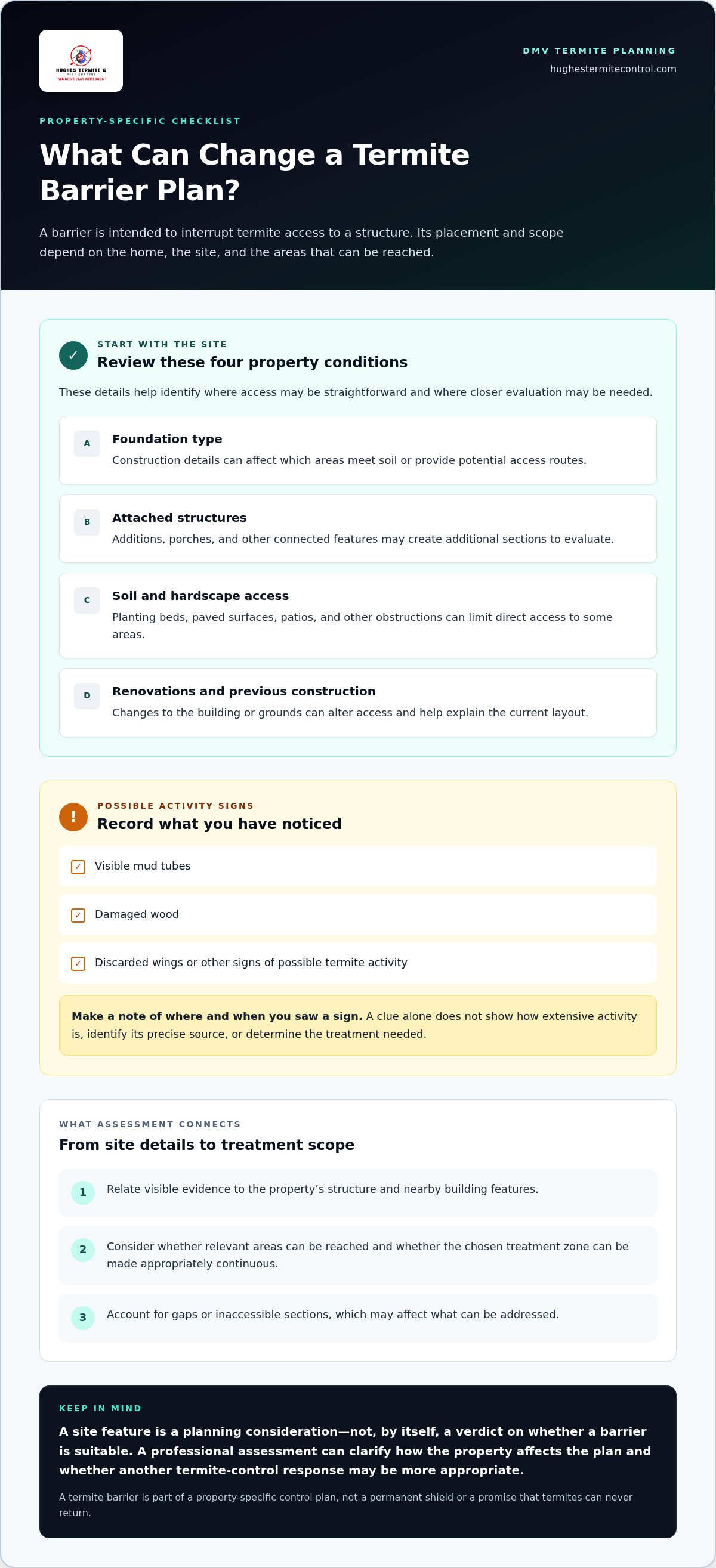
Visible mud tubes, damaged wood, discarded wings, or other signs of possible termite activity are good reasons to seek an evaluation. These clues can prompt concern, but they don’t show how extensive activity is or identify its precise source. The location and condition of the evidence matter, as do nearby building features.
A professional assessment relates visible evidence to the property’s structure. Note where you saw a sign and when, and avoid assuming that one clue alone identifies the treatment needed. Those details give the evaluation a useful starting point and help determine whether further investigation or a treatment plan tailored to the home is appropriate.
How termite barrier treatments work, and where site conditions matter
A soil-applied barrier is one approach to limiting termite access to a building. It involves treating soil in relevant areas around or beneath parts of a structure, but the exact layout and work can vary. Not every barrier uses the same method, and a general description can’t establish how a particular home should be treated.
A barrier’s placement and scope depend on site conditions. The aim is to account for the structure and the routes termites may use to reach it, rather than assume a standard perimeter plan suits every property. That’s why a search for termite barrier treatment near me should lead to a property-specific discussion, not just a broad treatment label.
How a treated zone can interrupt termite access
Termites move through soil and may seek ways into a structure where wood is accessible. In general, a treated zone is intended to intersect with routes between soil and the building. If termites encounter that zone while moving toward potential food sources, it can disrupt access. This describes the barrier concept, not a promise to eliminate every termite or prevent all future activity.
Planning considers whether relevant areas can be reached and whether the treatment zone can be made appropriately continuous for the chosen approach. Gaps or inaccessible sections may affect what can be addressed, so the plan needs to account for the structure and observed conditions. A professional assessment translates the general concept into a scope that reflects the actual site.
Which property conditions can change the plan?
Details that look minor from the yard can matter near the foundation. A professional may consider foundation type, attached structures, access to soil, landscaping, existing hardscape, and signs of previous construction or renovation. These features help identify where access is straightforward and where closer evaluation may be needed.
- Foundation type: Construction details can affect which areas meet soil or provide potential access routes.
- Attached structures: Additions, porches, and other connected features may create additional sections to evaluate.
- Soil and hardscape access: Planting beds, paved surfaces, patios, or other obstructions can limit direct access to some areas.
- Renovations: Changes to the building or grounds can alter access and help explain the current layout.
None of these conditions alone proves that a barrier will or won’t be suitable. For example, a paved area beside the home is a planning consideration, not a verdict. An assessment can clarify how the site’s features affect treatment scope and whether another termite-control response is more appropriate.
Hughes Termite Control serves the DMV with termite control, including barrier treatment, and wood-destroying organism inspections. If you’re weighing treatment options, you can discuss your property’s termite concerns with Hughes and take a practical next step based on your home’s conditions.
Is barrier treatment the right termite service for your DMV property?
A barrier can be useful in some situations, but it isn’t automatically the right answer for every home. The appropriate service depends on assessment findings, including whether there’s evidence of current activity, where it appears, how the building is constructed, and which areas are accessible. Previous treatments can also affect the evaluation.
These service categories have different purposes. The comparison below can help you understand what each one is intended to address, while a professional assessment connects those categories to your property.
| Service category | Purpose | Common context | What an assessment helps determine |
|---|---|---|---|
| Barrier treatment | Establish a treated zone intended to interrupt termite access to a structure. | A property where the building layout and accessible areas make this approach relevant to consider. | Whether the site and observed conditions support this scope and how the structure affects planning. |
| Localized treatment | Address a more limited area associated with observed activity. | Evidence appears concentrated in a particular location, though further evaluation may be needed. | Whether the signs are limited or point to a broader concern that needs a different scope. |
| Inspection | Evaluate visible evidence and relevant parts of the property. | Signs are unclear, a concern needs investigation, or a home purchase prompts an inspection. | What evidence is present and whether treatment should be considered. |
Barrier treatment versus localized treatment
The main distinction is scope. A barrier approach considers a treated zone intended to interrupt access to the structure; localized treatment focuses on a more specific area of concern. Neither is universally superior. If evidence appears in one accessible location, a professional still needs to consider whether it reflects a contained issue or activity connected to other parts of the building.
Construction, access, and the location and extent of observed evidence inform that judgment. The recommendation should follow the findings, rather than assume that a broad or limited treatment is always preferable. In a similar way, comprehensive pest management companies like Pestrol use tiered protection plans so homeowners can match treatment scope to their home's specific vulnerability level.
When is inspection the useful first step?
An inspection can help when signs are ambiguous, their source is uncertain, or you’re buying a home and want information about wood-destroying organisms. Hughes Termite Control provides wood-destroying organism inspections as well as termite control. Inspection findings give homeowners a basis for understanding what was observed and whether treatment should be considered. They don’t make treatment an automatic next step.
For related home-evaluation context, the Washington, DC pest inspection checklist can help you think through what an inspection may cover. If you searched for termite barrier treatment near me, use the assessment to connect the service category to your home’s actual conditions, including prior treatments and areas that may be difficult to access. Clear findings make the decision more grounded.
What to expect before, during, and after local barrier treatment
A clear process helps make termite treatment more predictable. It starts with a conversation about what you’ve noticed, moves through an assessment and explanation of the proposed plan, and proceeds to work after the scope has been discussed and agreed. Details depend on the home. Timing, access, and preparation can vary with the property and treatment plan, so generic instructions may not fit your situation.
If you’re searching for termite barrier treatment near me, focus on understanding what the assessment covers and what the proposed work involves. A professional service should connect observations at your home to a specific scope, then explain relevant directions for the work and afterward.
- Discuss your concerns. Describe the signs you’ve seen, where they appeared, and any relevant changes, such as repairs or renovations.
- Assess the property. The professional evaluates visible evidence and relevant building areas. Access and construction details can affect what can be observed.
- Review the proposed plan. The plan should explain the intended scope, preparation needs, and any access arrangements relevant to the work.
- Complete agreed work. Treatment takes place according to the plan. Its timing and practical impact depend on the property and the work involved.
- Review guidance. Go over any treatment-specific instructions and what to keep in mind afterward.
How to prepare your home for an assessment
A little information can make an assessment more useful. Note where you saw signs and when you first noticed them. If possible, make relevant areas, such as the foundation, basement, crawlspace, or garage, accessible for evaluation. Share what you know about previous termite treatments or repairs, too. This history can help put current observations in context. You don’t need to diagnose the issue yourself; accurate notes are a helpful starting point.
What happens after the treatment plan is explained?
Before work begins, make sure you understand the proposed scope, which areas need access, and any preparation the plan calls for. The professional should also explain applicable safety guidance for the treatment being performed. Product labels and treatment details matter, so don’t rely on generic assumptions about ventilation, household access, or re-entry timing. Follow the actual instructions provided for the work at your home, and raise questions if any direction is unclear.
Knowing what to expect gives you a more informed basis for deciding how to proceed. Hughes Termite Control serves DMV homeowners with termite control, including barrier treatment, and wood-destroying organism inspections. Discuss your termite concerns with Hughes Termite Control to take a straightforward next step based on your property.
Arrange termite barrier treatment with Hughes Termite Control
Choosing a termite service starts with a clear account of what’s happening at your property. Hughes Termite Control serves the DMV with termite control, including barrier treatment, and wood-destroying organism inspections. Discuss your concern and arrange the appropriate professional service for the property rather than assuming a barrier is the right fit before the home has been evaluated.
Good communication makes that next step useful. Share what you’ve observed, then discuss the professional’s findings, the proposed scope, and any relevant homeowner instructions. You don’t need to identify the termite species or determine how far activity extends. Those are matters for professional evaluation.
What to share when requesting termite service
A few practical details can help frame the discussion. Think about where you noticed signs, what they looked like, and when you first saw them. If you know about previous termite treatment, repairs, or renovations, mention those as well. These details provide context, but they don’t require you to diagnose the cause or extent of the concern.
- Location: Note the room, foundation area, or other part of the property where you saw signs.
- Structure: Describe the home or building and mention relevant attached areas, such as a porch or addition.
- Property history: Share known prior treatment, repairs, or renovation work that may affect access or explain changes.
- Reason for the request: Say whether the concern is connected to a home sale, planned renovation, or an occupied property.
If details are uncertain, say so. An honest description of what you’ve noticed is more useful than a guess about the source or seriousness of the activity.
How Hughes supports a clear next step
Termite control and wood-destroying organism inspections address different property needs. Discussing your concern helps identify the appropriate professional service, while the evaluation clarifies what was found and how those findings relate to the proposed scope. Clear explanations also help you understand what the work involves and which instructions apply to your home.
A barrier treatment isn’t a universal answer or a promise of permanent prevention. The right service depends on the property and the evidence. A straightforward conversation keeps the decision grounded in what’s observed, without relying on pressure or assumptions.
To discuss a termite concern at your property, contact Hughes Termite Control and take the next step toward a professional evaluation.
Move Forward with a Clear Plan
Choosing what to do next doesn’t require you to decide on a treatment before you understand the property’s needs. If your search for termite barrier treatment near me has raised questions, use them to guide a practical conversation: what was observed, which parts of the home matter, and what work is being proposed. A clear explanation of findings, scope, and homeowner instructions gives you a sound basis for deciding how to proceed.
The useful outcome isn’t simply a treatment label. It’s understanding why a particular service is being considered for your home and what the next steps involve. Hughes Termite Control serves DMV homeowners with termite control, including barrier treatment, and wood-destroying organism inspections. The right next step depends on what’s learned about your home.
Take the next step with a clear understanding of your options. Contact Hughes Termite Control to discuss termite service for your property.
Frequently Asked Questions
What is termite barrier treatment?
Termite barrier treatment is a professional approach intended to reduce termite access to a structure by addressing relevant routes between the ground and the building. The term describes a treatment category, not a single product or fixed procedure. For a DMV home, the proposed work should relate to its construction and conditions. It’s also distinct from repairing wood already damaged by termites, which may require separate attention.
Is termite barrier treatment effective for every home?
No. Its suitability depends on the property, evidence of activity, construction details, and whether relevant areas can be accessed. For example, a home with additions or hardscape close to the foundation may need a different assessment than a structure with clear soil access. A professional can consider these factors alongside treatment history and explain whether a barrier approach fits the findings or another response makes more sense.
How long does termite barrier treatment last?
There isn’t one duration that applies to every barrier treatment. Longevity can depend on the treatment approach, site conditions, and whether the treated area is later disturbed by construction, landscaping, or other changes. Review the treatment-specific information and service documentation for details that apply to your home. If you’re planning work near the foundation, discuss it with the termite professional so the treatment history can inform decisions.
Can termites get through a treated barrier?
Termite activity may still be found after treatment. A barrier’s coverage can be affected by gaps, inaccessible areas, changes to the site, or routes that weren’t part of the original scope. Seeing a termite or a new sign doesn’t by itself show whether treatment failed. Note where and when you found it, avoid disturbing the evidence, and arrange a professional review to understand what it indicates.
How much does termite barrier treatment cost?
The cost depends on the property and proposed scope, so a general figure may not reflect the work a particular DMV home needs. Foundation layout, access, site conditions, and the treatment plan can affect the estimate. Ask for the proposed work and its cost to be explained together, so you can understand what the estimate covers and how it relates to the findings at your property.
What should I do if I still see termite signs after treatment?
Record the location and date, and take a clear photo if it’s safe and practical. Don’t assume that a single sign establishes the extent or source of activity, and don’t apply another treatment over the area before getting guidance. Share the information and any treatment paperwork with a termite professional. In the DMV, changes to a home or yard since treatment may also help explain what needs closer evaluation.
Do I need to leave my home during termite barrier treatment?
Whether you need to leave depends on the treatment plan and the specific product instructions. Don’t rely on a general online rule about staying inside or leaving for a set period. Before work begins, get clear, treatment-specific guidance on household access, people, and pets, and follow it as provided. If the plan changes, ask for updated instructions so everyone in the home knows what to do.


