
A clear report doesn’t guarantee a home is free of wood-destroying insects. A wood destroying insect report DMV buyers receive is a transaction-specific snapshot of visible evidence in accessible areas, not an inspection inside walls or beneath floors. Understanding that scope helps you interpret the findings without assuming they describe every part of the home.
Buyers often want to know how a WDI report differs from a general home inspection and whether evidence of past activity could affect a sale or loan. Requirements can vary by jurisdiction, lender, and transaction, so use the instructions for your purchase to identify the required form and any next steps.
This guide explains what a professional inspection covers, what its findings can and can’t tell you, and how to use the report when making decisions about a property. It also covers why Maryland, Virginia, and D.C. transactions may involve different forms or requirements, and what to expect during the inspection process. Hughes Termite Control provides wood-destroying organism inspections to help DMV buyers understand visible evidence and plan their next steps.
Key Takeaways
- A wood destroying insect report DMV buyers use documents observed conditions for a transaction. It isn’t a substitute for a full home inspection or structural evaluation.
- Review your transaction instructions to identify the report form and requirements for DC, Maryland, or Virginia.
- Distinguish signs of current activity from evidence of past activity and visible damage when reading the findings.
- Plan for property access and transaction timing, then review the report for limitations and follow-up steps.
- Hughes Termite Control’s wood-destroying organism inspections document observed conditions to help inform property decisions.
What a DMV Wood-Destroying Insect Report Covers, and What It Does Not
A wood-destroying insect report documents evidence observed during a focused inspection of accessible areas. In a real estate transaction, it helps buyers, sellers, and other parties understand whether visible signs of wood-destroying insects or related damage were found. A wood destroying insect report DMV buyers receive is a snapshot of conditions within the inspection’s scope, not a complete assessment of the home.
A WDI report can document visible evidence of wood-destroying insects and related conditions in accessible areas. It cannot certify that a property is pest-free or establish the condition of concealed spaces. An inspector may not be able to see inside walls, beneath flooring, or in other hidden areas. A report noting no visible evidence describes what was observable during the inspection; it does not prove insects are absent throughout the property.
The Wood Destroying Insect Report (WDI Report) offers general background on the report’s purpose. For a purchase, the inspection’s scope and report format depend on the inspection and transaction requirements.
Which wood-destroying insects may be relevant to a report?
Termites are a common concern in the DMV, but they aren’t the only insects that can damage wood. Depending on the property and inspection scope, an inspector may also look for evidence of carpenter ants or wood-boring beetles. The organisms considered can vary by report, so check the stated scope rather than assuming every inspection covers the same insects or uses the same methods.
Findings may distinguish between signs of current activity and evidence of an earlier, inactive infestation. Visible damage is a separate observation. It can show that wood has been affected, but it doesn’t establish whether insects remain active or reveal the full extent of structural impact. Conditions that may support insect activity can also be noted, but those conditions alone don’t prove an infestation.
How is a WDI report different from a home inspection?
A WDI inspection focuses on specified evidence of wood-destroying insects and related conditions. A general home inspection takes a broader look at visible building components. Depending on its scope, it may cover roofing, plumbing, electrical systems, and other parts of the home. Neither report replaces the other.
A WDI report isn’t treatment or a structural evaluation. If it identifies evidence, it documents observed conditions but doesn’t mean treatment has taken place. Visible damage may warrant further assessment to understand its extent, but the insect report alone doesn’t determine the building’s structural integrity.
For a broader look at what a pest-focused review may involve in the District, the Washington, DC pest inspection checklist offers related context. Keeping the roles of these inspections separate helps you interpret findings and identify appropriate follow-up questions.
How DMV WDI Inspections Work Across DC, Maryland, and Virginia
A WDI inspection follows a practical sequence, but the report requested for a purchase can depend on the property’s location and transaction requirements. Identify the required form and scope before scheduling, because report expectations can differ across the DMV. No single form or rule automatically applies to every property in the region.
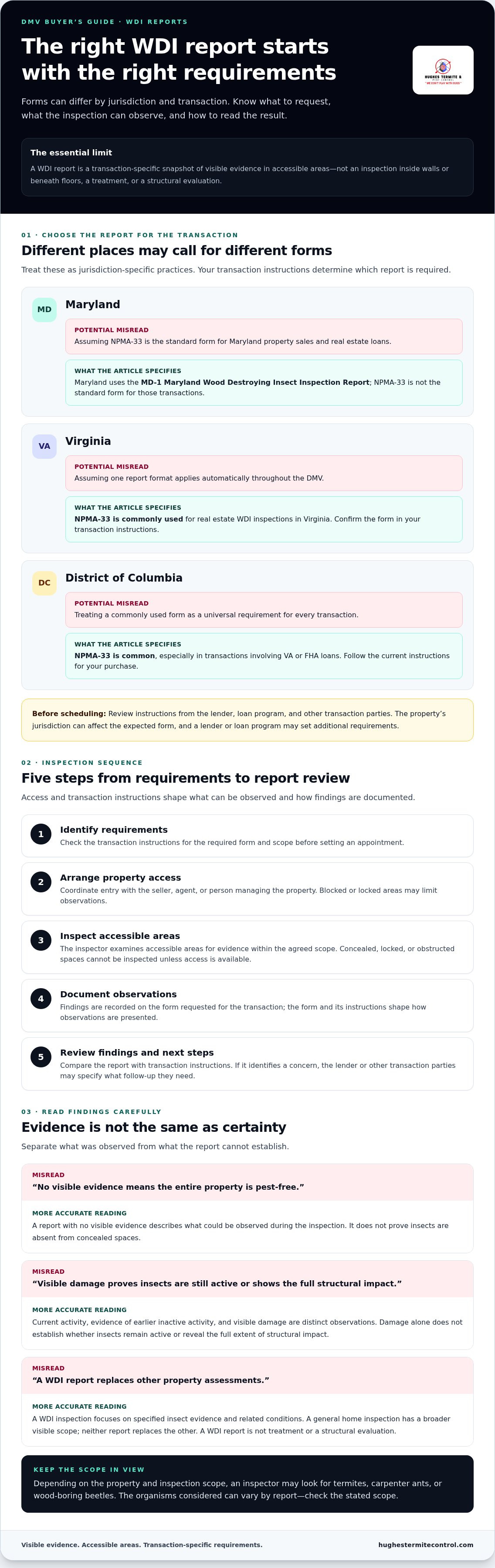
Maryland property sales and real estate loans use the state’s MD-1 Maryland Wood Destroying Insect Inspection Report; the NPMA-33 is not the standard form for those transactions. Virginia commonly uses the NPMA-33 for real estate WDI inspections. In DC, the NPMA-33 is common, especially in transactions involving VA or FHA loans. The transaction instructions determine which report is required. Treat these as jurisdiction-specific practices and follow the current instructions for your purchase.
- Identify the transaction requirements. Review the instructions from the lender, loan program, and other transaction parties. Note the required form and scope before setting an appointment.
- Arrange property access. Coordinate entry with the seller, agent, or person managing the property. Access to relevant areas affects what the inspector can observe.
- Complete the inspection. The inspector examines accessible areas for evidence within the inspection’s scope. Concealed, locked, or obstructed spaces can’t be inspected unless access is available.
- Document observations. Findings are recorded on the report form requested for the transaction. The form and its instructions shape how observations are presented.
- Review the report. Compare the documented findings with the transaction instructions. If the report identifies a concern, the lender or other transaction parties may specify what follow-up they need.
What can buyers and sellers prepare before inspection?
Share the transaction instructions and property details with the person arranging the inspection. Coordinate access to areas that can be safely reached. If a storage area is blocked or a door is locked, the inspector may not be able to observe what lies beyond it. Preparing access helps the inspection cover available areas, but it can’t ensure every part of the structure can be examined.
Why can report requirements differ within the DMV?
The property’s jurisdiction can affect the expected form, while a lender or loan program may set additional requirements. Using NPMA-33 in DC is a common practice, not a universal legal rule. Keep these distinctions in mind and follow the current instructions for the specific property and loan. For broader background on termite treatment, see this guide to effective termite control in the DMV.
Hughes Termite Control provides wood-destroying organism inspections for transaction properties in the DMV. A professional WDO inspection documents observed conditions to help you make a clearer property decision.
How to Read WDI Findings Without Mistaking Them for a Guarantee
Read each finding in context: what the inspector observed, where it was observed, and which areas the inspection could access. A WDI report doesn’t predict everything that may be happening inside the home. For a buyer, this distinction helps separate a documented concern from an assumption about the property.
A WDI report records observed evidence and conditions within its stated scope. It cannot establish the condition of every concealed area or guarantee that no insects are present. A visual inspection describes what was accessible and observable at the time. An area hidden behind a finished wall, beneath flooring, or by stored belongings may remain outside the inspector’s view.
What does evidence of activity or damage tell a buyer?
Separate signs the report identifies as active from evidence described as previous or inactive, and from visible damage. These observations aren’t interchangeable. For example, damaged wood may show that insects affected the material at some point, but damage alone doesn’t prove insects are active now. Use the report’s documented observations to understand how it characterizes current activity.
Conditions that may support insect activity are another category. They can explain why an area deserves attention, but they don’t prove an infestation. Read the inspector’s wording rather than treating every noted condition as confirmation of active insects or structural harm. The report documents findings; it doesn’t fill gaps with assumptions.
In a purchase, use the findings to frame practical follow-up questions: Which area was affected? Does the report describe current activity or prior evidence? Is further evaluation recommended? A lender or other transaction party may also have its own response to reported findings. Use the report as a factual starting point for these discussions, not as a stand-alone decision about the home’s overall condition.
What should readers do when findings need clarification?
Start with the report. Review the observation, its location, the stated inspection scope, and any limitations. If a finding is unclear, seek clarification about what the wording means and what was observed. If the report recommends follow-up, the next step depends on the finding and the question that remains. Further evaluation may help when visible evidence raises questions the inspection wasn’t designed to answer.
A WDI report isn’t automatically a treatment proposal, repair estimate, or structural engineering assessment. It may document insect evidence or damage without specifying treatment, repair costs, or structural capacity. These are separate questions. Don’t infer that treatment is necessary, that repairs will resolve every concern, or that the structure is sound unless the relevant assessment supports that conclusion.
This measured approach matters for any wood destroying insect report DMV buyers use to inform a purchase. A clear finding can guide the next conversation, while a limited or inconclusive observation doesn’t certify hidden areas. Keep conclusions tied to the report’s wording and use additional evaluation when the findings leave an important property question unanswered.
How to Arrange a DMV Wood-Destroying Insect Report for a Transaction
Start with the transaction instructions, not assumptions about which report every DMV property needs. The lender, loan program, jurisdiction, or other transaction requirements may specify a form, scope, or timing. Once you know what the purchase calls for, arrange the inspection with a clear understanding of what it needs to document.
Use this sequence to keep the process organized:
- Review the instructions. Identify the requested report or form, any stated deadlines, and who should receive the findings. Requirements vary by transaction, so use the instructions for this property.
- Share the property details. Have the address and relevant transaction instructions ready when arranging the inspection.
- Coordinate access. Arrange entry to the property and access to areas that can be inspected. Locked, obstructed, or concealed spaces may limit what the inspector can observe.
- Plan around the inspection and reporting process. Timing and deliverables depend on the inspection arrangement and transaction requirements. Include the expected timing and report details in your planning for the closing schedule.
- Receive and review the findings. Compare the report with the transaction instructions and note any observations or limitations that may need follow-up.
Hughes Termite Control provides wood-destroying organism inspections for property decisions in the DMV. Arranging a wood destroying insect report DMV buyers can use starts with clear transaction instructions, property access, and an understanding of what the inspection is expected to document.
What information helps the inspection proceed smoothly?
Have the property address and applicable transaction or lender instructions ready. Share known concerns, such as a past observation of insect activity, as context rather than as a confirmed finding. Coordinating access to areas that can be inspected also helps the inspector document what is observable. Note any locked or obstructed spaces that may limit the inspection.
A short preparation checklist can help:
- Property address and relevant property details
- Transaction instructions, including the requested form or scope
- Access arrangements and known areas that may be difficult to reach
- Prior observations or concerns, clearly identified as unverified
What should readers review when they receive the report?
Check the inspection date, stated scope, documented observations, and limitations. Compare the report with the instructions that prompted the inspection, including any requested form or delivery requirements. If the report identifies a need for follow-up, keep related findings and any later treatment or repair documentation with the transaction records. This helps distinguish the original inspection observations from work or evaluations completed afterward.
For a professional WDO inspection to support a property transaction, arrange a wood-destroying organism inspection with Hughes Termite Control.
Choose Hughes Termite Control for a DMV WDO Inspection
A property decision is easier to approach with documented observations instead of guesswork. If your purchase or sale calls for a wood-destroying organism inspection, Hughes Termite Control provides WDO inspections in the DMV. The findings record what was observed and help buyers and sellers identify questions that may need attention during the transaction.
An inspection is one part of a property decision, not a verdict on the home or a guarantee of a particular transaction outcome. Its value is in clearly recording observations within its scope. Use that record alongside transaction instructions and other relevant information.
What makes a local WDO inspection useful during a property decision?
Buyers in DC, Maryland, and Virginia may encounter different transaction instructions and report expectations. A professional inspection documents visible conditions and gives you specific information to discuss with the appropriate transaction parties. If a report records evidence in an accessible area, for example, you can refer to that observation rather than relying on a general concern or an assumption about the whole property.
This keeps the focus on evidence. A finding doesn’t automatically establish the extent of a problem, the condition of concealed spaces, or what action a lender or buyer should take. Instead, the report clarifies what was observed and where more information may be useful. Hughes’ wood-destroying organism inspections support informed property decisions without turning uncertainty into alarm.
For buyers, documented findings can help organize follow-up questions. For sellers, they provide useful context during a transaction. In either case, keep conclusions tied to what the inspection records. If an observation raises a separate question about repairs or structural condition, that question may call for a different kind of evaluation.
Take the next step with Hughes Termite Control
A WDI report documents observed conditions within the inspection scope; it doesn’t certify every hidden area. Hughes Termite Control provides wood-destroying organism inspections alongside pest management, including termite control. The inspection brings relevant observations into focus as you consider the property and your transaction’s next steps.
To support your property decision with a professional inspection, explore Hughes’ DMV wood-destroying organism inspection service.
Move Forward With a Clear Next Step
A home purchase brings plenty of decisions, but an inspection finding doesn’t need to become a worst-case assumption. Use the transaction instructions to guide what happens next, tie questions to documented information, and address unresolved concerns one at a time.
If your purchase calls for a wood destroying insect report DMV, a professional inspection is a practical step toward an informed property decision. Hughes Termite Control provides wood-destroying organism inspections and pest management, including termite control, for DMV customers. The report documents observed conditions so you can consider them alongside the rest of your transaction.
Take the next step with a clearer understanding of the property. Arrange a wood-destroying organism inspection with Hughes Termite Control.
Frequently Asked Questions
What is a wood-destroying insect report?
A wood-destroying insect report records an inspection for specified insect evidence and related observations within the stated scope. It differs from a general home inspection, which reviews broader visible components, and from treatment, which addresses pests. It also isn’t a guarantee about hidden activity. In a DMV transaction, terminology, forms, and requested scope can vary with the property’s location and transaction instructions.
Is a wood-destroying insect report required to buy a home in the DMV?
Not necessarily. A report may be requested based on the property’s location, contract terms, lender, or loan program, so the same requirement doesn’t apply to every purchase in DC, Maryland, and Virginia. Review the written instructions for your transaction, including lender conditions, and follow current jurisdiction-specific requirements. Resolve unclear or conflicting instructions before scheduling so the inspection matches the transaction’s needs.
Can a WDI report confirm that a house is free of termites?
No. A wood destroying insect report DMV buyers receive describes what the inspector observed in accessible areas during the inspection. It can’t establish that concealed areas, such as spaces behind finished walls or beneath flooring, are free of termites or damage. No reported evidence means none was observed within the inspection’s scope; it isn’t a permanent certification. Read the report’s limitations alongside its findings.
How long is a wood-destroying insect report valid?
There isn’t one validity period that applies to every DMV transaction. A lender, loan program, jurisdiction, or contract may set timing conditions, and changes in property conditions can affect how useful an earlier inspection is. Check the written instructions for date limits before relying on a completed report. If the transaction has changed since the inspection, determine whether updated documentation is needed.
What happens if a WDI report finds termite evidence or wood damage?
Use the report’s specific observations to guide the next discussion. Evidence of insects, visible damage, and suspected activity are distinct findings; damage alone doesn’t prove termites are currently active. Depending on the documented findings and transaction requirements, further evaluation, treatment, or repair discussions may follow. Keep each next step tied to the recorded finding, and don’t assume the report alone determines the sale’s outcome.
Does a wood-destroying insect report include a repair estimate?
Not automatically. A WDI report documents inspection observations within its stated scope; it isn’t necessarily a treatment proposal, repair estimate, or structural assessment. A note about damaged wood, for example, may identify an area of concern without determining repair methods or cost. Keep any later evaluation, treatment plan, or repair documentation separate from the original report so each record’s purpose is clear.
Which insects are covered in a wood-destroying insect inspection?
Termites are commonly included, but the organisms covered depend on the inspection scope and transaction requirements. Other wood-destroying insects may include carpenter ants or wood-boring beetles when relevant to the property. Don’t assume every report covers every insect or uses the same inspection approach. Review the report’s stated scope to understand what the inspection addressed, especially if a particular pest concern prompted the request.


