
A small area of damaged wood can leave a big question: what’s happening behind the surface? For homeowners searching for termite damage repair contractors DMV, the key is understanding the full scope of the issue and addressing termite activity as repairs are planned. Visible damage may not tell the whole story, so a clear assessment matters.
It’s reasonable to want answers before work begins, especially when pest management and home repairs involve different steps. A sound plan explains what was inspected, what damage was identified, how termite control fits into the sequence, and which home improvement work is proposed. That clarity helps you understand what to expect and how the decisions connect.
This guide walks through the process from assessment to completed repairs, outlines what to look for in a project-specific repair plan, and explains how Hughes Termite Control coordinates termite management with relevant home improvement work. With wood-destroying organism inspections and services such as roofing, siding, decking, flooring, windows, and doors, one local DMV company can help simplify communication across the project.
Key Takeaways
- Visible termite damage may not show the full extent of affected areas, so repair decisions should follow a careful assessment.
- Repair scope depends on which home components are affected and their condition. Not every project calls for the same work.
- When comparing termite damage repair contractors DMV homeowners can focus on how clearly each project plan explains findings, pest-work sequence, repair scope, and communication.
- A defined sequence connects assessment, termite management, repair planning, and a review of completed work.
- Hughes Termite Control coordinates termite management and wood-destroying organism inspections with relevant home improvement work, helping simplify communication across a project.
Termite Damage Repair in the DMV: What Needs Attention First?
Termite damage repair means restoring home components affected by termites after the damage has been assessed. The first visible sign can help identify where to look, but it doesn’t show how far the damage extends. Termites can affect wood out of sight, including areas behind finishes or within a component. Base repair decisions on the assessment, not just the spot where you first noticed a problem.
There are two related but separate questions: Is termite activity present, and what materials are damaged enough to need repair? Managing termite activity addresses the pest concern. Repair decisions address the condition of affected home components. Keeping those questions distinct helps clarify the sequence and prevents the assumption that treatment alone restores damaged materials.
Assess the damage before defining the repair scope. You need to understand what’s affected before deciding what to repair or replace. When comparing termite damage repair contractors DMV, consider how clearly each assessment explains the findings and the reasoning behind the proposed work, not just the range of services offered.
What termite damage can look like in a home
Possible clues include wood that sounds hollow when tapped, weakened trim, blistering on a surface, or mud tubes along a foundation or wall. These signs warrant attention, but none establishes the full extent of damage on its own. Termites feed on cellulose in materials such as wood; the Termite overview explains more about their biology and behavior. Damage may involve framing, flooring, decks, or other wood components, depending on where activity has occurred.
A clue is a reason to assess, not a repair specification. Blistering may draw attention to a surface, for example, but its appearance alone doesn’t show what lies behind it or whether the material needs repair. The same caution applies to a hollow sound or weakened trim. Consider each sign in the context of the inspection findings.
Why repair decisions should follow an assessment
An assessment helps identify areas of concern and clarify what should happen next. It can distinguish observed signs of termite activity from decisions about the condition of materials and the work they may need. Those issues are connected, but they aren’t interchangeable: evidence of activity doesn’t automatically mean every nearby component requires replacement.
Before work begins, use the findings to understand which areas are affected, which questions remain, and how pest management relates to the repair plan. The timing and scope depend on the project’s findings. For broader context on termite treatment and prevention, see the DMV termite control guide. A clear distinction between pest work and home repairs makes the next steps easier to follow.
How Termite Damage Repair Scope Changes by Home Component
Termite damage doesn’t lead to one standard repair list. The work depends on which home components show damage, what the assessment finds, and the condition of each affected area. A flooring concern may call for a different response than damage to a deck or siding. Don’t assume the scope is the same just because symptoms look similar. Photos and surface clues can help document where questions began, but they can’t establish the condition of concealed materials or support a structural conclusion on their own.
Repair scope should match documented damage, not assumptions. For homeowners comparing termite damage repair contractors DMV, look for a clear connection between the findings and proposed work. The EPA Guidelines on Termite Control provide separate context on identifying termites and control methods. Repair planning still needs to address the condition of affected home components.
Repairs involving floors, decks, and visible woodwork
If an assessment identifies localized damage to flooring, trim, or another visible wood component, the repair plan can focus on that component. Depending on the findings, work may involve repairing or replacing affected material. Location and extent matter: a concern in one section of flooring doesn’t establish that the entire floor needs work.
Decking may be relevant if an outdoor wood structure is among the affected areas. The assessment should clarify what was observed and how that connects to the proposed decking work. Don’t infer a specific repair method or reinforcement need from a symptom alone. The plan should identify the component involved and tie the proposed work to documented conditions.
When roofing, siding, windows, or doors enter the project
Roofing, siding, windows, and doors belong in a termite-related repair scope only when the assessment connects those components to the work. Their inclusion shouldn’t be assumed simply because a home has termite concerns. If a component is affected, its condition and relationship to the findings should guide whether related home improvement work is appropriate.
A project can coordinate confirmed repairs with relevant home improvement work. This helps clarify which tasks address the termite findings and which involve another affected component. A Washington, DC WDO inspection checklist can provide additional context as you organize what you’ve observed and what needs assessment.
Keep the scope specific. A useful plan identifies the affected component, summarizes the finding that supports the work, and describes the proposed home improvement without assuming every area needs attention. Hughes Termite Control provides termite management, wood-destroying organism inspections, and residential home improvement, so homeowners can explore a coordinated approach through Hughes’ termite and home improvement services.
Comparing Termite Damage Repair Contractors Across the DMV
A broad label such as “termite repair” doesn’t explain what a project includes. To compare plans, focus on whether each one connects inspection findings to pest management, specific home improvement work, and clear communication. This gives you a more useful basis for comparing termite damage repair contractors DMV than service labels alone.
Use these points to review plans side by side:
| Planning area | What a clear plan should explain |
|---|---|
| Assessment | Which areas were reviewed, what conditions were observed, and what the findings do and don’t establish. |
| Written scope | Which home components are included, what work is proposed for each, and what assumptions could change if additional conditions become apparent. |
| Pest-work sequence | How termite management fits into the project and how its timing relates to planned repairs. |
| Repair categories | Which relevant home improvement work is included, such as flooring, decking, siding, roofing, windows, or doors, and how it relates to the assessment. |
| Communication | Who provides updates, how decisions are handled, and how changes to the scope will be explained. |
What a useful repair plan should make clear
A useful written scope names affected areas and separates termite management tasks from home improvement or repair tasks. That distinction helps you see what addresses pest activity and what restores a home component. The plan should also identify assumptions, such as areas that may need further review once work is underway, rather than presenting uncertain details as settled facts.
Give communication the same attention as the work description. A clear plan explains how updates will be shared and how decisions will be discussed if new findings change the proposed scope. Long-standing remodeling contractors like Lotz Renovations emphasize that transparent planning and detailed documentation are vital whenever structural or finish repairs are underway. For broader considerations when reviewing home improvement plans, the home improvement contractor vetting guide offers additional context.
How one coordinated company can simplify the work
When one company handles pest management and related home improvement, homeowners have a more direct path for discussing how those parts of the project connect. Coordination doesn’t mean every home needs the same repairs. The scope should still follow the assessment and the condition of each affected component.
Hughes Termite Control combines termite management and wood-destroying organism inspections with residential work involving areas such as decking, flooring, roofing, siding, windows, and doors. The National Pest Management Association Termite Guide also provides background on termite identification and professional pest management. Because DMV projects can fall under different local jurisdictions, verify any applicable permit, code, or inspection requirements for the property’s location. For a coordinated approach to termite management and home improvement, explore Hughes’ termite and home improvement services.
The DMV Termite Repair Process: From Findings to Finished Work
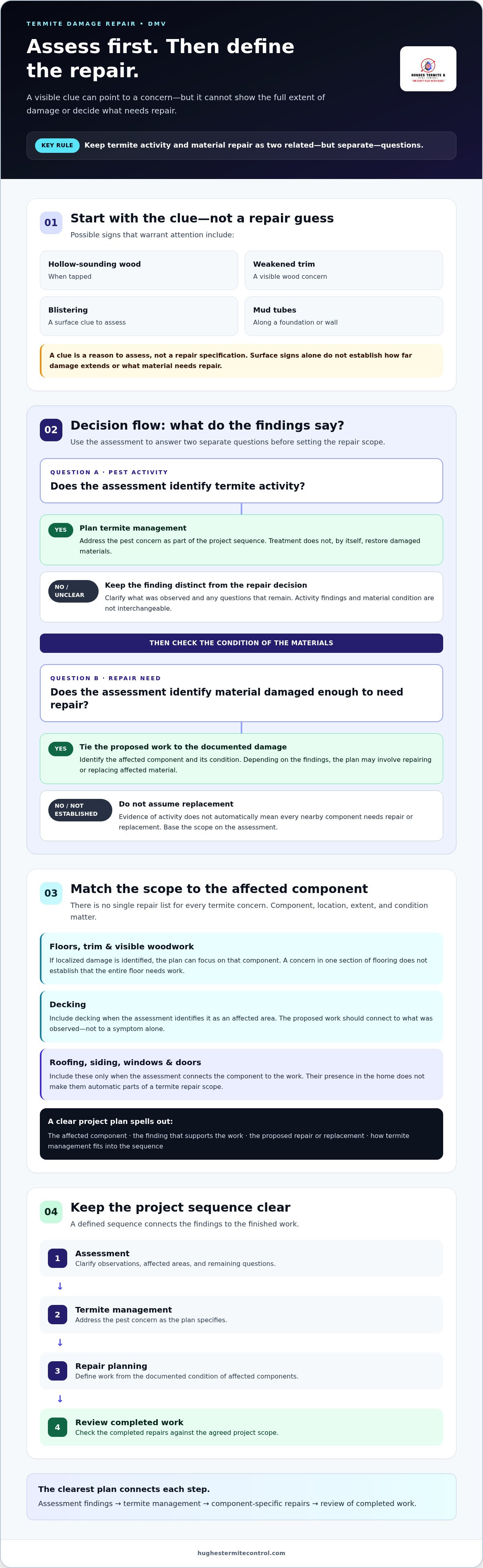
A well-organized project moves from assessment to pest planning, then to repairs and a final review. The exact sequence and timing depend on the findings and the home components affected. Use these steps as a roadmap, not a fixed schedule. Before work is arranged, establish how the homeowner, pest-management team, and repair team will share updates and decisions.
- Assess the findings. Review the inspection information, affected locations, and observed conditions. Make sure you understand what the assessment identifies and what remains uncertain.
- Define pest work. Clarify which termite-management tasks are proposed and how they relate to the areas of concern. Treatment details and timing should be explained for the project, not assumed.
- Finalize the repair scope. Identify the affected components and the home improvement work proposed for each. Separate confirmed work from assumptions that could change if additional conditions are found.
- Complete the repairs. Coordinate access and work sequence so pest-management tasks and repairs are clear. The appropriate order depends on the project and should be understood before affected areas are concealed or restored.
- Review the results. Compare completed work with the agreed scope, note any items that need follow-up, and keep project records together.
Local requirements can vary by property location and project. Don’t assume a requirement in one DMV jurisdiction applies in another. Confirm applicable permit, code, or inspection requirements for the specific property before work proceeds.
Coordinate termite work before repairing affected areas
Addressing the termite concern before covering or restoring affected areas helps distinguish pest-management work from repairs to home components. Otherwise, it may be difficult to understand which tasks have been completed and what the repair work is intended to address. Coordination can reduce confusion, especially when more than one component is involved. The plan should explain how the sequence fits the assessment, without implying a guaranteed outcome or a universal timeline.
Keep the project clear while repairs are underway
Keep a written record of the agreed scope, project updates, and decisions. If newly exposed conditions lead to a proposed change, review what was found, which work may change, and why. Discuss a revised scope clearly before treating the new work as part of the plan.
Handoff checklist:
- Scope: Keep the current written description of pest tasks and repair work.
- Access: Note which areas need to be accessible and any arrangements for entry.
- Decisions: Record approved changes and unresolved questions.
- Communication: Agree on how updates will be shared and who will relay them.
At completion, review the work against the agreed scope and record any remaining questions. For homeowners looking for termite damage repair contractors DMV who coordinate pest management with relevant home improvement, explore Hughes’ termite and repair services.
Hughes Termite Control: A Coordinated DMV Repair Next Step
Termite concerns can involve two connected needs: managing pest activity and deciding what to do about affected parts of a home. Hughes Termite Control brings termite management, wood-destroying organism (WDO) inspections, and residential home improvement together through one local, privately owned business serving DMV homeowners. Homeowners can discuss how inspection findings relate to potential repair work in one place, instead of treating those parts of the project as unrelated from the start.
One local point of coordination for pest management and home improvements
The right repair categories depend on what the assessment identifies. If findings point to an affected floor or deck, flooring or decking work may be relevant. Depending on the property and documented scope, other projects may involve siding, roofing, windows, or doors. These are possibilities, not a standard package: a home doesn’t need every service simply because termite damage is present.
Keep the scope specific. Discuss which areas raised concern, what the WDO inspection found, and how termite management relates to the home improvement work under consideration. Proposed work should connect to the assessment and the condition of affected components. This project-specific approach helps avoid treating a general service label as a complete repair plan.
Plan your next step with Hughes Termite Control
Before starting a project discussion, gather useful context about the property and the concern. Note where you observed signs, which areas have been assessed, and whether you have inspection findings or a written repair scope. These details help organize the conversation around the property’s actual needs. If the scope is still being determined, begin with what you know and the questions that remain.
A practical next step is to connect the findings, termite-management needs, and relevant home improvement categories. That doesn’t mean deciding in advance that every affected component needs replacement or that all work will follow the same sequence. It means approaching the project with a clear view of what has been observed, what needs attention, and how the pest and repair work relate.
Homeowners comparing termite damage repair contractors DMV can look for a plan that explains those connections plainly. Hughes Termite Control provides termite management and WDO inspections alongside home improvement work such as decking, flooring, siding, roofing, windows, and doors. The appropriate work depends on the property assessment and repair scope, keeping the discussion grounded in findings rather than assumptions.
If you’re ready to discuss your DMV property, share your concerns and any inspection information you have. Discuss your termite damage repair project with Hughes Termite Control and take a clear next step toward understanding how termite management and relevant home improvements fit together.
Take the Next Step With a Clear Project Plan
You don’t need to have every repair decision figured out before moving forward. Start with what you’ve observed, any inspection findings you have, and the questions you still need answered. A focused project discussion can help turn those details into a clearer path, with termite management considered alongside the home components that may need attention.
For homeowners considering termite damage repair contractors DMV, Hughes Termite Control offers one local point of coordination for termite management, wood-destroying organism inspections, and residential home improvement. Depending on the assessment, relevant work may involve roofing, siding, decking, flooring, windows, or doors. The right scope depends on the property and its findings.
Share your concerns and property context to begin discussing practical next steps with Hughes. Discuss your termite damage repair project. A clear conversation is a steady first step toward a well-planned repair.
Frequently Asked Questions
How do I know if termite damage needs professional repair?
Arrange an assessment if you find damaged wood, mud tubes, or surfaces that appear blistered or weakened. These clues don’t show how far damage extends or whether a component needs repair. Note where and when you observed them, and share that information during the inspection. If a door, floor, or other home component has changed in use or condition, mention it rather than trying to diagnose the cause yourself. This helps termite damage repair contractors DMV homeowners consult understand what needs attention.
Should termite treatment happen before repairing termite damage?
Address termite management as part of the plan before affected areas are concealed or restored. The exact order depends on inspection findings, proposed pest work, and which materials need repair. For example, a plan involving an affected floor should explain how pest-management tasks relate to flooring work. Ask for the sequence to be described in writing so you can distinguish treatment steps from repairs and understand when the work may need to be adjusted.
Can termite damage be repaired without replacing all the wood?
Yes, a project may involve work on only the affected material rather than replacing all the wood in the home. The decision depends on the assessment and the condition of each area, including any material that becomes visible as work proceeds. A photo or surface clue alone can’t confirm what should stay or go. A project-specific scope should identify the included areas and explain how newly discovered conditions could affect the proposed work.
What types of home repairs may be involved after termite damage?
Repairs depend on which home components the assessment connects to the damage. A project may involve flooring or decking, or related work such as siding, roofing, windows, or doors if those components are part of the documented scope. When damp crawlspaces or hidden moisture contribute to the issue, coordinating with specialized remediation teams like Foundation ResQ can help address mold growth and structural stabilization. Not every termite concern calls for each category. For a DMV home, focus on findings tied to the property rather than assuming a particular repair is needed based on termite activity alone.
Does homeowners insurance cover termite damage repairs?
Standard homeowners insurance policies almost never cover termite damage, but the answer depends on the wording of your policy and your circumstances. Review the policy’s exclusions and any sections that address pest damage or resulting repairs. If you’re unsure how the language applies to your situation, contact your insurer and ask for an explanation of the relevant provisions. Keep inspection notes, photographs, and repair documents together as you review the issue.
Do termite damage repairs require permits in Washington, DC, Maryland, or Virginia?
Permit requirements depend on the property’s location and the specific work proposed, so there isn’t one rule to apply across the DMV. A repair in Washington, DC, may be subject to different requirements than a project in Maryland or Virginia. Before work begins, describe the planned work to the local building department and ask which permits or inspections apply. Don’t assume that pest treatment and home repairs follow the same approval process.
Can one company coordinate termite control and home repairs in the DMV?
Yes. Hughes Termite Control provides termite management and wood-destroying organism inspections alongside residential home improvement work. Depending on the assessment, relevant categories may include decking, flooring, roofing, siding, windows, or doors. This gives homeowners one local company to discuss how pest work and related repairs fit together, while keeping the scope specific to the property. Sharing inspection findings, areas of concern, and questions about next steps can help start that discussion clearly.


