
Could the same sign in your home point to termites, bed bugs, wildlife, or a different pest entirely? It’s understandable to want a quick fix, but pest control solutions work best when they address the specific pest and the conditions that allow it to return. A general treatment may not resolve the underlying concern.
Start by noting what you’re seeing and where it’s happening. This article explains how termite, bed bug, and wildlife services differ, what to consider when comparing pest control solutions in the DMV, and what information can help prepare for service. You’ll also learn how treatment, inspection, prevention, and repair can fit together.
Hughes Termite Control provides termite control, bed bug control, wildlife control, and wood-destroying organism inspections, along with home improvement services. When a pest concern also involves property damage, the company’s remodeling and repair work can address relevant materials. The goal is a clear path from identifying the issue to choosing a practical response for your home.
Key Takeaways
- Match the response to the signs you’ve found: termite, bed bug, and wildlife concerns call for distinct service categories.
- Compare pest control solutions by asking what concern the service addresses, what the inspection covers, and what prevention guidance is provided.
- Before a visit, record where and when you noticed signs and share relevant history. Follow the service team’s preparation instructions for your specific project.
- A wood-destroying organism inspection can assess a property concern, while pest treatment addresses the identified pest issue.
- When a pest concern also involves home damage, Hughes Termite Control offers pest services and relevant repairs to roofing, siding, decking, flooring, windows, and doors.
What Do Pest Control Solutions Include for DMV Homes?
Pest control solutions are services tailored to a particular pest and property concern. Depending on the evidence, the right response may involve identifying the pest, assessing affected areas, treating an active issue, or considering ways to reduce the chance of recurrence. As a general overview, Pest control measures can include different approaches. The appropriate option for a home depends on the problem being addressed.
Start with the evidence, not an assumption about the cause. A mark on wood, an insect sighting, or a noise in a wall can raise questions, but one sign alone doesn’t confirm an infestation or identify the pest. Before discussing a response, describe what you observed, where it appeared, whether it has happened more than once, and whether you’ve noticed related damage.
When does a pest concern call for professional attention?
Recurring sightings, visible damage, or uncertainty about what you’ve found can make a professional assessment useful. These signs don’t all call for the same response, and a single sighting shouldn’t be treated as proof of an infestation. Before an appointment, note where and when you noticed activity, whether it has happened more than once, and any changes you’ve observed nearby. Those details help focus the assessment on the concern you’re seeing at your DMV home.
How are pest treatment, inspection, and repair different?
Treatment responds to an identified pest issue. Its scope depends on the pest, so termite, bed bug, and wildlife concerns aren’t interchangeable. A wood-destroying organism (WDO) inspection serves a different purpose: it assesses a property for wood-destroying organisms and related evidence. An inspection can clarify a concern, but it isn’t the same as treatment.
Repair addresses damaged building materials. If an assessment identifies damage to a deck, siding, flooring, roofing, window, or door, repairing that material is a separate step from addressing the pest issue. Hughes Termite Control’s home improvement work includes projects involving these parts of the home, connecting property care with its pest services where relevant.
Keep the three needs distinct as you consider next steps:
- Identify: Record the signs and discuss what they may indicate.
- Inspect: Assess for a specific concern, such as evidence of wood-destroying organisms.
- Treat or repair: Address the pest issue and any damaged materials through the appropriate work.
This sequence helps homeowners move from uncertainty toward a response that fits the evidence and the property concern.
Which Pest Control Solution Fits Termites, Bed Bugs, or Wildlife?
Similar-looking signs can point to different concerns, and a visible clue isn’t a confirmed identification. Note what you’ve seen and where, then use the assessment to guide the next step. The right pest control solutions depend on the specific concern and conditions at the property, not on applying one response to every situation.
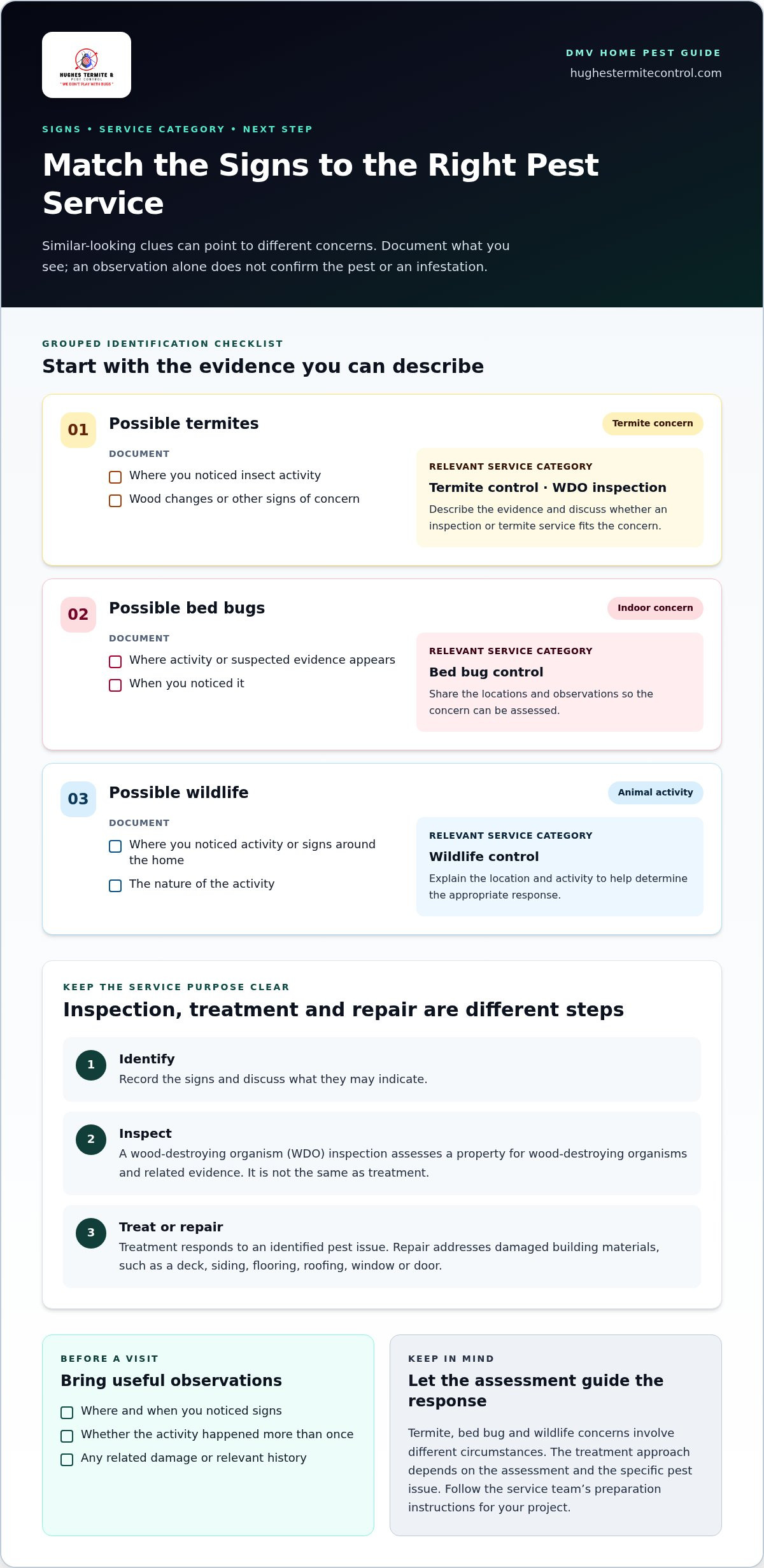
| Concern | Signs to document | Relevant service category | Next step |
|---|---|---|---|
| Possible termites | Where you noticed insect activity, wood changes, or other signs of concern | Termite control; WDO inspection | Describe the evidence and discuss whether an inspection or termite service fits the concern. |
| Possible bed bugs | Where activity or suspected evidence appears, and when you noticed it | Bed bug control | Share the locations and observations so the concern can be assessed. |
| Possible wildlife | Where you’ve noticed activity or signs around the home | Wildlife control | Explain the location and nature of the activity to help determine the appropriate response. |
What should homeowners know about termite control and WDO inspections?
Termite control addresses a termite concern. A wood-destroying organism (WDO) inspection assesses for wood-destroying organisms and related evidence, so the two services serve related but distinct purposes. If you notice visible changes in wood or suspect an impact on the structure, describe what you’ve observed and discuss whether an inspection is appropriate. For more context, see A Grounded Guide to Effective Termite Control in the DMV.
How do bed bug and wildlife concerns call for different responses?
Bed bug control addresses a bed bug concern inside the home, while wildlife control responds to animal activity around or in the property. They involve different circumstances and shouldn’t be treated as interchangeable. Note where activity occurs, when you noticed it, and what evidence you observed. For related information, read Managing Bed Bug Infestations with Clarity and Calm.
For any of these concerns, the treatment approach depends on the assessment and the specific pest issue. A useful discussion should explain what the observations indicate, what service category fits, and what happens next. The U.S. Environmental Protection Agency offers guidance on choosing a pest control company, including points to consider when discussing a pest concern.
If termite activity is the concern, explore Hughes Termite Control as a next step toward understanding the service that fits your home.
How Can You Compare Pest Control Solutions Without Guesswork?
A single treatment plan won’t fit every pest or property. The signs, affected areas, and homeowner’s concern all shape what needs attention. Comparing pest control solutions is easier when the service explanation connects those details to a clear scope instead of relying on a generic description.
Use this checklist to understand what a proposed service is intended to address:
- Pest identification: What pest or evidence is the assessment addressing? Keep observed signs separate from a confirmed identification.
- Inspection scope: Which areas of the home will be assessed, and what concern is the inspection meant to clarify?
- Service explanation: What does the proposed treatment address, and what falls outside its scope?
- Preparation and access: Which areas does the team need to reach, and are there project-specific steps to take before the visit?
- Prevention and follow-up: What guidance or follow-up is part of the service discussion?
What should a clear pest control plan explain?
A clear plan describes the concern, the service being proposed, and the parts of the property involved. It explains preparation or access needs in plain language when they apply, and distinguishes what the service addresses from other concerns that may need separate attention. If the assessment points to a different issue than expected, the next step should be explained before the scope is treated as settled.
Prevention guidance should relate to the pest and property concern, not assume the same steps work for every situation. You should leave the discussion understanding what the service includes and what remains outside its scope. That clarity makes it easier to prepare and recognize whether an inspection or separate repair discussion is relevant.
When should a pest issue include a property inspection or repair?
Suspected wood damage may call for a wood-destroying organism (WDO) inspection, which assesses for relevant organisms and evidence. It is distinct from pest treatment, and it doesn’t itself repair building materials. For an overview of what this assessment covers, read WDO Inspection: Coverage, Reports, and Next Steps.
If materials are damaged, repair is another part of addressing the property concern. Depending on what needs attention, that work may involve roofing, siding, decking, flooring, windows, or doors. Separating inspection, treatment, and repair helps prevent confusion about what each step is meant to accomplish. It also gives homeowners a practical way to discuss the pest issue and related property needs without assuming one service covers everything.
What Should You Do Before and After a Pest Control Visit?
A little preparation can make it easier to explain what’s happening and focus the visit on your concern. Before service, gather observations rather than trying to diagnose the pest yourself. Afterward, keep the guidance you receive so you can follow the next steps for your property.
How can you prepare useful information before service?
Write down where you noticed activity or suspected damage and when it occurred. Note whether you’ve seen it more than once, and which rooms or parts of the property are involved. If it’s safe and practical, take a photo of visible evidence, but don’t disturb suspected pest activity to get a closer look.
It also helps to share relevant property history. Make a short list of prior pest treatments or repairs that may relate to the concern. During the discussion, describe what you observed and where, then mention anything you’re unsure about. These details help the service team understand the issue without treating an unconfirmed sign as a diagnosis.
- Record: Where and when activity or damage appeared.
- Photograph: Visible evidence only when you can do so safely without disturbing it.
- Share: Relevant treatment or repair history, along with questions about the concern.
Preparation needs can vary by pest and property. Follow the service team’s project-specific instructions rather than relying on general advice about chemicals or assuming every visit requires the same steps. If you’re unsure what access is needed, discuss it with the team before the appointment.
What should you understand about follow-up and prevention?
Before the visit ends, make sure you understand the service scope, any next steps, and the guidance provided for your home. Keep written instructions or notes from the discussion with your property records. Prevention advice should reflect the pest concern and the conditions at your home, rather than promise a fixed schedule or outcome that may not apply to your situation.
Clear records can also help you describe changes if the concern comes up again. For local context on pest services, see Pest Management Near Me: Local Services and Answers for DMV Homeowners. If you’re ready to discuss a pest concern at your property, connect with Hughes Termite Control to talk through an appropriate next step.
How Hughes Termite Control Connects Pest Solutions With Property Care
A pest concern and damage to a home can be connected, but they call for different kinds of work. Hughes Termite Control provides pest management and home improvement services, helping homeowners consider the identified pest issue alongside relevant property needs. Treatment addresses the pest concern; an inspection assesses for specific evidence; repair work addresses affected building materials.
Which Hughes services address pest and inspection concerns?
Hughes provides termite control, bed bug control, and wildlife control as distinct services for different concerns. Its wood-destroying organism (WDO) inspections assess for organisms and related evidence that may affect wood. An inspection is not the same as treatment, so understanding what the assessment finds helps clarify the appropriate next step. For more inspection context, see pest inspection checklist for Washington, DC homes.
These pest control solutions begin with the concern at hand. Describe signs that suggest termites, bed bugs, or wildlife activity separately, including their locations and any relevant property observations. This keeps the conversation focused on what needs assessment or treatment, rather than assuming one service applies to every pest.
How can pest management and home improvement work support property care?
If an inspection or other assessment raises questions about damaged materials, repair can be considered as a separate project. Hughes handles home improvement work involving roofing, siding, decking, flooring, windows, and doors. The right repair depends on the part of the home and the condition observed. Repairing materials does not treat a pest issue, just as pest treatment does not replace repairs to damaged materials.
Keeping those needs distinct makes the next steps easier to understand: identify and address the pest concern, assess relevant evidence, then discuss repairs if the property needs them. These services can support a coordinated view of home care without confusing their purposes.
If you’ve noticed pest activity, suspected wood concerns, or damage to a part of your home, share what you observed and where it occurred. Hughes Termite Control provides pest management and home improvement services to address the appropriate needs of your property.
Take the Next Step Toward a Clearer Plan
The right pest control solutions start with the evidence and the concern at your home. Termite, bed bug, and wildlife issues call for distinct responses, while a wood-destroying organism inspection assesses a different, related property concern. Treatment, inspection, and repair each have a separate role, so understanding the scope helps you know what happens next.
Before service, note where and when you observed activity, share relevant property history, and follow the preparation guidance provided for your project. If damage is also a concern, pest management and home improvement may be related parts of caring for your property, but they address different needs.
Hughes Termite Control is a privately owned local business with more than 20 years of experience. Its services include termite control, bed bug control, wildlife control, and WDO inspections, alongside home improvement work. Contact Hughes Termite Control to discuss your pest control needs and take a clear, informed next step for your DMV home.
Frequently Asked Questions
What are pest control solutions?
Pest control solutions are services chosen to address a specific pest or property concern. Depending on the evidence, that may involve identifying the pest, assessing affected areas, treating an issue, or discussing prevention. Termite control, bed bug control, wildlife control, and wood-destroying organism inspections serve different purposes. For DMV homeowners, a useful first step is to describe what you’ve observed so the response can fit the concern rather than assume every pest needs the same service.
How do I know which pest control service I need?
The signs you observe and where they occur can help determine which service to discuss, but they don’t always confirm the pest. Note the location, timing, and whether activity has recurred. Termite concerns, suspected bed bug activity, and wildlife signs call for different service categories. If wood damage is part of the concern, a wood-destroying organism inspection may be relevant. Sharing your observations helps clarify the appropriate next step for your home.
Can pest control prevent property damage?
Addressing a pest concern may help limit continued exposure to pest-related damage, but no service should be treated as a guarantee against future damage. The right response depends on the pest, assessment, and property conditions. If you suspect damage to wood or another building material, describe what you’ve noticed and discuss whether an inspection is appropriate. Pest treatment and repair are separate needs, and both may matter when caring for a home in the DMV.
What happens during a wood-destroying organism inspection?
A wood-destroying organism (WDO) inspection assesses a property for wood-destroying organisms and related evidence. It serves a different purpose from pest treatment: the inspection helps clarify a property concern, while treatment addresses an identified pest issue. If you’ve noticed changes in wood or suspect structural impact, record the locations and share what you observed. The inspection’s scope and next steps depend on the concern and the property being assessed.
Are termite control and a WDO inspection the same service?
No. Termite control addresses a termite concern, while a WDO inspection assesses for wood-destroying organisms and related evidence. They can support related homeowner needs, but one does not replace the other. If you suspect termites and have noticed possible wood damage, describe both concerns when discussing service. An assessment can help clarify whether termite control, an inspection, or another property-related step is appropriate for your home.
How should I prepare for a pest control visit?
Before the visit, write down where and when you noticed activity or suspected damage, and note whether it has happened more than once. Photograph visible evidence if it’s safe and practical, without disturbing it. Share relevant history, including prior treatments or repairs. Follow the service team’s project-specific preparation and access instructions, since steps can vary by pest and property. Avoid relying on generic chemical advice in place of guidance for your visit.
Does pest control include repairing termite or other property damage?
Pest control and property repair are distinct kinds of work. Treatment addresses a pest issue; repair addresses damaged building materials. If an assessment raises concerns about roofing, siding, decking, flooring, windows, or doors, those needs can be addressed separately. Hughes Termite Control provides pest management and home improvement services, so homeowners can consider both types of work as relevant to their property. The appropriate next step depends on the findings and the repair needed.


