

What determines whether a roof performs well goes beyond the shingles you see. If you’re researching asphalt shingle roofing Arlington VA, look beyond color and curb appeal: underlayment, flashing, ventilation, and the condition of the roof deck all contribute to how the system works. These details matter when planning roof work on an Arlington home.
Curling, missing, or worn shingles can raise a practical question: is a repair enough, or is replacement worth considering? The visible symptoms help identify where to look, but they don’t settle the question on their own. A roof assessment can help put the condition and appropriate scope of work in context.
This guide covers common signs of shingle wear, how to compare material options, and which roofing components matter beyond the visible surface. It also offers steps for preparing for a local project, from recording symptoms to reviewing the proposed scope. With a clearer view of the roof and the work involved, you can make more informed decisions.
Key Takeaways
- Curled shingles or ceiling stains can signal a problem, but an assessment helps clarify whether repair or replacement may be appropriate.
- Asphalt shingle roofing Arlington VA involves more than the shingles. Underlayment, flashing, decking, and ventilation also contribute to the roof system.
- Compare shingle options by appearance, project goals, and documented material details, while considering how the full system fits your roof.
- Prepare for a roofing project by recording leaks or visible damage, noting when symptoms began, and discussing the proposed scope.
- Hughes provides roofing installation and repair as part of its home improvement services, with clear scope and straightforward communication guiding the project.
When Does Asphalt Shingle Roofing in Arlington Need Attention?
A curled edge, bare-looking patch, or ceiling stain can leave you wondering whether a small repair will help or the whole roof needs replacement. These signs deserve attention, but none establishes the scope of work by itself. With asphalt shingle roofing Arlington VA homeowners should consider visible symptoms alongside the roof’s overall condition, maintenance history, and evidence of water entry.
Look at the roof from the ground and note what you can see. Don’t climb onto a roof to inspect it. A professional assessment can examine areas that aren’t safe or easy to view, including flashing and roof intersections. For general background on shingle materials and construction, see this overview of asphalt shingle roofing systems.
Which asphalt shingle roof warning signs should homeowners notice?
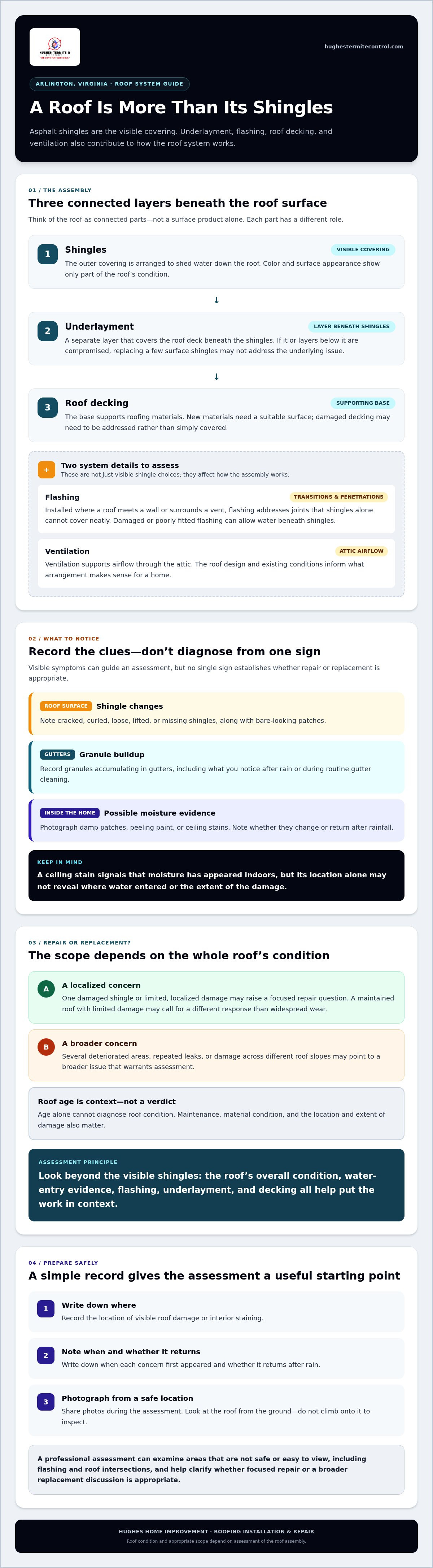
Cracked, curled, loose, or missing shingles may leave parts of the roof more exposed to weather. Granules collecting in gutters can be a sign of shingle wear. Damp patches, peeling paint, or water stains on ceilings may point to moisture entering the home. A leak’s source isn’t always directly above the stain, so the stain’s location alone may not identify the repair needed.
- Shingle changes: Note cracked or curling edges, shingles that appear lifted, and spots where shingles are missing.
- Gutter debris: Record whether you’ve noticed granules accumulating after rain or during routine gutter cleaning.
- Interior evidence: Photograph stains or damp areas and note whether they change after rainfall.
One damaged shingle may raise a localized repair question. Several areas of deterioration, repeated leaks, or damage across different roof slopes may point to a broader concern. These observations help guide an assessment, but the repair scope depends on examining the roof.
Does an aging roof always need replacement?
No. Age is useful context, not a verdict. Maintenance, material condition, and the location and extent of damage all matter. Roof age alone cannot diagnose roof condition. A maintained roof with limited, localized damage may call for a different response than one with widespread wear or recurring water entry.
During an assessment, the key question is whether the issue appears limited to one area or reflects deterioration across the roof. The visible shingles are only part of the assembly; a closer look can also help identify concerns around flashing, underlayment, or the roof deck. A ceiling stain signals that moisture has appeared indoors, but it doesn’t show by itself where water entered or how extensive the damage is.
Before arranging an assessment, make a simple record:
- Write down where you see damage or interior staining.
- Note when you first noticed each concern and whether it returns after rain.
- Take photos from safe locations and share them during the assessment.
This information gives the assessment a useful starting point and helps clarify whether the next step is focused repair or a broader replacement discussion.
How Asphalt Shingle Roofing Works as a Complete Roof System
From the street, asphalt shingles are the part of a roof homeowners notice first. But they’re only the outer layer of a larger assembly. Shingles, underlayment, flashing, roof decking, and ventilation each have a role, and how those parts meet matters. A sound-looking shingle surface doesn’t necessarily tell the whole story beneath it.
Shingles are the visible covering; the roofing system includes the supporting layers and details that work together to protect the home. That distinction is useful when discussing asphalt shingle roofing Arlington VA, because an assessment should consider more than the color or surface condition.
What do shingles, underlayment, and flashing each do?
Shingles form the visible outer covering and are arranged to shed water down the roof. Underlayment covers the roof deck as a separate layer beneath them. Flashing is installed at transitions and penetrations, such as where a roof meets a wall or surrounds a vent, to address joints that shingles alone can’t cover neatly.
These components meet at vulnerable details. If flashing is damaged or poorly fitted around a roof penetration, water may get beneath the shingles. If underlayment or the layers beneath it are compromised, replacing a few surface shingles may not resolve the underlying issue. The appropriate scope depends on what an assessment finds across the assembly.
Why do roof decking and ventilation matter?
Roof decking is the base that supports the roofing materials. Its condition matters because new materials need a suitable surface beneath them. If decking is damaged, the work may need to address it rather than simply cover it. That’s why a project plan should explain what is included and how concealed conditions will be handled if they’re uncovered during work.
Ventilation supports airflow through the attic. Its layout and condition can affect how air moves through that space, so it should be considered as part of the roof rather than treated as an unrelated detail. A particular vent arrangement won’t suit every home; the roof design and existing conditions inform what makes sense.
Think of the assembly as connected parts, not a checklist of independent products. A gap at a transition can affect nearby materials, while a deck concern may change the installation plan. The Arlington County permit requirements page is an official reference when a roofing project raises questions about local permitting. Project needs vary, so don’t assume one roof’s scope or details apply to another.
For homeowners planning roof work in Arlington and the surrounding DMV, Hughes provides roofing installation and repair as part of its home improvement services. A clear discussion of the roof’s condition and proposed scope helps keep the project focused on the home’s needs. Learn more about Hughes roofing services.
How to Compare Asphalt Shingles and Roofing-System Choices
Shingle options can look similar in a sample but differ in their documented specifications, appearance, and role in a project. A useful comparison starts with the home and the work required, not a universal ranking of “best” shingles. For asphalt shingle roofing Arlington VA homeowners can compare options more clearly by separating the visible material from the full installation plan.
Use this framework to organize a discussion about options. The table describes comparison points, not a recommendation for a particular product.
| Comparison point | What to consider | Why it matters |
|---|---|---|
| Appearance | Color, shape, and the overall look on the home | Helps assess how the roof will fit the house and its surroundings. |
| Project goals | Whether the work addresses localized damage, broader wear, or a planned replacement | Keeps the choice connected to the actual scope. |
| Material specifications | Documented details for the specific shingle being considered | Provides a sound basis for comparing stated product characteristics. |
| System components | Underlayment, flashing, decking, and ventilation included in the plan | Shows what work supports the visible shingle layer. |
Which asphalt shingle qualities should homeowners compare?
Start with appearance, then review the product’s written specifications against your project priorities. A sample can help you judge color and profile, but it can’t show how a shingle fits the roof’s condition or installation details. Durability and warranty claims depend on the product documentation and the terms that apply, so don’t assume a familiar name or attractive finish establishes suitability.
Keep the comparison practical. Note which qualities matter most to you, then look for those details in the product information and proposed scope. General descriptions are not a substitute for specific documentation.
Why compare the whole roofing system, not just shingle styles?
Shingles are one part of the work. A project plan also needs to account for the layers and details beneath and around them. Shingle choices make sense only in the context of the roof system they’ll be installed on. A shingle’s appearance or product name doesn’t explain whether the roof deck needs attention or what work is planned for flashing and ventilation.
- Underlayment: Identify its place in the proposed assembly beneath the shingles.
- Flashing: Include roof transitions and penetrations in the scope discussion.
- Decking: Clarify how the plan addresses the supporting surface.
- Ventilation: Consider existing airflow and the roof’s design rather than assuming one approach fits every home.
Material selection and installation planning are related, but they’re not the same decision. You may prefer a particular look, while the assessment and project scope shape which materials and components fit the work. The most useful comparison connects documented product details to the home’s condition and a clearly described scope, rather than relying on a universal winner.
How Arlington Homeowners Can Prepare for a Shingle Roofing Project
A roofing project is easier to plan when you have a clear record of what prompted it and a practical picture of the property. For asphalt shingle roofing Arlington VA homeowners can follow a simple sequence: record concerns, arrange an assessment, discuss the proposed scope, then prepare the home for work. The assessment connects your observations to a plan instead of treating every visible symptom as the same repair.
What information helps clarify the roof project?
Before an assessment, write down where you’ve noticed missing shingles, interior stains, or leaks. Include when each issue first appeared and whether it returns after rain. Share relevant maintenance or repair history, such as earlier work on a roof area or a recurring leak. These details give the assessment useful context, but they don’t replace an examination of the roof itself.
Then discuss the findings and proposed scope. An assessment can help establish whether the work concerns a limited area or a larger portion of the roof. Ask for a plain explanation of what the plan includes, which components are involved, and how the scope relates to the observed conditions. Clear details make it easier to understand the work before scheduling begins.
What should homeowners plan before roofing work begins?
Property layout and roof access can shape how a project is organized. Consider where workers may need access, whether vehicles or outdoor items could be near active work areas, and what household routines may be affected. Move or protect items around the work zone as appropriate, and plan for noise and activity near the home.
Timing depends on the project scope and working conditions, so don’t assume every roof follows the same schedule. Discuss the expected sequence of work and household preparations as part of planning. If access is limited or the home has shared spaces, mention that early so those details can be considered.
Permitting can also be part of project preparation. Requirements depend on the work involved, so don’t assume a previous project followed the same process. Consult Arlington County’s official permit guidance for current information relevant to your property and proposed work.
A short preparation checklist can keep the conversation focused:
- Record visible damage, interior stains, and leak locations.
- Note when symptoms began and share relevant repair history.
- Discuss the proposed scope, access needs, and household scheduling.
- Review official local guidance on permits before work begins.
Hughes provides roofing installation and repair as part of its home improvement services. For a clear discussion of your roof’s condition and project scope, discuss your Arlington roofing project with Hughes.
Asphalt Shingle Roofing in Arlington: Working with Hughes
Roofing is part of maintaining and improving a home, and the right next step depends on the property’s needs. Hughes Termite Control provides roofing installation and repair as part of its home improvement services. For homeowners considering asphalt shingle roofing Arlington VA, a clear conversation about the concern and project scope helps bring the work into focus without assuming every roof needs the same solution.
What roofing support does Hughes provide?
Hughes provides roofing installation and repair for homeowners addressing roof concerns or planning improvements. This work is part of the company’s broader home improvement services. Each project’s details depend on the property and the work involved, so the scope should reflect the home rather than a one-size-fits-all package.
That distinction matters if you’re deciding between a repair and a larger project. Start by explaining what you’ve noticed, where it appears, and what outcome you’re hoping to achieve. The discussion can then focus on the property’s needs and the work being considered, rather than assumptions based only on appearance.
- Share the concern: Describe the roof issue or planned improvement in straightforward terms.
- Discuss the property: Include details that may affect the work, such as the roof’s condition and access around the home.
- Clarify the scope: Review what the proposed installation or repair addresses and what the next project step involves.
What happens when you discuss a roofing project?
A roofing conversation should make room for your concerns and the specific needs of your home. Describe what prompted the project, share relevant history, and talk through the work you’re considering. Project details are tailored to the property, and a clear explanation of scope helps you understand what is proposed before moving forward.
Good communication is practical. It helps distinguish the issue you’ve observed from the work that may be needed and gives you a chance to understand how the project is organized. If you’re unsure what to raise, start with the symptoms, your priorities, and questions about the scope. The next step should be clear, without pressure to decide before you understand the work.
Hughes provides roofing installation and repair with a straightforward focus on the home and project at hand. If you’re ready to discuss your roofing needs and clarify a next step, talk with Hughes about asphalt shingle roofing.
Take the Next Step With a Clear Plan
A roofing decision is easier to approach when you focus on what you need to know before committing to a scope of work. Take time to understand the proposed next step, how it relates to your home, and what questions remain. That measured approach can help you choose a plan that fits your priorities rather than reacting to uncertainty.
If you’re considering asphalt shingle roofing Arlington VA, start a conversation about your roof’s condition and the work you have in mind. A clear discussion can bring the project into focus and clarify how to move forward. Hughes provides roofing installation and repair as part of its home improvement services, with project details shaped around the property.
Talk with Hughes about asphalt shingle roofing and take a practical first step toward your roofing plans. Share what you’ve noticed and discuss the scope that fits your home.
Frequently Asked Questions
How long does an asphalt shingle roof last?
An asphalt shingle roof’s lifespan varies with the product selected, installation quality, maintenance, and conditions at the home. Rather than relying on a standard age estimate, note changes such as recurring leaks, visible wear, or repairs that keep returning. Age provides context, but it can’t show the roof’s full condition. An assessment can help determine whether a specific area needs repair or a broader replacement merits consideration.
How can I tell if my asphalt shingle roof needs repair or replacement?
Missing, curled, or cracked shingles, granules in gutters, leaks, and interior stains are all reasons to look more closely. A ceiling stain that reappears after rain, for example, is useful information to share, but it doesn’t pinpoint the entry point. A single damaged area may be localized, while concerns in several parts of the roof could call for a broader review. An assessment helps clarify the appropriate scope.
Are asphalt shingles a good choice for homes in Arlington, VA?
Asphalt shingles are a common residential roofing material, but whether they suit a particular Arlington home depends on the roof’s condition, product specifications, and project goals. For asphalt shingle roofing Arlington VA homeowners should compare documented details of specific materials rather than relying on appearance or general claims. Discuss how the planned work fits the property, including supporting components and existing roof conditions, before choosing.
What is included in an asphalt shingle roofing system?
The visible shingles are only one part of the assembly. Underlayment sits beneath them, flashing addresses joints and penetrations, decking supports the roofing materials, and ventilation helps manage airflow through the attic. These parts meet and interact, so the proposed work may need to address more than the surface covering. The exact scope depends on the roof’s condition and the project, not a fixed checklist for every home.
Can asphalt shingles be installed over an existing roof?
It depends on the existing roof’s condition, the number and state of its layers, applicable local requirements, and the planned work. An overlay shouldn’t be assumed suitable just because shingles are already present; concealed conditions may also affect the decision. For Arlington-specific permitting information, consult the county’s official permit guidance. A project assessment can help clarify the roof conditions relevant to the proposed scope.
Does replacing an asphalt shingle roof require a permit in Arlington, VA?
Permit requirements can depend on the work involved and current local rules, so don’t rely on a general yes-or-no answer. Before planning a replacement, review Arlington County’s official permitting guidance for information relevant to your project. The scope of work matters, and the county resource provides current requirements. This helps you plan without assuming a particular approval outcome.
What affects the cost of asphalt shingle roof replacement?
An estimate can be affected by roof size and configuration, project scope, existing conditions, material selection, and any necessary work on supporting roof components. For example, the plan may differ if the roof needs more than surface replacement. General factors alone can’t estimate the cost for a specific home. A property-specific discussion helps define the scope and identify the project details needed for relevant information.


